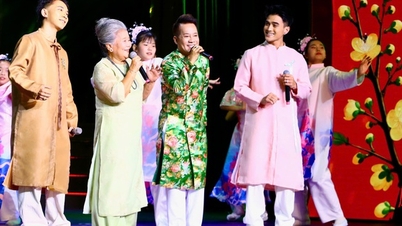
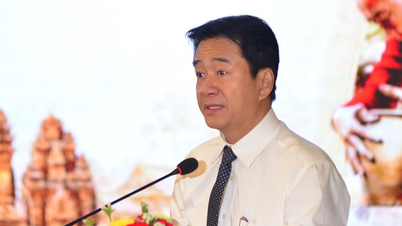
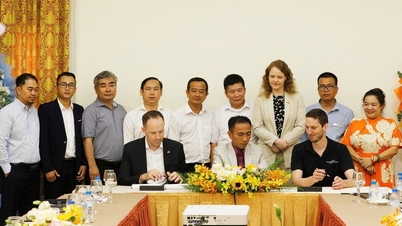
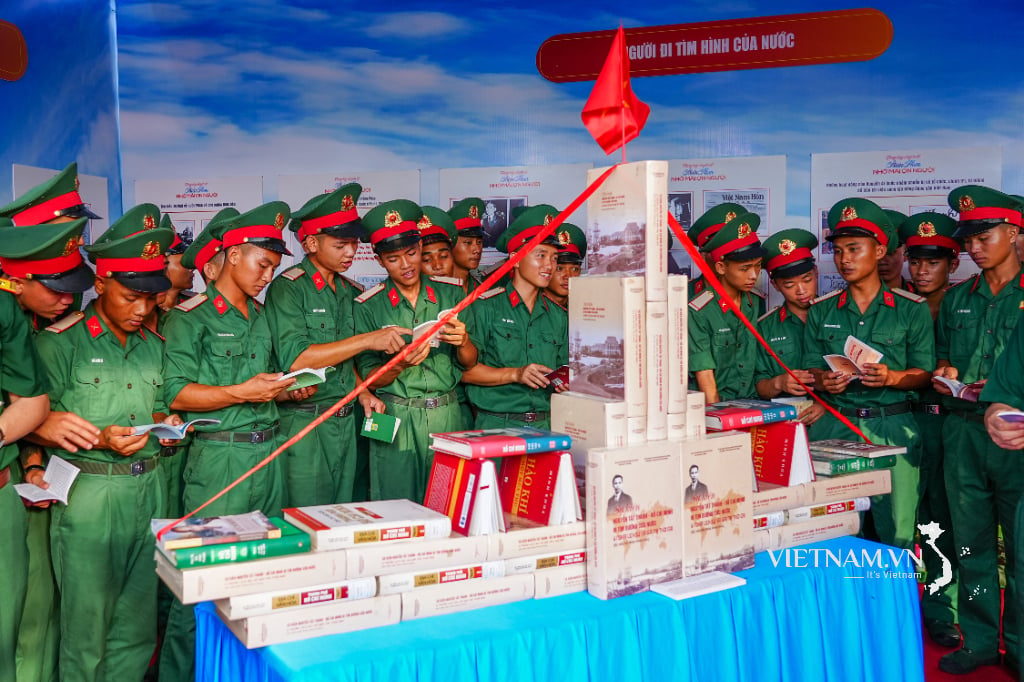
At the scientific conference "50 Years of Ho Chi Minh City: Historical Milestones, Development Aspirations, and Institutional Breakthroughs" organized by the Ho Chi Minh City People's Committee on June 24th, artists and researchers engaged in lively discussions about cultural resources within the 50-year development trajectory of Ho Chi Minh City.
From urban memory to development resources
After 50 years of construction and development, Ho Chi Minh City is facing a new phase, where its competitive advantage lies not only in land, infrastructure, or the speed of urbanization, but also in the cultural depth of a city more than three centuries old.
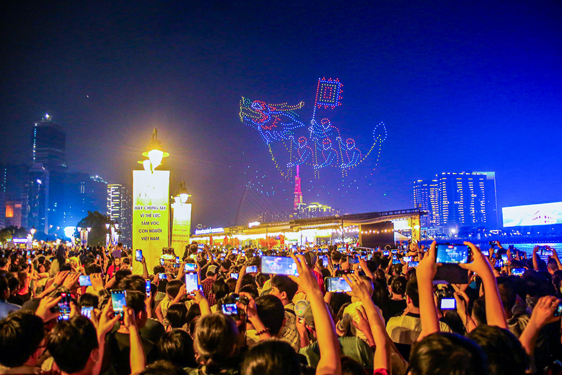
People watch a drone demonstration at the Ho Chi Minh City River Festival. (Photo: HOANG TRIEU)
"Conservation thinking cannot simply stop at preserving the heritage in its original state, but must bring heritage into contemporary life through digital technology, performing arts, film, design, games, fashion , and experiential tourism," shared Meritorious Artist Le Thien. Those involved believe that historical memory cannot remain dormant in museums but must continue to live on in today's life.
Many artists and writers expressed their appreciation for the opinions and discussions that viewed heritage as "input material" for artistic creation. For many years, artists in theater, film, fine arts, and music have been grappling with the question of how to tell the story of Saigon - Gia Dinh using modern artistic language. The old streets, ports, Cholon area, canal system, craft villages, alleyways, and the city's multicultural life are all rich and evocative materials, yet they have not been exploited to their full potential.
Urban heritage is not just the setting, but also the soul of a work of art. Any artist aspires to create based on the true values of the city. When there are mechanisms to integrate heritage into theater, film, and art programs, the works will have greater depth, and audiences will understand and love the city through emotion, not just through development statistics.


In fact, Ho Chi Minh City could absolutely create large-scale live performance programs along the Saigon River. If the city skillfully combines the history of the region's development, port culture, and the life of Southern Vietnamese people with modern performance technology, it could create products that are competitive with other famous destinations in the region.
Creating a creative space
Cultural researchers and artists have highly praised the proposal to build a digital heritage data bank and a smart museum system. This is not simply a storage activity, but will create an "open resource repository" for screenwriters, directors, designers, filmmakers, architects, and video game developers to explore.
Many countries have demonstrated the power of digitizing heritage. When historical documents are easily accessible, the creative process becomes faster, more accurate, and generates more new economic value. This is also what Ho Chi Minh City is aiming for in building its cultural industry.
Over the years, Ho Chi Minh City's art scene has produced numerous works inspired by history and urban life. The stage tells stories of the pioneers who settled the South. Cinema recreates Saigon's memories through various historical periods. Music preserves the city's rhythm through songs that have resonated with generations. Photography, fine arts, and literature continue to explore the beauty of alleyways, traditional markets, riverside areas, the old quarter, and the vibrant lives of its residents. However, many artists believe these creations still lack a sense of individuality.
"What we expect is an ecosystem where the work doesn't stop at a performance, a film, or an exhibition, but can connect with tourism, education, museums, public spaces, and experiential activities for both locals and tourists," the experts suggested.
Many artists and writers hope that after the workshop, Ho Chi Minh City will soon develop creative spaces associated with heritage routes such as Dong Khoi, Nguyen Hue, Ton Duc Thang, Cho Lon area, Binh Dong wharf, and Tau Hu - Ben Nghe canal; and at the same time, build live performance programs, art festivals, and cultural festivals with the city's own brand.
Director and People's Artist Tran Minh Ngoc believes that if the heritage city model is implemented effectively, the theater community will have more "storytelling spaces" instead of being confined to the theater itself.



People's Artist Trinh Kim Chi, President of the Ho Chi Minh City Theater Association, emphasized: "Preservation is only truly sustainable when heritage has a life of its own. When architectural works and cultural spaces become venues for theater, music, fine arts, and film, attracting locals and tourists every day, the value of the heritage will spread naturally."
Source: https://nld.com.vn/danh-thuc-di-san-do-thi-196260627182730623.htm


![[Image] A look back at the capital's preparations for the century-long master plan.](https://vphoto.vietnam.vn/thumb/1200x675/vietnam/resource/IMAGE/2026/06/29/1782750453122_quy-hoach-100-nam-minh-duy-1-2118-jpg.webp)
![[Photo] National Assembly Chairman Tran Thanh Man attends the Conference to announce the Master Plan for Hanoi Capital City with a 100-year vision.](https://vphoto.vietnam.vn/thumb/1200x675/vietnam/resource/IMAGE/2026/06/29/1782709639728_ndo_br_1-jpg.webp)
![[Photo] General Secretary and President To Lam works with the Party Committee of the Government on the work of preventing and combating storms, floods, extreme natural disasters and climate change.](https://vphoto.vietnam.vn/thumb/1200x675/vietnam/resource/IMAGE/2026/06/29/1782729441945_a1-bnd-0385-9454-jpg.webp)