Opening up livelihood opportunities from the forest.
In the early summer days, winding through the forests of Ho Thau commune, the green of cardamom and purple cardamom plants stretches under the canopy of the old forest. For many years, this has become an important source of income for the local people. Currently, Ho Thau commune has over 500 hectares of cardamom, concentrated in the villages of Chien Thang, Tan Minh, Trung Thanh, and Son Thanh Thuong. Thanks to the cool climate, high humidity, and the cover of natural forests, the plants grow well and yield a stable harvest.
 |
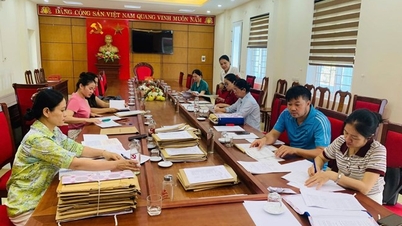
| Officials from Ho Thau commune surveyed and evaluated the effectiveness of the model of growing purple cardamom under the forest canopy. |
Comrade Phuong Chan Nu, Vice Chairman of the People's Committee of Ho Thau commune, said: "Cardamom and purple cardamom have been identified by the commune as one of the key crops in economic development. These plants grow under the forest canopy, are easy to cultivate, and do not require much care. Besides their economic value, these plants also help to prevent soil erosion, retain water, and maintain moisture in the forest. People gain additional income while also raising their awareness of forest protection."
The family of Mr. Lo Van Sinh, in Son Thanh Thuong village, is one of the households with the largest cardamom plantations in the commune, with over 40 hectares. Nearly 20 hectares are already producing a harvest, while the remaining area is still under cultivation. Mr. Sinh shared: “Currently, each harvest yields 4-5 tons of fresh cardamom. After deducting expenses, the income reaches over 150 million VND per year. With this income from cardamom, the family feels secure in staying in the forest and developing their economy.”
Not only in Ho Thau, but many other highland localities are also gradually exploiting the economic potential under the forest canopy. In Con Lon commune, the model of growing cardamom under the forest canopy in Phieng Ten village, covering an area of about 12 hectares, is showing positive signs. Comrade Nguyen Trong Doan, Secretary of the Party Committee and Chairman of the People's Council of Con Lon commune, said that through field surveys, cardamom plants grow well under the forest canopy and are initially bringing economic benefits to the people. This is the basis for the locality to research and replicate the model, gradually forming a concentrated production area to increase people's income.

![[Image] A look back at the capital's preparations for the century-long master plan.](https://vphoto.vietnam.vn/thumb/192x108/vietnam/resource/IMAGE/2026/06/29/1782750453122_quy-hoach-100-nam-minh-duy-1-2118-jpg.webp)
Enhancing the value derived from forests
Along with expanding cultivation areas, medicinal plants grown under the forest canopy are gradually forming a stable consumption chain. Mr. Dang Lao Thanh, owner of an agricultural product purchasing facility in Tan Sa Phin village, Nam Dich commune, said that during the harvest season, his facility purchases 5-6 quintals of cardamom and purple cardamom daily at a price of 70-80 thousand VND/kg for fresh fruit. After processing, the product is bought by traders at a price of over 400 thousand VND/kg. Not only cardamom and purple cardamom, many other local medicinal plants are also being exploited commercially.
In Vi Xuyen commune, Son Y Medicinal Herb Cooperative collaborates with local people to develop raw material areas for various medicinal herbs such as dandelion, wild spinach, purple velvet leaf, and northern codonopsis... Many types of plants that were previously mainly harvested from the wild or grown on a small scale under the forest canopy are now produced in a concentrated manner with technical procedures and stable output.
 |
| It's harvest season, providing a source of income for the people. |
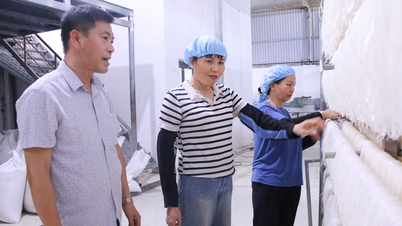
Ms. Nguyen Thi Hong Lieu, Director of Son Y Medicinal Herbs Cooperative, said: “To achieve sustainable development, we must link production with processing and brand building. The cooperative has invested in machinery and developed products such as herbal teas and medicinal powders to enhance product value and meet market demands.”
In reality, models for cultivating medicinal plants under the forest canopy are creating a double benefit. People gain additional income from the forest area they manage, while the forest is protected, maintaining its canopy cover and ecological balance. For cardamom, purple cardamom, and other medicinal plants to thrive, people must conserve water resources, minimize impacts on natural forests, and proactively protect the plants' habitat.



From forests that were once viewed solely from a conservation perspective, many localities are gradually effectively exploiting the economic value beneath the forest canopy. When production is linked to consumption, processing, and brand building, forests not only preserve the greenery of the mountains but also become a sustainable source of livelihood, contributing to increased income and poverty reduction for people in mountainous areas.
Text and photos: Nhu Quynh
Source: https://baotuyenquang.com.vn/kinh-te/202606/danh-thuc-tiem-nang-duoi-tan-rung-9974355/

![[Photo] Strengthening character and expertise: Intense training for artillery soldiers.](https://vphoto.vietnam.vn/thumb/1200x675/vietnam/resource/IMAGE/2026/06/30/1782815602541_lu-368-1875-4571-jpg.webp)