Besides being famous for its fabric dyeing craft, Trinh Ha village in Hoang Trung commune (Hoang Hoa district) also has a temple dedicated to Trieu Viet Vuong - the king of Van Xuan Kingdom, who succeeded Ly Nam De in driving out the invading Liang dynasty from the North...
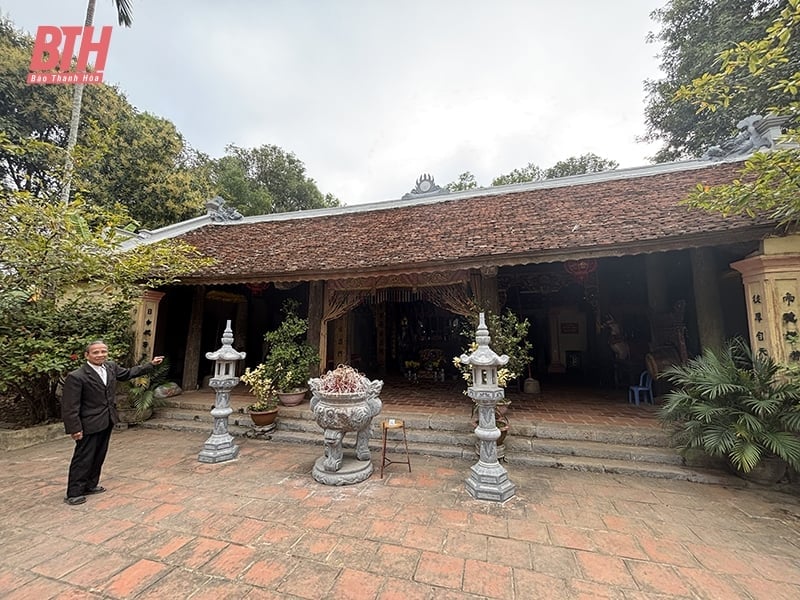
These days, the spring atmosphere still permeates Trinh Ha village. From the village roads to the alleys, the sounds of drums and songs fill the air as preparations are underway for the Ky Phuc Festival, the village's biggest festival of the year, held at the Trieu Viet Vuong Temple National Monument. This annual festival takes place from the 11th to the 13th of the second lunar month.
The Ky Phuc Festival in Trinh Ha village recreates many cultural and spiritual activities. One of the most distinctive features of the festival, and one that the villagers eagerly anticipate, is the rice cooking competition, reenacting the spirit of feeding the army in ancient times. Each participating team consists of three members: one carrying a stick, one tending the fire to cook the rice, and one preparing the ingredients, cooking while walking. Team members are usually selected by the village from among young men and women, outstanding young people with good health and dexterity. The teams wear traditional costumes.
The rice-carrying poles used in the cooking competition are shaped like dragons and phoenixes. This cultural tradition has been preserved by the villagers for hundreds of years, expressing their pride and remembrance of King Trieu Viet Vuong. A steel frame is attached to the pole, and each team carries a small pot containing rice and water. When the opening drum sounds, the teams begin walking and cooking rice around the village square. The members coordinate their steps and breathing rhythmically to ensure the rice pot is balanced, the water doesn't spill out, and the fire is kept stable, resulting in perfectly cooked, delicious, and flavorful rice. The winning pot of rice is offered as a sacrifice to King Trieu Viet Vuong. The remaining pot of rice is shared and celebrated by everyone in the village square. Mr. Do Minh Nghia, the head of Trinh Ha village, happily stated: “The village festival is an opportunity for everyone to meet and interact, thereby continuing to preserve and promote the cultural values of the village... Every year the festival is held in a joyful and warm atmosphere.”
According to the elders, Trinh Ha is the name King Trieu Viet Vuong gave to the village. Legend has it that during the construction of the army headquarters here, the soldiers in the unit teased the girls, but the girls did not reciprocate and always maintained the "ladylike" demeanor of virtuous women. Seeing this, the king changed the name from Van Ha to Trinh Ha, the word "Trinh" meaning to praise the virtue and purity of women.
At that time, the villagers all supported the rebel army. Among them were two very kind-hearted people who provided money and food. These two people who helped Trieu Quang Phuc were known by the people as "Old Nuoi Great King" and "Xa U King". The inscription on the Trinh Ha village stele, composed by Thanh Hoa Governor-General Vuong Duy Trinh in 1897, records: "Trieu Viet Vuong's name during his campaign was Quang Phuc. During the Tang Dynasty of the Liang Dynasty, he and his father, Trieu Tuc, served as officials during the Early Ly Dynasty. When the Lam Ap rebels invaded our country, the king ordered him to lead the troops in repelling them. He stationed his troops in the Tay Ha river branch (also known as Kim Tra River, Au River, or Doc River), fought the rebels in Cuu Duc district, and completely defeated them, earning the title of Dai Viet General. A few years later, King Ly Nam De was defeated by the Liang army and died in Khuat Lieu (Khuat Lao) cave. Trieu Viet Vuong then led his army to defeat the Liang general Duong San and became king" (according to the Hoang Hoa Cultural Gazetteer).
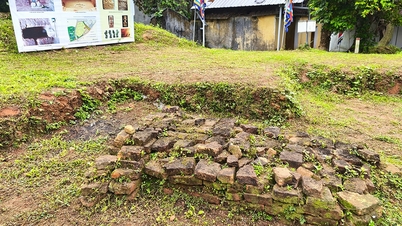
To this day, the imprint of the uprising remains in the fields and roads of the village. “Trieu Viet Vuong established his headquarters in Trinh Ha to serve as a base against the Liang invaders from the North and the Lam Ap invaders from the South. Even today, the fields and roads in this area still bear names that reflect this historical event, such as Ban Phu field, Ha Ma field, Can Co road, Trong cave, Chieng cave...” (History of the Party Committee and the Revolutionary Movement of the People of Hoang Trung Commune).
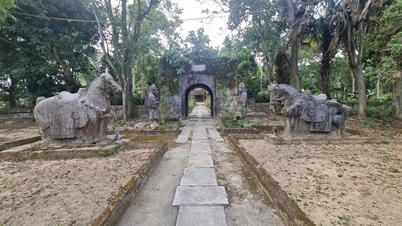
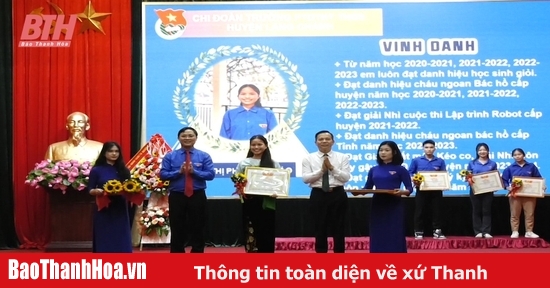
In remembrance of his great contributions, the people of Trinh Ha village established a temple dedicated to Trieu Viet Vuong, formerly known as the "Quoc Te" shrine. In 1879, during the reign of Tu Duc, the temple was renovated to become one of the most beautiful in the district. The temple is built on a spacious and airy grounds, featuring a three-tiered entrance gate and a grand main sanctuary. The third tier of the entrance gate still bears the four characters "Nam Thien Co Mieu" (meaning "Ancient Temple of Southern Heaven"). At that time, artisans from Trinh Ha village, such as Pham Van Sac and Do Van Bon, participated in the temple's restoration, becoming famous for their elaborate and exquisite relief carvings. Over time, the Trieu Viet Vuong temple has become a sacred place of worship for Trinh Ha village and surrounding areas.
The Trieu Viet Vuong Temple stands out with its exquisite wooden architecture. The sturdy stone pillars and solid ironwood columns, crafted by the skilled hands of ancient carpenters, help the monument withstand external forces. The wood carvings depict mythical creatures symbolizing strength, such as tigers, dragons, and unicorns.
Mr. Do Van Chan (80 years old), who has been looking after the temple for over 30 years, said: “Because it is a temple dedicated to the king, the ceremonies used to be very solemn. During major ceremonies, the provincial governor had to preside over the ceremony, along with the prefect, district, and other dignitaries from the region. The temple still preserves a pair of couplets, the gist of which is: In the past, it was a military encampment, now it is a sacred shrine / Above, the king is worshipped, below, the common people will worship for eternity.”
In addition, the ancient Trinh Ha village was also famous for its dyeing craft. The village's dyed fabrics were once renowned in markets such as Ke Quang, Huyen, and But... Dyeing was the main source of income, helping people become wealthy at that time.

To date, Trinh Ha village, also known as Trinh Ha hamlet, has become a model rural area that is bright, green, clean, and beautiful. This is the second hamlet in the commune to achieve the model new rural area status. Currently, the lives of the villagers are increasingly improving both materially and spiritually.
Van Anh
Source: https://baothanhhoa.vn/dat-lang-trinh-ha-240336.htm