

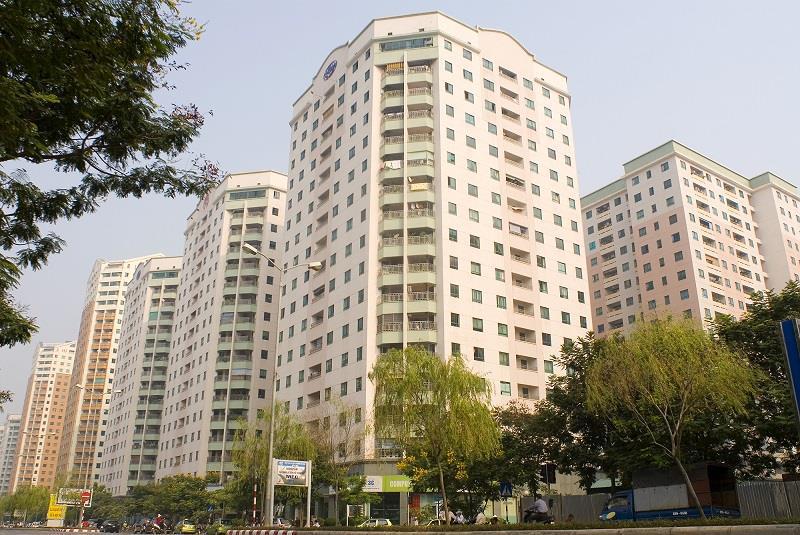
A noticeable change.
According to a representative from the Institute of Building Materials ( Ministry of Construction ), before 1990, most concrete mixed on construction sites was manually measured and mixed using small, free-fall mixers, resulting in low productivity, quality, and stability. The national output was only about 300,000 - 500,000 m3 per year.
Starting in the 1990s, Vietnam's concrete industry has experienced strong development in terms of production volume, product variety, design and construction standards for reinforced concrete structures; research, compilation, and review of technical standards; building a team of specialized concrete engineers and workers; and establishing laboratories to support research and quality control of concrete in construction projects.
A series of commercial concrete mixing plants have been established, along with specialized concrete transport and pumping equipment, providing the construction market with large volumes of consistently high-quality concrete mixes. The volume of concrete produced in Vietnam is currently estimated at around 120-140 million m³/year.
Regarding concrete mixing technology, planetary or twin-horizontal forced-mixing machines are used. Automation and control of the mixing plant are digitized at an advanced level. Mixer capacities at mixing plants in Vietnam typically range from 60, 80, to 125 m³/hour. Notably, some hydroelectric projects are equipped with mixers with capacities up to 250 m³/hour, allowing for the mixing of very dry concrete mixtures with aggregate diameters up to 120 mm.
For civil and industrial construction projects using high slump concrete mixes, the mix is delivered to the construction site by specialized trucks, and the concrete mix is then pumped into the formwork using mobile boom pumps, with tower pumps and pumps capable of supplying and transporting the mix to heights of 60 and 350m respectively (such as the Keangnam Landmark Tower in Hanoi , 336m high, 70 floors; Bitexco Financial Tower, 262m high, 68 floors; and Land Mark 81, 81 floors in Ho Chi Minh City...).
Industry experts observe that the concrete market in Vietnam is highly competitive among major enterprises, ranging from traditional concrete manufacturers to new companies supplying ready-mix concrete or specialty concrete products. For example, many advanced concrete pumping equipment from around the world are now available in Vietnam, such as Putzmeiser, Schwing, Elba (Germany); Hyundai, Junjil (Korea), etc.
In addition, Vietnam is witnessing a strong development of civil, industrial, and transportation infrastructure construction projects, and especially real estate projects (houses, apartments, urban areas). This creates a large demand for concrete for construction projects.
The government is stepping up investment in transportation infrastructure projects, including the construction of bridges, roads, airports, seaports, and metro systems. This presents a great opportunity for concrete companies to supply products for these projects.
Variety of types
With the introduction of new generations of chemical and mineral additives, the performance of concrete has been continuously enhanced and improved. Along with advancements in mechanical engineering and automation, concrete materials in Vietnam have reached new limits in terms of performance and construction productivity.
According to Dr. Tran Ba Viet, Vice President of the Vietnam Association of Building Materials, many projects have now begun using ultra-high performance concrete (UHPC) – a very new type of material – for civil engineering works and bridge girders.
Over the past 8 years, more than 180 rural bridges have been constructed, including one 30m x 4-span bridge, and the Thang Long bridge deck has been repaired using a composite UHPC layer with a steel deck. All of these bridges have undergone girder testing and bridge inspection, yielding reliable results after being put into use.
"With research results and applications using natural Vietnamese materials and industrial waste, the cost of UHPC can be reduced to below $590/ton of UHPC powder, allowing for the expansion of UHPC applications in civil engineering and infrastructure projects," said Dr. Tran Ba Viet.
In addition, there are many other types of concrete, such as self-compacting concrete (SSC), which have been used for pouring concrete at beam-column intersections (where the reinforcement density is high) in construction.
Many projects have applied this technology, such as the high-rise apartment buildings in the Trung Hoa Nhan Chinh urban area (implemented by Vinaconex and IBST in 2005), and more recently, it has been used for filling steel pipe cores in concrete-filled steel pipe arch bridges (Dong Tru Bridge, Hanoi; Hoang Van Thu Bridge, Hai Phong).
Fiber-reinforced concrete has reinforcing fibers evenly distributed throughout the concrete mass. The use of this product allows for faster concrete construction, increases tensile strength under bending several times, and reduces concrete cracking due to shrinkage and water loss. It is applied in the repair of reinforced concrete floors subjected to heavy loads, such as aircraft hangars and cement concrete pavements.
In addition, self-compacting concrete (RCC) is a type of dry, low-cement concrete that is compacted using a roller, and is commonly used in the construction of cement concrete roads and gravity dams. The record for pouring RCC is at the Son La hydroelectric dam project with a pouring capacity of 8,000 m3/day. Due to its cost advantages, the amount of RCC used in Vietnam has reached nearly 20 million m3, used in the construction of most hydroelectric and irrigation gravity dams in the country.
Source: https://kinhtedothi.vn/dau-an-cong-nghe-nganh-be-tong.html

![[Image] National Assembly discusses the implementation of the socio-economic development plan.](https://vphoto.vietnam.vn/thumb/1200x675/vietnam/resource/IMAGE/2026/04/20/1776696707422_ndo_br_img-20260420-185419-jpg.webp)
![[Photo] General Secretary and President To Lam meets with National Assembly delegates from ethnic minorities.](https://vphoto.vietnam.vn/thumb/1200x675/vietnam/resource/IMAGE/2026/04/20/1776696701056_a1-bnd-8331-3342-jpg.webp)










































































Comment (0)