The story begins in 1782, when Charles Thomson—one of the lesser-known founding fathers—designed the American coat of arms, depicting a bald eagle with outstretched wings, holding an olive branch and a quiver of arrows, symbolizing the newly independent nation.
The decision was controversial from the start. Benjamin Franklin once argued that the eagle in the sketch looked more like a turkey and frankly expressed his preference for turkeys—which he considered brave and upright—over eagles, which he deemed "cowardly."
Nevertheless, after three failed attempts to find a suitable symbol for the newly formed United States, the bald eagle was chosen. At the time, it was a common bird of prey in North America, with a majestic appearance and the ability to convey the image of a nation on the rise.
According to Professor Janet M. Davis, an expert in American studies at the University of Texas at Austin, when an animal becomes a national symbol, it no longer just has biological significance but also represents the values and identity of an entire nation, according to CNN.
After 250 years, America has changed a great deal, and many questions arise about whether there is any animal that more accurately represents modern America.
Bald eagle: An enduring symbol?
For many scholars, the bald eagle remains the most worthy choice.
Charles Thomson's choice of the eagle actually continued a long-standing tradition of many empires that used birds of prey to symbolize power. However, unlike the European eagle, the bald eagle is native to North America, distributed throughout the first 13 states and today present across most of the United States, from the 48 continental states to Alaska.
According to Professor Jack E. Davis, a Pulitzer Prize-winning environmental historian and author of a book about bald eagles, this bird still quite accurately reflects the spirit of America.
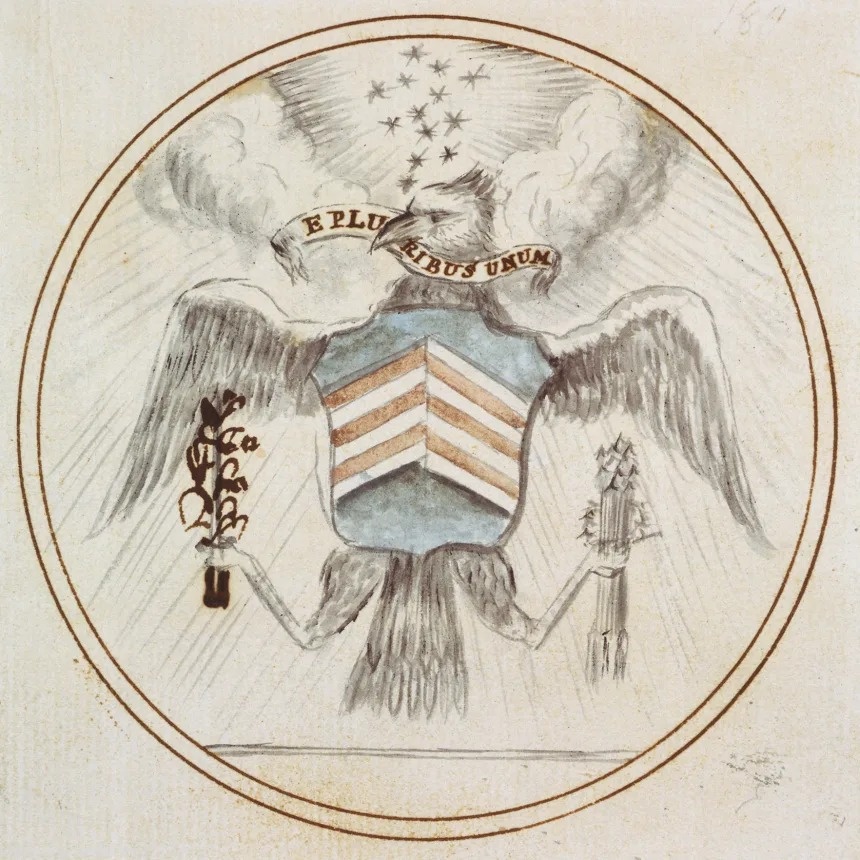 |
The original design of the U.S. coat of arms, created in 1782. Photo: U.S. National Archives. |
"It's true they can scavenge and steal fish from other species, but humans aren't perfect either," he said. "More importantly, bald eagles have demonstrated incredible survival skills, and so has America – at least for now."
Few people know that for much of American history, people loved the eagle symbol more than the bird itself.
During the Civil War, the 8th Wisconsin Volunteer Infantry Regiment brought a live eagle named Old Abe into battle as a mascot, and it survived dozens of battles.
However, outside the battlefield, bald eagles were relentlessly hunted. For decades, Americans believed they frequently preyed on livestock, even kidnapping children. Therefore, killing an eagle was once considered a beneficial act for the community.
While the United States had approximately 100,000-300,000 bald eagles in its early days, nearly two centuries of hunting, habitat loss, and the effects of the pesticide DDT have reduced their numbers to just 417 nesting pairs.
Since the 200th anniversary of the founding of the nation, the picture has begun to shift. The Endangered Species Act and the ban on DDT have paved the way for a strong recovery of the bald eagle. Today, the population has exceeded 300,000 individuals – one of the most successful stories in American conservation history.
The U.S. Department of the Interior once called this "the greatest victory for wildlife conservation" in the country's history.
According to Professor Jack Davis, the bald eagle's journey from the brink of extinction back to its status as a national symbol means it represents not only strength, but also resilience and self-repair—qualities many Americans want to see in their own country.
Bison: A symbol of a vast America.
If eagles reign supreme in the skies, then bison represent America on the ground. Few people know that the bald eagle will not be officially recognized as the national bird of the United States by Congress until 2024. Meanwhile, the bison has held the title of national animal since 2016.
Renowned documentary filmmaker Ken Burns chose the bison as the most "American" animal.
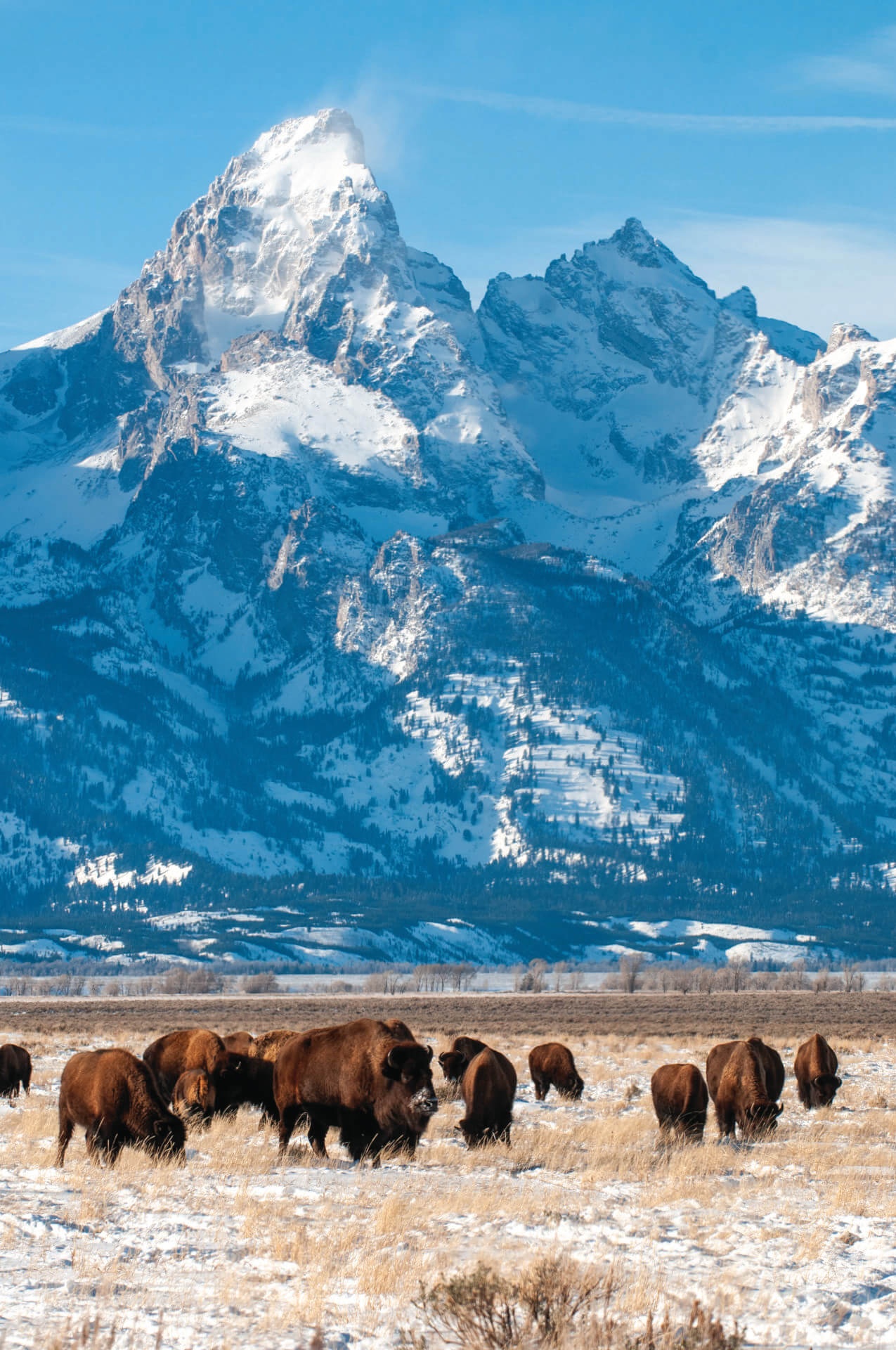 |
Bison in the Antelope Flats area of Grand Teton National Park (USA). Photo: Bradley J. Boner. |
While not as widespread as eagles in the early colonies, bison flocks once covered the vast grasslands of the American Midwest in numbers reaching tens of millions. This enormous scale reflected the territorial ambitions of a nation striving to become a continental superpower.
Before Europeans arrived in North America, many indigenous tribes regarded bison as sacred animals. They not only provided meat, hides, and bones for toolmaking but were also deeply intertwined with the spiritual lives of the natives.
However, the history of the bison is similar to that of the bald eagle. Following the wave of exploration of the West, large-scale hunting caused the bison population to decline from tens of millions to only a few hundred individuals by the end of the 19th century.
The bison's recovery process is much slower than that of the bald eagle and requires more active human intervention.
Today, bison have been reintroduced to many areas in the Western and Great Plains regions. In Yellowstone National Park, their numbers are so large that many visitors ignore warnings, get too close to take pictures, and are seriously injured by these seemingly docile animals.
Giant animals are for a powerful nation.
Not just eagles or bison, but many other animals have been used by the US as symbols of national power.
In 1787, while serving as ambassador to France, Thomas Jefferson had a moose, over 2 meters tall, hunted in New Hampshire and its carcass transported to Europe.
The purpose was not for display, but to refute the view of a French naturalist who claimed that animals in the New World were smaller and less developed than those in Europe.
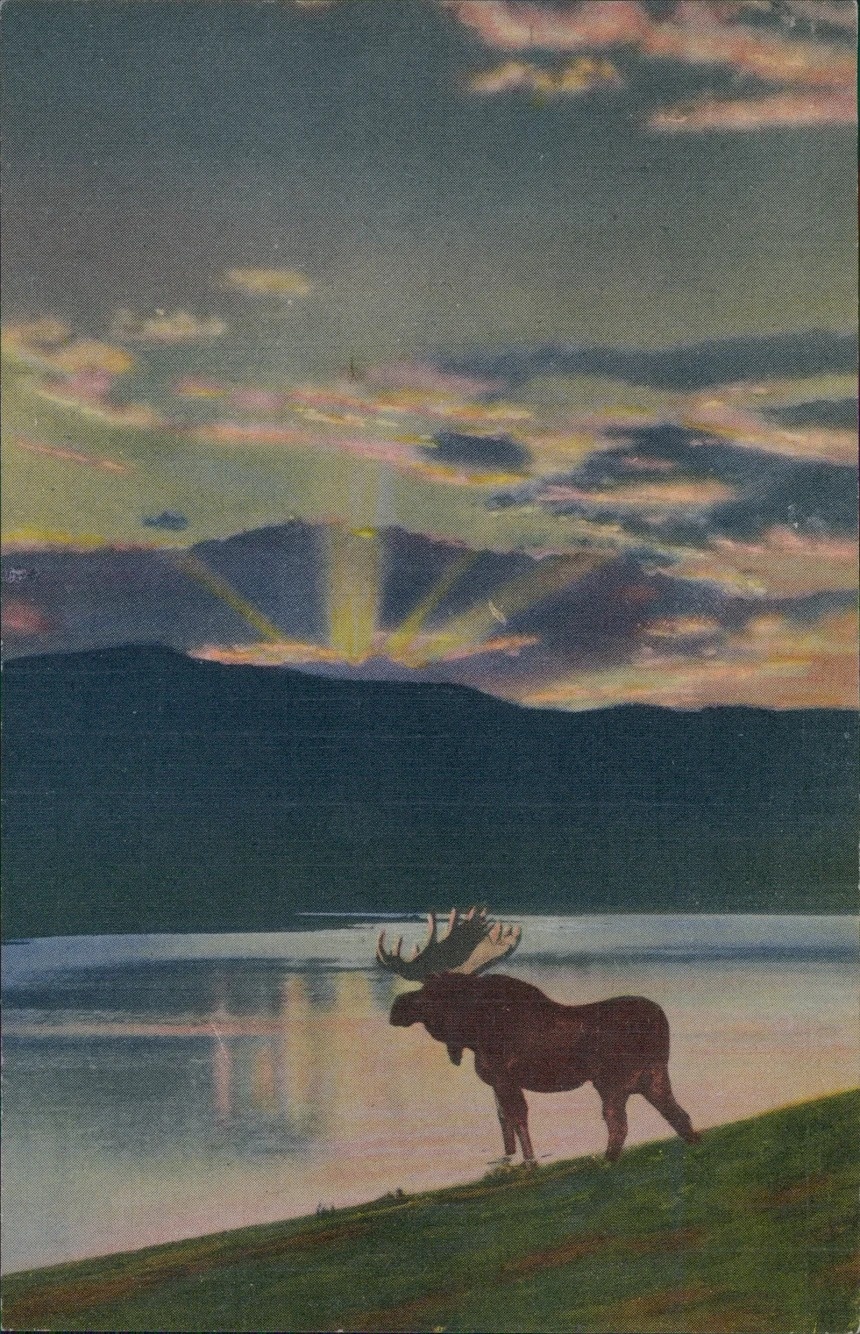 |
A postcard depicting a male moose standing by a lake at sunset in Colorado in 1930. Photo: Smith Collection. |
According to Hamilton College history professor Mackenzie Cooley, the moose was, in essence, a "diplomatic argument." It sent the message that America is capable of creating creatures as large and powerful as anywhere else in the world.



"The moose reflects the early American mentality of wanting to assert itself while simultaneously seeking European recognition," she observed.
Even the Eastern gray squirrel—a fairly common animal in America—once became a symbol in a different way.
When introduced to England, they quickly overpowered the native red squirrels due to their larger size, better competitiveness, and ability to carry more diseases. Gradually, grey squirrels replaced red squirrels across much of England, becoming an image that many Britons associated with a crowded, wealthy, and dominant America.
For Professor Harriet Ritvo of the Massachusetts Institute of Technology (MIT), the story of the gray squirrel shows that sometimes an animal not only reflects national identity in its homeland, but also how the rest of the world perceives that nation.
Not symbols, but "survivors".
While bald eagles or bison represent the values that America aspires to, some scientists argue that the most "American" animal doesn't necessarily have to be noble or beloved. Instead, it could be a creature that is adaptable, resilient, and survives in all circumstances – much like America's own history.
One of the most surprising names was... mouse.
According to urban ecologist Michael Parsons, images of soaring eagles, majestic grizzly bears, or other large animals only reflect the ideals Americans have built for themselves. In reality, the animal that best reflects America is the rat.
He argued that rats thrive in crowded urban areas, scavenging on human waste to survive and adapting very quickly to man-made environments. From this perspective, they reflect a modern America with its enormous cities, fast-paced lifestyles, and massive consumption levels.
However, Professor Harriet Ritvo of the Massachusetts Institute of Technology (MIT) argues that this characteristic is not unique to the United States, as the relationship between humans and rats is almost the same in every country.
The coyote - the one who never gives up.
If asked to choose a symbol for adaptability, many experts would lean towards the coyote.
Unlike many wild animals whose habitats are shrinking due to human expansion, coyotes have done the opposite. They have not only survived but also expanded their territory across almost the entire United States. In the cultures of many indigenous tribes, they are both mischievous characters and creatures possessing supernatural powers.
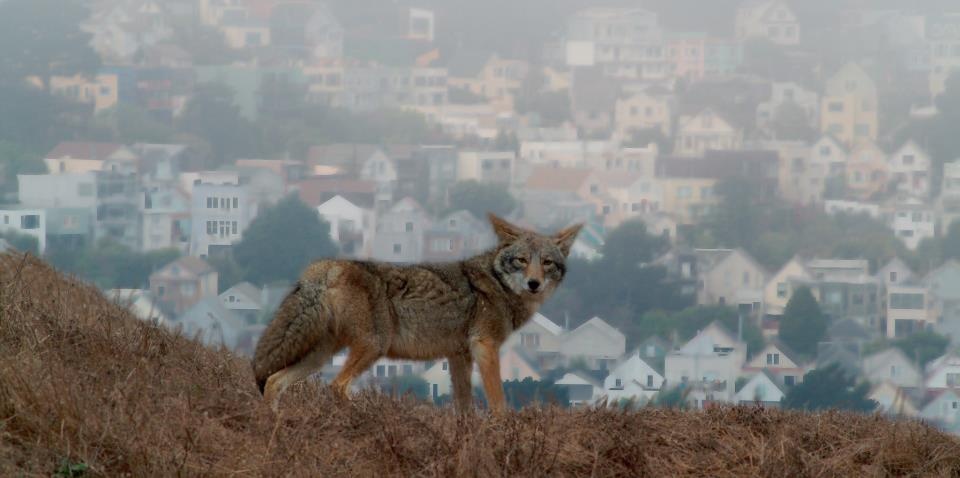 |
Coyotes in San Francisco. Photo: KALW. |
According to Erim Gómez, assistant professor of wildlife biology at the University of Montana, coyotes are one of the very few species that have benefited from human urbanization and continental exploration.
As gray wolves—larger rivals but more sensitive to environmental changes—decline, coyotes quickly fill the ecological void. They appear everywhere from grasslands and deserts to densely populated cities like Chicago, Los Angeles, and New York.
Remarkably, for over a century, the federal and many state governments have continuously implemented programs to control, and even eradicate, coyotes. Despite this, the population of this animal continues to expand.
According to Gómez, coyotes are proof of a rare and enduring ability to survive in the natural world.
Raccoons and the lesson of adaptation
Another "candidate" frequently mentioned by experts is the North American raccoon. While not possessing the strength of a bison or the majesty of an eagle, the raccoon is renowned for its intelligence, dexterity, and ability to utilize almost any available food source.
They can live in dense forests, suburbs, or even in the middle of crowded cities, feeding on human waste and still thriving.
According to Professor Harriet Ritvo, if an environmental catastrophe were to occur one day causing the disappearance of most large animals, raccoons could be one of the last species to survive.
This assessment partly reflects a different perspective on America: not as the strongest nation, but as the nation that always knows how to adapt to change.
"Immigrants" also shaped America.
Not all candidates were native species. The European starling was not at all present in North America when the Founding Fathers chose the coat of arms.
According to various sources, around 1890, a flock of starlings was released into Central Park in New York. From a few dozen individuals initially, they multiplied at an astonishing rate and now number between 80 and 200 million across the United States.
Wildlife journalist Charles Siebert argues that, from a historical immigration perspective, the starling is perhaps the most quintessential American animal.
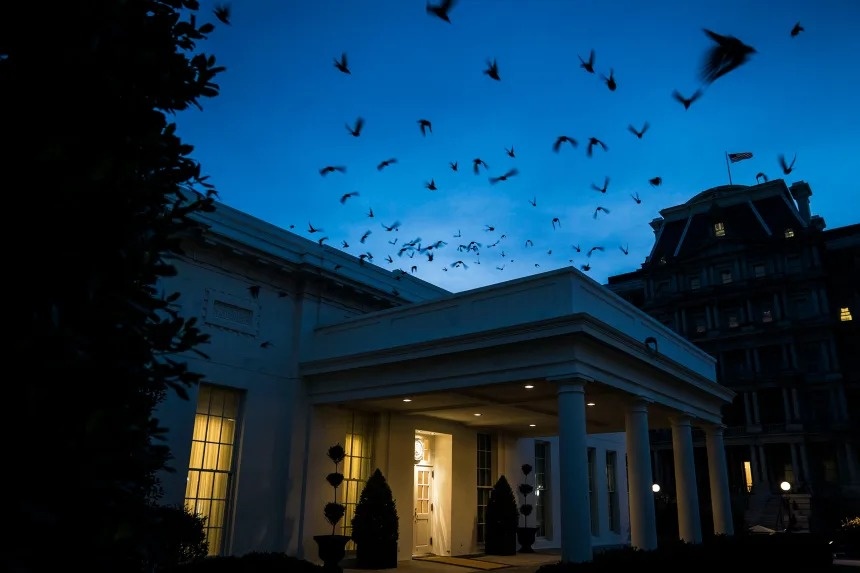 |
Starlings fly over the West Wing of the White House in 2018. Photo: Washington Post. |
Like millions of immigrants who have come to America over generations, starlings are not native but have adapted, survived, and become part of the national ecosystem.
However, Professor Nyeema Harris of Yale University opposes the idea of searching for a "most American animal." According to her, diversity is America's greatest identity.
Bald eagles, rattlesnakes, black-footed ferrets, or any other animal contribute to the rich ecological landscape of this nation. No single species is sufficient to represent the entire United States.
The less-mentioned "heroes"
Besides the prominent candidates, many experts have also suggested some unexpected names.
Professor Jack Davis chose pigs – animals not native to North America but which have contributed to promoting movements for improved working conditions and animal welfare in the meat processing industry.


Horses are also considered an important part of American history. They evolved in North America, then became extinct, and were reintroduced by Europeans, becoming a means of transportation for both indigenous people and the pioneers of the West.
Meanwhile, beavers are considered America's "first engineers." Before becoming targets of the fur trade, they helped shape river systems and wetlands across the continent.
Another candidate is the fire ant – an insect native to South America but famous for its ability to build complex "cities," even forming rafts to weather floods or erecting living towers to protect the entire colony.
According to Professor David Hu of the Georgia Institute of Technology, this is one of the most sophisticated insect societies in nature, despite being known for its painful stings and aggressive nature.
Rattlesnakes are also considered by many scholars to be very "American." Even during the colonial era, images of rattlesnakes appeared in propaganda posters and political symbols to call for unity before the American Revolution.
Benjamin Franklin's famous painting "Join, or Die" and the Gadsden flag with its coiled rattlesnake were once symbols of independence, before being adopted by many modern political movements.
And finally... turkey?
Finally, there's the candidate that Benjamin Franklin favored more than two centuries ago: the turkey. At first glance, turkeys don't possess the majesty of eagles. Their bare heads, dangling neck skin, and clumsy gait make them unlikely to be symbols of power.
But it is precisely this unassuming nature that has led many scholars to argue that turkeys reflect America more authentically than any other animal.
Turkeys were domesticated by Native Americans before becoming an indispensable dish at Thanksgiving – one of America's most iconic cultural traditions.
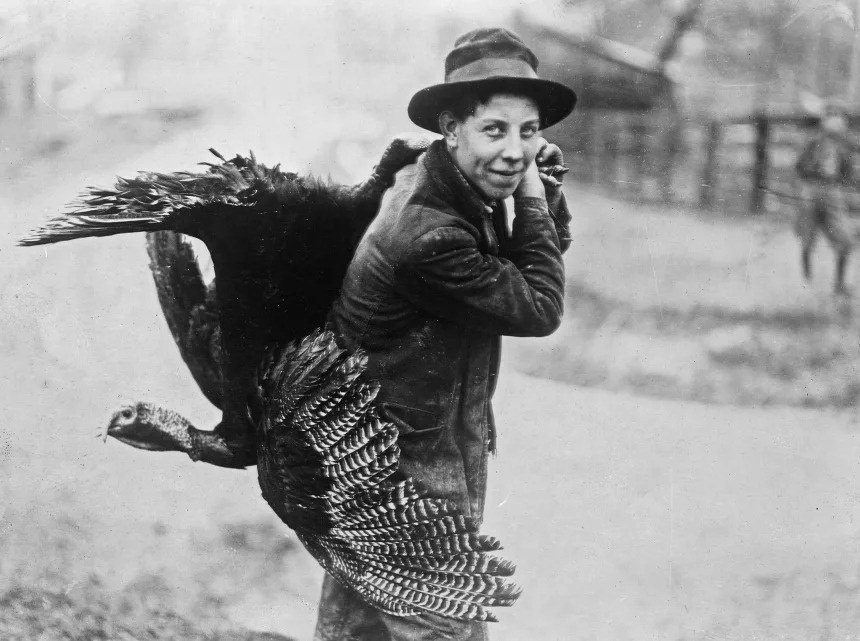 |
A man brought a turkey home after Thanksgiving, sometime between 1910 and 1915. |
Unlike eagles, which have relatives found in many parts of the world, turkeys are almost exclusively associated with North America. They are also a conservation success story, with populations increasing from around 30,000 individuals at the beginning of the 20th century to nearly 7 million today.
According to Professor Mackenzie Cooley, Benjamin Franklin's fondness for turkeys wasn't simply due to the animal's biological characteristics.
In his eyes, the eagle was a symbol of the old European empires, while the turkey represented a new republic—approachable, practical, and belonging to the ordinary people. If the eagle symbolized power, then the turkey symbolized everyday life.
Today, turkeys can still be aggressive when needed, capable of attacking humans if threatened, and are well-adapted to both mountainous forests and crowded urban areas. They are also the "star" of Thanksgiving dinners for millions of American families each year – a position no other animal can replace.
Source: https://znews.vn/dau-la-loai-vat-my-nhat-post1665515.html