


A corner of Son Vi commune, a model new rural area, is spacious, clean, and beautiful.
Son Vi village is situated in a low hilly area. Its name, Son Vi, means "Encircled by Mountains," while its vernacular name is Ke Vay (Encircled by Mountains), and it is popularly known as Ke Vay. This place preserves many tangible and intangible cultural artifacts that bear witness to the legend of the "Village Fortress" where soldiers of the Hung Dynasty fought against the Shu invaders, protecting the southwestern gateway to Phong Chau citadel and securing the borders of ancient Van Lang.
The people of Son Vi are immensely proud because the place where they were born, raised, and have lived for generations is one of the cradles of the ancient Vietnamese people. The 2019 Yearbook of Typical Historical and Cultural Relics and Traditional Festivals of Lam Thao District states: A corner of the Vuon Sau site - Son Vi archaeological site, discovered in March 1968 at the Rung Sau mound, Son Vi commune. With its distinctive features discovered for the first time in Son Vi, it was named the Son Vi culture, a culture of the late Paleolithic inhabitants.
Archaeologists have confirmed that a prominent feature of the Son Vi culture's stone tools is the use of river and stream pebbles for toolmaking. These were locally sourced materials, selected by the ancients for their relatively stable shapes for each type and group of artifacts. The characteristic tools of the Son Vi culture are divided into two groups: uncut pebble tools, including pestles, grinding stones, and chipping stones; and chipped and polished pebble tools.
In the archaeological collections of the Son Vi culture, the group of chipped and carved tools is numerous and diverse, including: tools with horizontal edges; tools with vertical edges; quarter-piece pebble tools; split pebble tools... These tools vary in size, demonstrating chipping and carving techniques as a distinctive method in Son Vi techniques.
Additionally, this collection includes two-edged, three-edged, pointed, and multi-edged tools, as well as some flakes, all primarily using chipping techniques. In the multi-edged tool type, the chipping technique is used to chip away an entire large surface of natural pebble bark, chipping from one to multiple layers to create a sharp edge.

Archaeological tools from Son Vi are on display at the Hung Vuong Museum in Viet Tri City.
Using the same techniques, the Hoa Binh culture made a further development, creating stone axes combined with grinding techniques. These tools were used daily by the Son Vi people as chopping, cutting, pounding, grinding, and crushing tools for everyday use, such as vegetables and wild game meat.
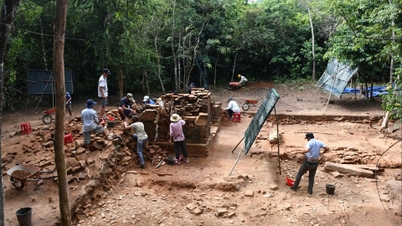
To date, archaeologists have discovered 230 sites related to the Son Vi culture nationwide, with the highest concentration in Phu Tho province (105 sites). In Phu Tho, the Son Vi culture is mainly concentrated in the river confluence and hilly areas of communes in Lam Thao district, such as: Son Vi (7 sites); Tien Kien (6 sites); Cao Xa (4 sites); Xuan Huy (3 sites); Xuan Lung (7 sites); and Lam Thao town (7 sites). In addition, this culture is also found in the hilly areas along the Thao and Lo rivers in the districts of Thanh Ba, Ha Hoa, Doan Hung, Cam Khe, Phu Ninh, Tam Nong, etc. Many artifacts are displayed and introduced at the Hung Vuong Museum in Viet Tri city.
Among the invaluable heritage of the Hung Kings era of nation-building and defense, Son Vi is honored and proud to have an archaeological site named after the Son Vi culture, one of the Paleolithic centers of Vietnam, helping scientists to definitively confirm the origins of people in the pre-Hung King and Hung King periods on this ancient land of the Fatherland.
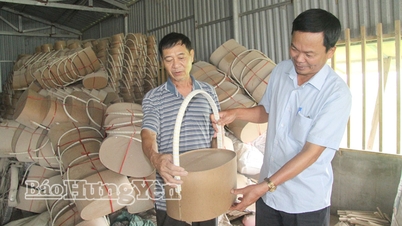
Today, Son Vi commune is the gateway to economic, cultural, and social development in Lam Thao district. With fully developed infrastructure such as electricity, roads, schools, and health stations, the people of the commune still maintain the traditional craft of making Son Vi rice husks, while also developing many production and business establishments and companies located within the commune. Infrastructure serving agricultural production has been standardized, and the commune has focused on shifting its economic structure, crop and livestock structure, and developing various economic models. The commune has 14 historical and cultural relics, including 7 cultural relics ranked at the national and provincial levels. Leveraging its advantages and strengths as an advanced new rural commune, Son Vi continues to be selected by the district and province to build a model new rural commune in the field of education. To date, the commune has built and completed the criteria for a model new rural commune in the field of education in Phu Tho province for the 2021-2025 period...
Hoang Giang
Source: https://baophutho.vn/dau-tich-nguon-coi-o-son-vi-212879.htm











![[Photo] Prime Minister Pham Minh Chinh receives the Chinese Ambassador to Vietnam](https://vphoto.vietnam.vn/thumb/1200x675/vietnam/resource/IMAGE/2026/04/05/1775397481797_ndo_br_dsc-5512-jpg.webp)



















































Comment (0)