|
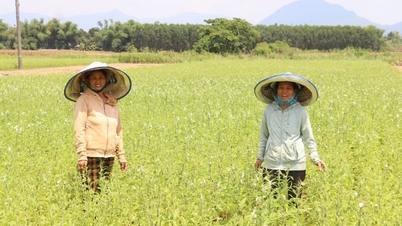
| In Thai Nguyen , tourists can easily find lush tea hills and experience the peaceful life of the local people. |
I arrived in Xinjiang one foggy morning.
That day, the land of Tan Cang unfolded like a Tay maiden just awakening. A thin mist clung to the rolling tea hills, as fine as the light powder left on her cheeks. Each row of tea plants curved, resembling the gentle, shy curves of a young woman in her prime. The first rays of sunlight touched them. So gently! As if only lightly caressing each tender bud, making the entire tea hill shimmer with a vibrant, fresh green. A green with a powerful vitality, caressing the entire hillside.
The tea hills lie still, undulating as if about to spring forth. A thin layer of tiny dewdrops, collected from the night, covers the young buds.
A sturdy man, bent over, diligently picks tea leaves. His back slightly hunched, his hands quick and steady. Picking. Breaking. Putting into the tray. He continues this swift, tireless process!
That's Mr. Le Quang Nghin, one of the tea artisans of Tan Cuong. Mr. Nghin is of the Ngai ethnic group, growing up in a family with a long tradition of tea making in the area. For him, tea is like a part of his blood and flesh. From the time he was a little boy running around watching his father pick tea, he asked: "Why is it called 'first water, second tea,' Dad?" Patting his son's head, his father slowly explained: "Water is the most important element in brewing a good pot of tea; it directly affects the aroma, flavor, and 'spirit' of the tea." In his innocent, adventurous childhood, Mr. Nghin didn't fully understand. Then his father taught him how to pick tea, the right time to roll, roast, and dry it. Although he didn't attend any formal school, he absorbed it deeply. He knew that this profession, besides being hard work, also requires perseverance and endurance.
Mr. Nghin recounted: "At fifteen, I already knew how to observe the sky and the land. I knew what the tea plants needed… That was water. The cool, refreshing water from Nui Coc Lake, flowing endlessly from the mountain ranges, formed the lake and irrigated and nourished the land. The entire surrounding area was lush and fertile because of the tea plants."
Hearing Mr. Nghin mention "water," I suddenly thought: that makes sense. Not only Tan Cuong, but Thai Nguyen tea has long been famous for its delicious taste. Perhaps it's because the tea plants in this land "drink" the water and benefit from the cool, fertile soil. The upstream of the Cau and Cong rivers originates from mountain ranges, with water seeping through the rocks day and night before flowing down. The tea plants are nourished by that clear water, resulting in famous tea-growing regions like La Bang, Trai Cai, and Song Cau.
 |
| Mr. Nghin, while offering tea to his guests, shared stories about Thai tea culture at his home. |
Wandering on the hill listening to Mr. Nghin's stories, before I knew it, it was noon. At midday, Tan Cuong suddenly changed color. Sunlight stretched across the tea slopes like a thin silk ribbon embracing the gentle body of the mountains and hills. The tea buds slightly closed, holding within them the essence of the earth and sky, like the girls of this "half-field, half-mountain" land—very real, yet still knowing how to maintain their traditions and foundation. At midday, the golden sunlight on the tea plantation shone on each green row. I was still busy taking notes from the slope when a young girl came down. Her skin was slightly tanned, her hair neatly tied back. She said nothing, only bent down to pick tea. Her wrists were slender yet strong, quick and decisive; each gentle turn neatly picked the tea buds. Her shirt, soaked with sweat, clung to her back, highlighting her healthy physique. Seeing me looking, she squinted and smiled:
"You think picking tea leaves is easy, don't you?" "It looks light, though." I chuckled.
She picked another bud, then held it up in front of me: "It's light, but one wrong move and the whole pot of tea is ruined. You have to pick exactly one bud and two leaves. We tea growers have to know how to 'pamper' the plant like we pamper our lovers." And she laughed, her laughter as clear as the breaking sun, then bent down and continued her work. Sweat glistened on her nose.
The wind sweeps across the hills, carrying the delicate, lingering scent of tea. It's a fragrance that makes one pause a little longer, like standing before a gaze deep enough to hold them back.
That day, Mr. Nghin poured me some tea. The tea was golden, clear, almost the color of mint honey. - "Drink some, and see what it tastes like."
I clicked a little.
- "It's bitter at first. Then it'll be sweet, sir!"
He laughed heartily: "Everyone knows that."



Then he looked out at the tea hill, where an ancient, century-old tea bush had been planted by his grandfather: "You have to see how the water flows, right? Water doesn't just stay in the teapot to brew tea. Water also seeps up the hillside, soaks into the soil, and nourishes the plants."
I silently pondered each word. Mr. Nghin's seemingly casual remark, however, made it difficult for me to return to my old way of drinking tea. In October 2025, at the event "Vietnamese Tea Culture - The Journey from Tea Plant to Teacup" held in Ho Chi Minh City, Mr. Nghin was invited as a guest. There, he represented tea producers and shared his life story – the story of a tea farmer, loyal to his profession and his land…
The tea hills quieted down. The sunset slowly descended over the hills and gently settled over Lake Nui Coc. The evening light bathed the entire space in a shimmering golden hue, warming the air after a long day. The rows of tea plants, layered one upon another, moved gracefully like the folds of a brocade skirt. In the distance, the lake's surface was calm and still, reflecting the changing sky, like clear, tranquil, yet profound eyes, gathering all that had happened during the day.
To learn more about tea appreciation, I sought out Mr. Mong Dong Vu, a renowned and passionate tea artisan in the province. Passing down the bustling Luong Ngoc Quyen street, I turned into an alley next to Thai Nguyen University of Education. Mr. Vu's room was filled with teapots—hundreds of them, I counted. Teapots crammed into cabinets, others hung on shelves. Some were faded, as if they had been there for many years.
"Why are you keeping so much?"
"To play," he said slowly.
Before brewing tea, he chose a teapot. He opened the cupboard and pulled out a whole pile: porcelain teapots, earthenware teapots, stoneware teapots, each bearing the marks of time.
He picked them up, put them down, examined them, and gently turned them in his hands. Finally, he took a tiny teapot, about the size of his fist. He rinsed the teapot. He rinsed the cups. The water steamed. The warm, earthy scent of the clay rose up.
He chuckled, "Drink sparingly. What's the point of drinking so much?"
I asked curiously, "Why don't you fill the water completely?" He laughed, "If it were full, there would be no room for the fragrance to linger." It sounded like a joke, but it was true.
On days of persistent rain, Xinjiang becomes fragile. The tea hills are shrouded in mist, their outlines no longer clearly defined, leaving only soft patches of green like clouds breaking apart.
Each tea bud, glistening with moisture, resembles a drop of sweat on tender skin. The entire landscape is like a young woman in a thin dress, paddling a dugout canoe down the Ba Be River. It's both discreet and alluring, making one unable to fully perceive it, only feel it, and gaze upon it endlessly, unwilling to leave.
Mr. Vu, like many people in this region, doesn't like tea flavored with flowers, unlike the luxurious but ostentatious teas found elsewhere. They don't like overly strong fragrances. "That kind of fragrance... is fake." They prefer the natural scent of the tea leaves. Some jokingly say, "Tea should smell like a country girl, not like a city girl wearing lots of perfume."
The people of Thai Nguyen value authenticity. Authentic and genuine, like the people from all corners of the country who, thousands of years ago, "dared" to leave their homeland to come to this land to struggle for a living. Authentic tea must have a slightly bitter taste, but the charm lies in the sweetness that follows. The aroma is subtle yet long-lasting. Slow and very profound.
I remember about ten years ago I once pressed an elderly, white-haired, dignified tea grower in Xinjiang about what determines good tea.
He said just one word: "Suffering." Seeing my bewildered expression, he added, "Not suffering... the tea is very bland!"
Xinjiang is peaceful when night falls.
The lake breeze blows through the tea rows, creating very gentle ripples, like the steady breathing of a sleeping person. Like a mountain maiden returning after a festival with a joyful heart, the tea hills, quiet yet still captivating, no longer flaunt their vibrant green, but sink into darkness.



One early summer day, I left Xinjiang, carrying a handful of tea that Mr. Nghin had given me, the sunlight falling like glass beads all along the road.
Back home, I excitedly took out the teapot and tried brewing some tea. It was the same water, the same teacup, but when I drank it… it tasted bland, something was missing. It wasn't the taste that was missing, perhaps it was the person. I missed the golden sunlight and breeze, the earthy smell, and the slow, simple, familiar voice.
I suddenly realized: No one's tea is too weak. For some, the water becomes strong and the tea becomes fragrant.
 |
| For many years, Mr. Vu has been diligently researching the origins and history of Thai tea (In the photo, Mr. Vu measures the circumference of the trunk of an ancient tea tree species from the midland region at the foot of the Tam Dao mountain range, in Quan Chu commune). |
Another afternoon, I brewed tea. Bitter. Then sweet. Then bitter again… But this time, I wasn't looking for the taste anymore. I was looking for the person. And in a fleeting moment, I saw that tea hill again in the early morning. I saw Mr. Nghin's hunched figure. I heard Mr. Vu's hearty laughter. I saw the young girl picking tea.
Everything appeared and then vanished like the smoke from the tea, like the thin clouds breaking over the tea hills in early summer. Only a familiar feeling remained, like stepping onto the tea hills in the morning. I set the cup down. Outside, cicadas began to chirp in the hot wind. Inside, the tea was hot, but sipping it slowly felt cool and soothing.
I suddenly understood: There are things in life that are so simple. They seem as old as the earth, but once you've experienced them, they're hard to forget. That's tea.
Source: https://baothainguyen.vn/van-nghe-thai-nguyen/chuyen-muc-khac/202605/dau-tra-tren-dat-thai-f514593/













![[Video] Weather forecast for tonight and tomorrow, July 3, 2026: Tropical depression likely to strengthen into a storm tonight](https://vphoto.vietnam.vn/thumb/402x226/vietnam/resource/IMAGE/2026/07/02/1782997465372_dem-2-png.webp)