

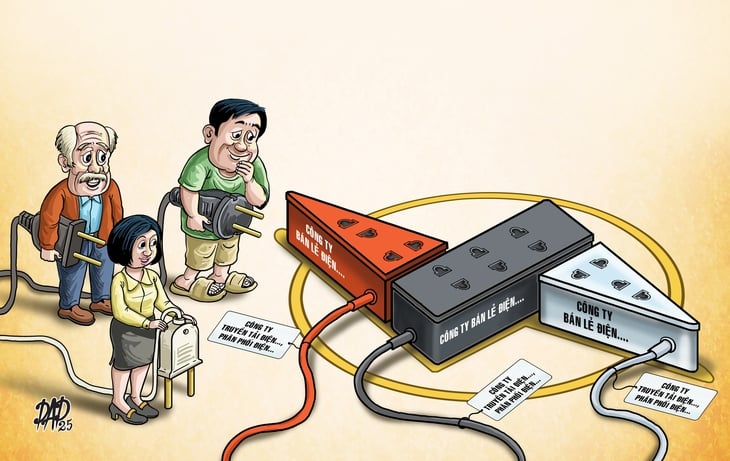
The problem of breaking the electricity sector's monopoly in transmission, distribution, and retail sales needs to be solved, promoting a fully competitive electricity market that is genuine and substantive, so that people have the right to choose to buy electricity from EVN or any other supplier.
Private companies act as "agents" to distribute electricity for EVN.
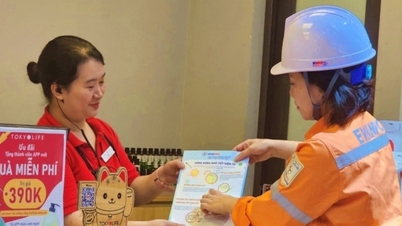
Providing electricity to approximately 3,000 households in Vinh Thuan commune ( Hai Phong ) and some neighboring communes, An Binh Electricity Trading and Service Joint Stock Company is one of many private units supplying and retailing electricity to customers alongside the largest supplier, Vietnam Electricity Group (EVN), in Hai Phong.
Mr. Vu Van Quy, director of An Binh Company and also the chairman of the Hai Phong Electricity Service Club, said that the company has been supplying electricity to the people since 1993.
At that time, the national power grid lacked the capacity to invest in and extend electricity to some villages and communes. Therefore, to meet the needs of the people and serve their lives, production, and economic development, Mr. Quy and his colleagues established a company to build a power distribution grid system, substations, and electricity distribution infrastructure to sell electricity directly to the people.
The electricity sold to residents is purchased directly by this company from EVN's electricity distribution units on the 35 kV medium-voltage grid. The company then steps down the voltage and sells the electricity to customers through a main meter. This is simply a way of setting up a company to act as an electricity distribution agent for EVN.
"We purchase electricity from EVN via the 35 kV grid as a wholesale purchase, and then resell it to customers at a retail price regulated by the State, which cannot exceed this level."
For household electricity, EVN uses a progressive tiered pricing system, and we also have to buy according to that tiered pricing. Therefore, whatever price EVN sells at, we sell to the people at the price set by the State.
"In Hai Phong, there are 24 cooperatives and businesses selling electricity like that, each serving about 2,500 to 3,000 customers in a specific area, so they also want an open mechanism to optimize operational efficiency," Mr. Quy said.
Mr. Quy expressed his delight and hope for the early issuance of specific policies to enable businesses to participate in the electricity market. According to Mr. Quy, the issuance of Resolution 70 by the Politburo , which calls for restructuring the electricity sector, promoting a competitive electricity market, and diversifying market participants, especially in wholesale and retail sales, is very correct and appropriate.
Mr. Quy cited the example of Hai Phong, where 24 cooperatives and businesses outside of EVN directly supply electricity to the people, and most of them wish to link up and cooperate in investing in medium-voltage grid systems and directly purchase electricity from power plants in the area.
However, currently, due to institutional constraints, private entities cannot invest in or purchase electricity from other power producers and suppliers, and still mainly buy from EVN and resell it to consumers.
Similarly, Mr. Nguyen Ba Quan - Director of Lien Ha Agricultural Cooperative (Dan Phuong, Hanoi) - said that they are also supplying electricity to about 2,000 households in the area. Purchasing electricity from the 35 kV power supply provided by EVN, the cooperative also sells electricity to residents at the price regulated by the Government.
However, the challenge of improving service quality and continuously investing in substations, power lines, poles, and meters, while ensuring electricity supply standards and criteria to reduce power losses, remains a pressing issue for this unit.
Therefore, Mr. Quan also hopes for an open mechanism that allows private electricity supply businesses to expand investment, cooperate with other units, and increase resources to improve the quality of service for customers.
In addition, there should be an open mechanism allowing electricity retailers to purchase electricity from entities outside of EVN, directly from electricity producers to optimize input costs, or to buy and sell on the electricity market, thereby offering competitive prices to end consumers.
Due to the lack of specific mechanisms, Mr. Quan believes that currently, most small-scale electricity retailers are still "staying put" serving customers in their local area, investing on a small scale, and trying to optimize costs by reducing power losses in the distribution grid.
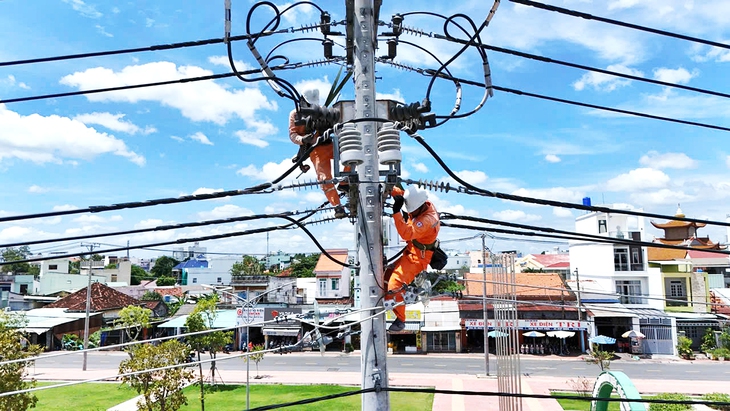
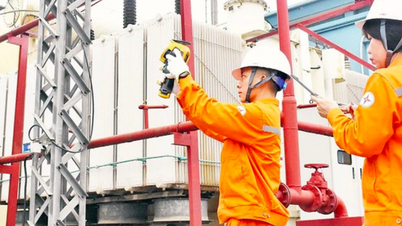
Problems need to be solved in the transmission, distribution, and retail stages of electricity... to promote a fully competitive electricity market. (In the photo: Electricity company employees maintaining the transmission grid system - Photo: T. HIEP)
Half-hearted retail
Along with EVN, which holds the dominant role in electricity retail, the Vietnamese electricity market currently has 724 businesses that purchase electricity wholesale from EVN to resell to the public.
Mr. Trinh Quoc Vu, Deputy Director of the Electricity Department (Ministry of Industry and Trade), provided the above information and added that the amount of electricity supplied to the people by these units currently accounts for about 8.59% of the market share. Thus, the amount of commercial electricity that EVN is selling directly to customers accounts for more than 91.4% of the market share.
Mr. Vu also affirmed that with the introduction of a roadmap to expand the electricity market to a competitive retail electricity market level, there will certainly be more units buying wholesale and selling electricity to the people, thereby forming a competitive market in retail electricity sales.
And from here, customers will have more choices when buying electricity. Certainly, people will choose the electricity retailer with the most competitive prices, which will benefit them the most.
Furthermore, there is now Government Decree 80 regulating the mechanism for direct electricity purchase and sale. This means that customers who use large quantities of electricity are allowed to purchase electricity directly from renewable energy power generation units.
Commenting on these policies, Mr. Vu said that this is a breakthrough mechanism that helps us move closer to a competitive retail electricity market. This means that businesses and companies that use a lot of electricity can choose to buy electricity from EVN or any other company.
"This will certainly boost the green transition, help develop renewable energy sources, and help achieve the net zero target by 2050," Mr. Vu said.
However, from a practical perspective, an expert in the electricity industry argues that the units currently supplying electricity to the public are small-scale and fragmented, acting as distributors for EVN.
Therefore, they cannot yet be called "electricity retailers." This is because they are mostly electricity supply service cooperatives, or electricity service businesses established to provide electricity to villages and rural areas that EVN (Vietnam Electricity) previously could not reach.
The formation of these units has historical roots and aims to reduce distribution losses, lessen the burden of grid investment for EVN in the past, and meet the electricity supply requirements for areas where EVN has not yet been able to deploy electricity.
According to the same expert, although the current electricity retailers are said to be "buying in bulk" from EVN, in reality, their electricity trading is still considered "retail" because the amount of electricity they buy and distribute accounts for only a very small market share compared to the amount of electricity that EVN directly supplies to consumers.
Furthermore, the distribution and retail of electricity by these entities are limited to specific licensed regions and operate on a small scale.
"Essentially, these are businesses involved in supplying electricity to the public, rather than true retailers in a competitive electricity retail market, because this market has not yet been fully and properly established," the expert further analyzed.
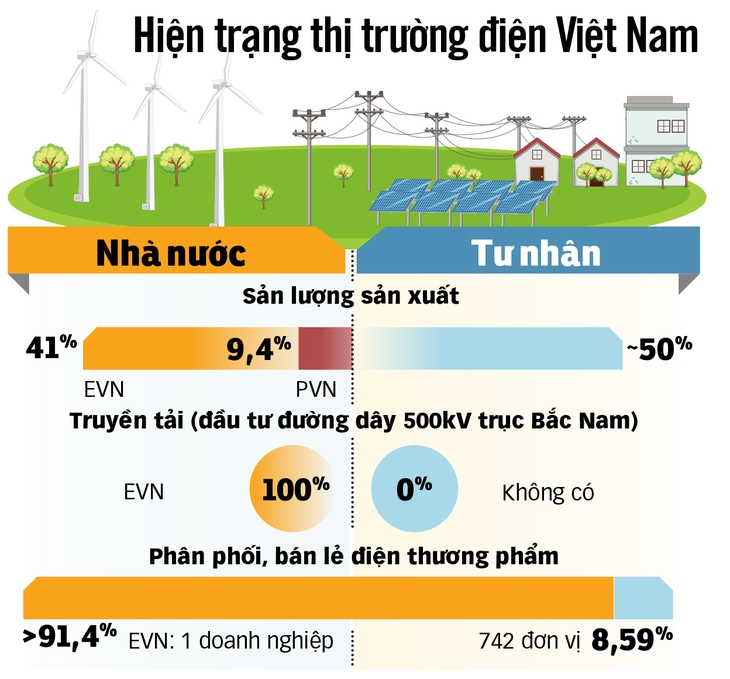
Source: Compiled by Ngoc An - Graphics: N.KH.
We need a truly competitive market.
Further analyzing the current electricity market, Mr. Ngo Duc Lam, former Deputy Director of the Institute of Energy, stated that the competitive electricity market has been laid the foundation since the amended Electricity Law of 2012 with a three-stage roadmap: competitive power generation market, competitive wholesale market, and finally competitive retail market.
However, progress so far has been slow and has not reached the true nature of competition. Therefore, Resolution 70, recently issued, will promote market restructuring and expand competition to the retail sector, giving people the right to choose their electricity supplier.
In detail, Mr. Lam stated that currently, electricity from state-owned power plants accounts for only about 38% of the country's total power generation capacity. And from a wholesale perspective, EVN remains the sole entity purchasing electricity from producers and then reselling it to consumers.
Meanwhile, in the retail market, although there is a mechanism for direct purchase from wind and solar power plants, it has not been effectively implemented, so most customers still have to buy electricity through EVN.
Furthermore, according to Mr. Lam, the transmission and dispatching of the power system have not been properly separated in accordance with the spirit of the law. Ideally, power transmission should be managed by an independent unit under the supervision of the State. However, currently, power transmission is still managed by EVN.
Similarly, the former electricity dispatching unit was also like that and was only recently separated from EVN. And Mr. Lam concluded: "If these stages are not separated, it will be difficult to have a truly competitive electricity trading market."
Source: https://tuoitre.vn/de-nguoi-dan-duoc-chon-nha-cung-cap-dien-20250921093338795.htm



![[Photo] Prime Minister Pham Minh Chinh receives the Chinese Ambassador to Vietnam](https://vphoto.vietnam.vn/thumb/1200x675/vietnam/resource/IMAGE/2026/04/05/1775397481797_ndo_br_dsc-5512-jpg.webp)














































































Comment (0)