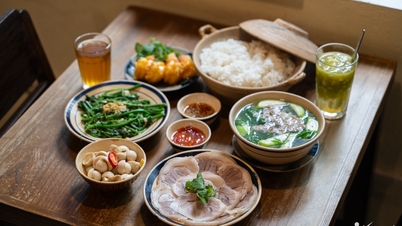
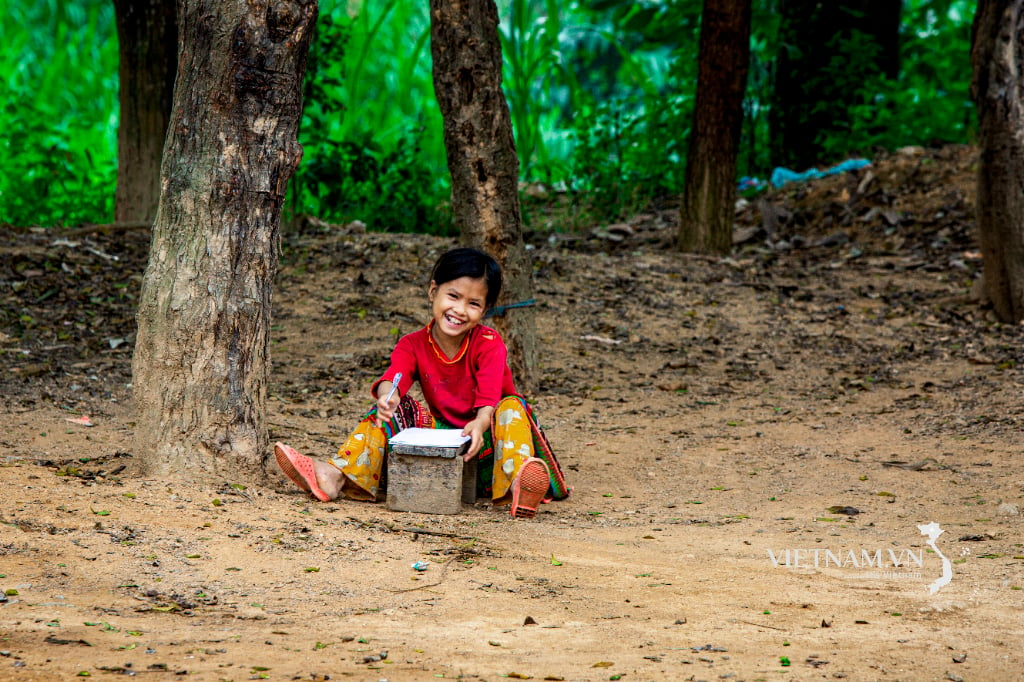
Children selling food at street food stalls.
Amidst the hustle and bustle of the city streets, there are still children who daily carry baskets of fruit or boxes of chewing gum, cotton swabs, etc., wandering through the city's alleys to sell and earn a living. Observing Lam Son Square in Hac Thanh Ward, from late afternoon onwards, many young children flock to sidewalks and shops to solicit customers. Looking at these children, Ms. Le Thi Vi, the owner of a sidewalk beverage stall in Lam Son Square, couldn't help but feel emotional, sharing: “Having sold goods in the square for many years, I frequently witness children wandering and working to make a living. They mainly sell goods, shine shoes, or beg, facing the risk of dropping out of school, malnutrition, and even being easily exploited or abused by those who control them.”
Child labor is one of the most pressing global issues, not only violating children's fundamental rights but also hindering the holistic development of future generations and causing significant losses to socio -economic development. To join the world in combating child labor, in Vietnam, the protection, care, and education of children has always been a consistent policy of the Party and the State. Simultaneously, the Vietnamese legal system has been continuously improved. Since 1990, Vietnam has been one of the first countries in the Asia-Pacific region to ratify the United Nations Convention on the Rights of the Child (CRC). Subsequently, Vietnam joined two important conventions of the International Labour Organization (ILO): Convention No. 138 on the Minimum Age for Employment and Convention No. 182 on the Elimination of the Worst Forms of Child Labor. In 2026, Vietnam will continue to improve its legal system for child protection with the 2016 Children's Law, the 2019 Labor Code, and many other child protection programs and policies. In particular, the National Program for the Prevention and Reduction of Child Labor for the period 2021-2025, with a vision to 2030, has been and is being implemented comprehensively nationwide.
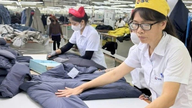


Furthermore, Vietnam is strengthening its labor inspection and child protection systems in production facilities, while establishing inter-sectoral coordination mechanisms between educational institutions, healthcare facilities, and civil society organizations. Support is provided for the reintegration of children who have been exploited into school through scholarships, tuition assistance, psychological counseling, and connections to community services. In particular, the policy of waiving tuition fees for public school students from preschool to high school starting in the 2025-2026 school year is a strategically significant step aimed at reducing the financial burden on families, enabling all children to attend school, and limiting the risk of dropping out and entering the workforce early due to economic circumstances.
However, despite commendable efforts, child labor persists in rural areas, remote regions, and areas inhabited by ethnic minorities. Many children are still forced to work in agriculture , livestock farming, small-scale trading, or as helpers for their families. This seriously affects their health, psychology, education, and future development opportunities.
In the context of increasingly deep international integration, preventing and ultimately ending child labor is not only a humanitarian responsibility but also a crucial requirement for building a sustainable economy and fulfilling international commitments on labor and human rights. President Ho Chi Minh always showed special love and concern for children. For him, children were the seedlings, the future masters of the country. He said: “If the seedling is green, the tree will be strong; if the bud is green, the leaves will be fresh and the fruit will be good; if children are properly nurtured and educated, the nation will be strong and independent.” Therefore, working together to eliminate child labor is a vital issue requiring the participation of the entire society, from individuals, families, and communities to organizations. The common goal is to ensure that children's rights are respected and that they live healthy lives, receive education, and develop comprehensively.
Text and photos: Le Phuong


Source: https://baothanhhoa.vn/de-tre-tron-ven-nbsp-uoc-mo-290830.htm
![[Photo] Opening Ceremony of the 13th National Congress of the Ho Chi Minh Communist Youth Union](https://vphoto.vietnam.vn/thumb/1200x675/vietnam/resource/IMAGE/2026/06/24/1782286753905_ndo_br_1-8510-jpg.webp)
![[Photo] General Secretary and President To Lam attends the Central Public Security Party Committee Conference](https://vphoto.vietnam.vn/thumb/1200x675/vietnam/resource/IMAGE/2026/06/24/1782302063612_a1-bnd-9302-9166-jpg.webp)
![[Photo] The 13th National Congress of the Youth Union conducts personnel work.](https://vphoto.vietnam.vn/thumb/1200x675/vietnam/resource/IMAGE/2026/06/24/1782299943080_ndo_br_1-6868-jpg.webp)