

Becoming the "prototype" of a love song.
In the book "Music and Life" edited by Le Giang and Luu Nhat Vu ( Hau Giang General Publishing House, 1989), there is an article by musician Hoang Hiep written in 1987, which mentions the "destiny" between the musician and the "prototype" of the song "A Song by the Banks of Hien Luong River" (lyrics co-written by Dang Giao), Mr. Phan Dinh Dong (born in 1915) in Hamlet 9, Gio Hai Commune (now Ben Hai Commune).
In 1956, composer Hoang Hiep moved from Hanoi to work in Vinh Linh, living in a border guard post about a hundred meters from Hien Luong Bridge... Later, he moved to Cua Tung to live with the fishermen in a fishing cooperative. It was during this time that composer Hoang Hiep met Mr. Dong. Unlike the people of the coastal region who liked to talk loudly, were open, and always initiated conversations, Mr. Dong was quiet and rarely smiled. Besides his duty of going out to sea to catch seafood, Mr. Dong was also assigned the task of guarding the lighthouse. One afternoon, seeing Mr. Dong preparing to climb up to where the lighthouse was located, composer Hoang Hiep asked to go along.
 |
| The Cua Tung lighthouse, formerly a lighthouse station, is where musician Hoang Hiep listened to Mr. Phan Dinh Dong confide about the pain of his family's separation - Photo: SH |
Composer Hoang Hiep and Mr. Dong silently gazed out at the vast ocean with its crashing waves.
Suddenly, Mr. Dong shared: “My house is right where the tallest trees are located… I also relocated to the North more than two years ago… I left my wife and children behind… So, I came here not only to fulfill my duties but also to look back at my hometown. Several times, I saw someone who looked like my wife and children coming out of the house to the beach to receive fish to sell at the market. I wanted to shout, but how could I shout to reach them… Once, just as dawn broke, I was standing here when I heard gunshots over there. Then I saw smoke rising right in my village. Just imagine, comrade, how I felt at that moment? I tried everything to find out what had happened to my house, my wife, and my children. But there was no way at all…”
"A while later, we quietly returned to the corporation. And my song 'The Song by the Banks of Hien Luong River' began that very night," composer Hoang Hiep shared in the book "Music and Life," edited by Le Giang and Luu Nhat Vu, published by Hau Giang General Publishing House in 1989.
The love story of a "Northern husband and Southern wife"
The small house of the former lighthouse keeper's daughter is nestled deep in a tree-lined alley in Hoa Ly village, Cua Tung commune. Ms. Phan Thi Hoa, daughter of Mr. Phan Dinh Dong, shared with a somber tone that her father had "reunited" with her mother and brothers in the afterlife 19 years ago (in 2006). War and turmoil prevented them from being together, so eternal sleep brought them closer.
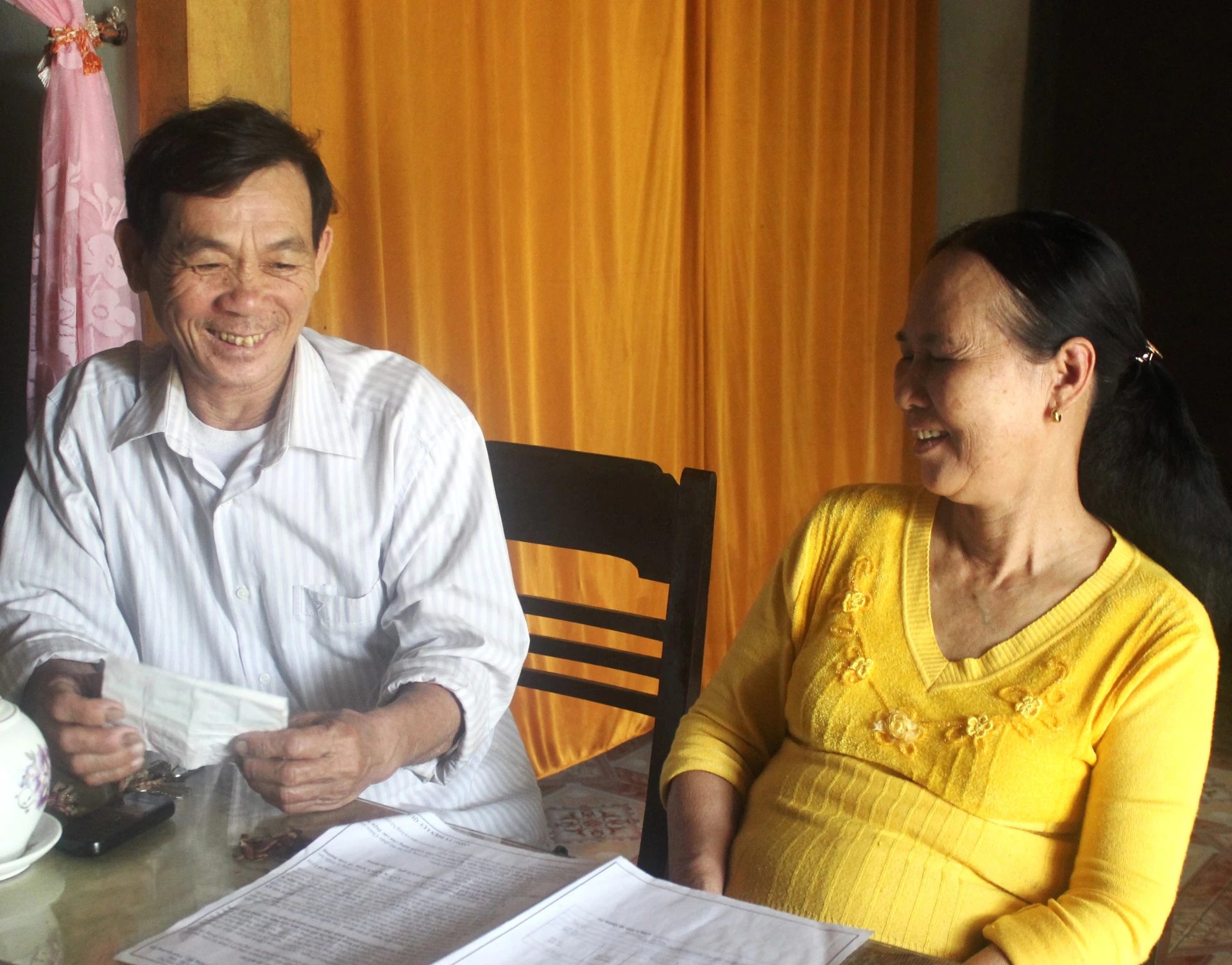 |
| Ms. Phan Thi Hoa recounts the story of her father, who was the "prototype" for the love song - Photo: SH |
In 1954, Mr. Dong bid farewell to his wife and children to relocate to the North. On the day he left, his wife was pregnant with their third daughter (now known as Ms. Phan Thi Hoa). Although he was relocated to the North, Mr. Dong didn't go far; he was assigned to lighthouse duty at the Cua Tung lighthouse station, just a few oars' distance from his hometown in the sandy village.
Late one night in late 1954, Mr. Dong secretly swam across the Ben Hai River to return to his village, hoping to see his newborn daughter who had just cried her first cry in a secret bunker. He only had time to kiss his infant daughter's forehead before hastily returning to the North bank, promising to see his wife and children soon. But then, it was a long 18 years before he finally saw his only remaining daughter…
His wife (martyr Khong Thi Nay) continued her revolutionary activities behind enemy lines after giving birth. Every day, she disguised herself as a fishmonger to approach enemy outposts along the southern bank of the Ben Hai River to gather intelligence, then reported to our troops so they could shell the outposts and eliminate the enemy. She bravely sacrificed her life while serving as the Party Secretary of Gio Hai commune and a member of the Gio Linh District Party Committee.
Mr. Dong's eldest son, Phan Dinh An, who served as the head of the Gio Hai commune militia, was also a martyr. His second son, Phan Dinh Trung, died of illness. Mr. Dong's family, living in the sandy village across the Ben Hai River, is now left with only one daughter, Phan Thi Hoa.
Following in her family's revolutionary tradition, Hoa joined the Gio Hai commune guerrilla force to defend her land and village. For 18 years, from her childhood until she became a "guerrilla fighter" in Gio Hai commune, the image of her father, whom she never met on the other side of the demarcation line, always haunted her.
After the country was reunified, composer Hoang Hiep once returned to Cua Tung to find Mr. Phan Dinh Dong, who was also present. Composer Hoang Hiep said that the song "A Song by the Banks of Hien Luong" initially encountered some "problems" because some people felt the song was too sad during the war... But later, this song became a timeless love song, touching the hearts of countless Vietnamese people. Because the story mentioned in the song is not just about one family on the banks of Hien Luong-Ben Hai, but speaks of the separation of millions of families in the North and South during the time when the country was divided…
In late 1972, while crossing the Ben Hai River to Vinh Kim commune (now Cua Tung commune) to receive more troops to fight on the South bank, Phan Thi Hoa was reunited with her father in a tearful reunion.
That day, she was chatting with some female guerrillas from Gio Hai commune in Vinh Kim when a man approached and silently stared at her. Seeing the stranger staring, she turned away. After a few minutes, the man, his eyes welling up with tears, approached her and choked out, “Hoa, is that you? It’s your father… It’s your father, my child…” After a few seconds of confusion, she burst into tears and hugged her father… To this day, that moment remains deeply etched in her memory whenever she thinks of her beloved father.
Sy Hoang
Source: https://baoquangtri.vn/xa-hoi/202511/dep-hon-ban-tinh-ca-0e404db/











































































Comment (0)