For over 20 years, Dr. Vo Minh Hai has been dedicated to ancient texts and documents. His chosen path is not just a profession, but a silent commitment to further clarifying the historical and cultural layers of Binh Dinh province (now Gia Lai province) – a land of martial arts and literary traditions that still harbors a vast treasure trove of Han Nom (Sino-Vietnamese) heritage that has yet to be fully explored.
In an interview with Gia Lai Newspaper and Radio & Television, he shared about his journey of "taking the less traveled path."
My connection with Sino-Vietnamese studies.
Meeting Dr. Vo Minh Hai at his private residence, with its walls covered in books, the first impression is his calm, unhurried demeanor—a characteristic of scholars of Sino-Vietnamese studies.
He said that his connection with Sino-Vietnamese characters began quite early, in his elementary school years, when he studied at schools associated with the Chinese community in Quy Nhon, such as Sung Nhon (now Tran Hung Dao Elementary School), Phuc Kien and Nhan Thao (now Tran Quoc Tuan Elementary School).

Dr. Vo Minh Hai, Deputy Head of the Faculty of Social Sciences and Humanities (Quy Nhon University), has persistently pursued research in Sino-Vietnamese studies for over 20 years. Photo: Ngoc Nhuan
* You came to the study of Sino-Vietnamese studies as if by "fate." Can you recount that journey?
- Actually, when I was little, I wasn't very conscious of it; I just felt that the words and cultural atmosphere at the elementary schools I attended back then were very captivating. It wasn't until I went to university that this connection truly became my career choice.
I studied Literature, specializing in Vietnamese Medieval Literature, at Quy Nhon University of Education (now Quy Nhon University). Fortunately, the curriculum at that time included many courses in Chinese and Sino-Vietnamese studies, which helped me approach classical studies in a relatively systematic way.
More importantly, I received guidance from my teachers, especially Mr. Huynh Chuong Hung, who had a profound influence on my later academic path.
* Could it be said that Mr. Huynh Chuong Hung was the one who "ignited" your passion?
- He not only imparted knowledge but also instilled a professional spirit. He taught me how to approach Sino-Vietnamese texts meticulously, respecting the source material and persevering in my chosen path. In October 2001, he gave me a copy of the *Analects of Confucius* – a text we had collected during a field trip – and said, "Go home and try translating it." At that time, I was still a student, without a computer, so the more than 50 pages of translation were handwritten in my school notebook. I translated continuously until May 2002, when I finished. For the first time, I began to believe I could go the distance with Sino-Vietnamese studies.

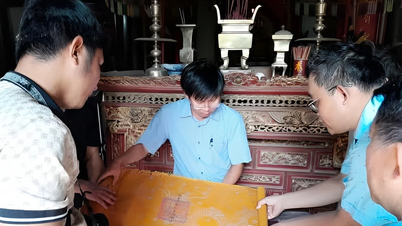
Dr. Vo Minh Hai (right in the photo) currently collaborates with the Provincial Historical Archives Center in the translation and research of royal decrees and Sino-Vietnamese documents. Photo: Ngoc Nhuan
Choose a profession of silence.
In his final years of university, Dr. Vo Minh Hai faced a crossroads: write a thesis on folklore or pursue Sino-Vietnamese studies – a difficult field with few students. He chose the difficult path.
* That decision must not have been easy, sir?
- That's right. Initially, I planned to write a thesis on Folklore and follow the research direction of Professor Tran Xuan Toan, my very dedicated supervisor. But I always felt I wanted to work more deeply with literary culture, with Sino-Vietnamese characters. Therefore, I decided to write a thesis on the cultural significance of the words "East - West" in medieval Vietnamese literature.
My thesis received an excellent rating, helping me graduate with honors and opening up opportunities to stay and teach at the university from November 2003, when I was just 22 years old. At that time, my academic credentials consisted only of a thesis and a translation, but both were in Sino-Vietnamese studies. From 2009, I participated in compiling the textbook "Selected Classical Chinese Texts". In 2012, I won third prize in the Young Scientists Award of the Ministry of Education and Training with the topic "Sino-Vietnamese Literature - Theory and Application".
* You once said: Classical Chinese and Vietnamese script is the profession of silence. Why is that?
- This is a field where things can't be done quickly, and certainly not with fanfare. To succeed, you need patience and quiet accumulation of knowledge. From around 2012 to 2020, I spent most of my time conducting fieldwork and collecting materials in Binh Dinh (now Gia Lai) and other provinces in the South Central region such as Quang Ngai, Quang Nam (now Da Nang City), Khanh Hoa… That was the preparatory phase for my later projects.
From that foundation, I have successively published works such as: The Language of Truyện Kiều from a Cultural Perspective (2020); Bình Định Han Nom Funeral Oration (2021); South Central Vietnam Han Nom Literature: Appearance and Characteristics (editor, 2022); The Essence of the Analects by Nguyễn Phúc Ưng Trình (2024); Research and Commentary on Han Nom Authors in Bình Định (2025); Language and Culture in Tây Sơn Period Literature (2025); Examination Culture and Examination Halls in Bình Định (2025)…

Besides research, Dr. Vo Minh Hai also devotes much of his time and effort to teaching and training the younger generation in the field of Sino-Vietnamese studies. (Photo: Provided by the interviewee)
Persistently "unearthing" the treasure trove of Han Nom (Sino-Vietnamese) in Binh Dinh.
Currently, Dr. Vo Minh Hai is working closely with the Gia Lai Provincial Historical Archives Center in translating imperial decrees and Sino-Vietnamese documents.
Are you devoting a lot of effort to exploring the rich collection of Han Nom (Sino-Vietnamese) texts in Binh Dinh province?
- Binh Dinh possesses a vast treasure trove of Sino-Vietnamese (Han Nom) literature, ranging from imperial decrees, funeral orations, family genealogies, theatrical plays, to the writings of renowned scholars. Without timely surveying and digitization, many documents could be lost permanently within a few years. My long-term goal is to build a systematic database of Binh Dinh's Sino-Vietnamese literature, from major authors such as Dao Tan, Nguyen Dieu, Ho Si Tao, and Dao Phan Duan to lesser-known authors.
In my opinion, proving that Binh Dinh is a "land of martial arts and literary talent" cannot be achieved solely through rhetoric, but requires original documentation. We need to conduct surveys, digitize data, build an open database, organize workshops, and publish specialized publications – similar to how Hue and Quang Nam have done things quite systematically in the past.
What keeps you persistent on this less-traveled path?
- For me, it's not just a passion, but also a responsibility to the land where I was born and raised. Those who come after must be grateful to those who came before, inherit with critical thinking, and continue what was left unfinished. Classical Chinese and Vietnamese script is a difficult, slow-paced field with little glamour, but if no one does it, that treasure will remain dormant. I chose this path not to be different, but because I believe it needs someone to walk it.
Currently, I am focusing my research on Sino-Vietnamese literature, the village culture of South Central Vietnam through Sino-Vietnamese documents, and the preservation and promotion of Sino-Vietnamese heritage. In the future, I plan to publish additional works such as: Nguyen Van Hien's Do Ban Citadel Chronicle; Binh Dinh through Nguyen Dynasty documents; Binh Dinh Royal Decrees; Binh Dinh Confucian Temple; Sino-Vietnamese texts around Hoang De Citadel; Family genealogies in Binh Dinh through Sino-Vietnamese documents…
Thank you for the conversation!
Source: https://baogialai.com.vn/di-con-duong-it-nguoi-di-post577616.html


![[Image] A brilliant symphony and explosive power in the skies of Da Nang.](https://vphoto.vietnam.vn/thumb/1200x675/vietnam/resource/IMAGE/2026/05/31/1780196945787_anh-man-hinh-2026-05-31-luc-10-08-51.png)


















![[Video] Sunset at Lap An Lagoon – Where the sun sets over the fishing nets](https://vphoto.vietnam.vn/thumb/340x192/vietnam/resource/IMAGE/2026/05/31/1780192137701_beach-landscape-sea-water-nature-grass-745871-pxhere-com.jpeg)
























































Comment (0)