

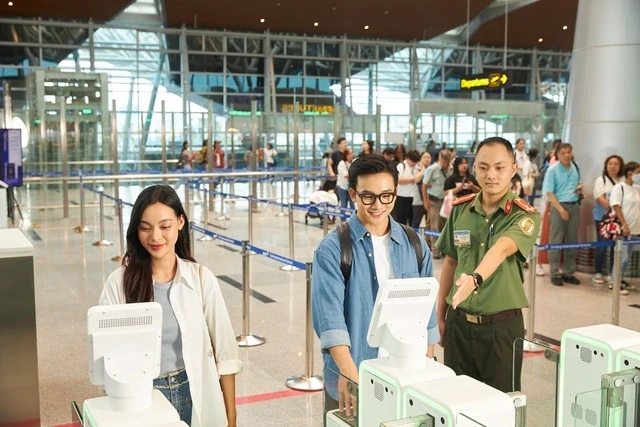
For nearly a century, in the same location, the airport has served four successive roles: a colonial landing strip, a wartime air base, civilian infrastructure during reconstruction, and an international gateway to a modern city.
Looking back over the past 100 years
In the years 1926-1930, when Tourane was still a stop on the Indochina air route, it was just an airfield with a dirt runway, sufficient for propeller planes to land and refuel. It wasn't an "airport" in the modern sense, but it established something important: Da Nang's strategic transportation location in Central Vietnam. The decision to establish the landing site then inadvertently shaped the future urban landscape for nearly 100 years afterward.
The 1960s and 1970s transformed this location into a completely different place, known as Da Nang Air Base. The US expanded it into a leading air base in Southeast Asia, constructing long concrete runways for jet aircraft, aprons, technical depots, and logistics systems. This period created the legacy of runway infrastructure that Da Nang Airport still utilizes today.
After 1975, Da Nang Airport entered a quieter period: civilianization, reuse of old facilities, a small terminal, and limited operational capacity. Its primary role was domestic connectivity during the country's reconstruction. But it was precisely this continuous maintenance that kept the infrastructure from being disrupted, allowing Da Nang to enter a new growth cycle.
Since the early 2000s, along with the rise of tourism and services, the airport has undergone significant modernization. Terminals T1 (2011) and T2 (2017) have transformed Da Nang into the international gateway of Central Vietnam. The rapid increase in passenger numbers has directly impacted urban economic growth. The airport is no longer just a transportation facility, but has become a driving force for development.
Four layers of historical roles have left four distinct legacies: transportation positioning from the colonial era, large-scale infrastructure from the wartime period, continuity of exploitation during reconstruction, and economic dynamics in the modern era.
Therefore, Da Nang Airport today is not just a story about aviation. It's a story about restructuring the urban development space for the next hundred years. How can we utilize the value of this historical land if its role changes? How can we reconcile urban growth, flight safety, and infrastructure efficiency?
Answering those questions requires viewing the airport not as a mere engineering project, but as a historical heritage – an infrastructure – a planning project. For nearly a century, every change at the airport has coincided with a turning point for Da Nang. And it is very possible that the city's next turning point will begin right here.
Future vision
For many years, the story of airports located in the heart of cities has often been framed within a familiar mindset: that they are a "bottleneck." People see the noise, the spatial fragmentation, the height restrictions on buildings, and from that arrive at a seemingly logical conclusion: the airport should be relocated to free up land for urban development.
That perspective was once appropriate for a period of development when cities were understood primarily as the physical expansion of housing, roads, and buildings. However, in the context of modern cities, where core values no longer lie in land area but in knowledge, technology, connectivity, and experience, that perspective is no longer relevant.
The issue facing Da Nang today is not "what obstacles does an airport in the middle of the city create?", but rather "what strategic opportunities does an airport in the middle of the city open up?". This represents a shift in thinking: from an infrastructure-oriented mindset to an urban positioning mindset.
Da Nang International Airport, viewed through a new lens, is no longer just a simple aviation infrastructure. It is the first point of contact between the city and the world . Every day, tens of thousands of people land here before experiencing My Khe Beach, before crossing the Han River, before feeling the rhythm of urban life. That moment of landing, in essence, is the "cover page" of Da Nang. And in the age of experiences, that "cover page" has far greater positioning value than any advertising slogan.
Looking at the world, the smartest cities aren't rushing to relocate airports out of the urban core. They're redefining the space around the airport to transform it into a new development hub.
Da Nang is facing an opportunity that very few Asian cities still possess: an international airport located right in the heart of this coastal city.
If relocated, Da Nang would lose an advantage that many cities have permanently lost when forced to move their airports tens of kilometers away. If it remains but continues to be treated as a regular airport as it has been, Da Nang will waste an opportunity. Only by redefining the airport's role can the city truly exploit its strategic value.
Redefining here doesn't mean renovating the terminal or expanding the runway. Redefining means reorganizing the entire space surrounding the airport as an innovation hub connected to international knowledge, technology, culture, and services. Then, when foreigners arrive in Da Nang, they are not just entering a terminal, but a space that immediately reflects the city's vision and aspirations.
Airports, from being merely technical infrastructure, will become urban knowledge infrastructure. From being a spatial dividing point, they will become the nucleus for restructuring development space, especially towards the West and Northwest. From being seen as a bottleneck, they will become a driving force.
More importantly, this approach aligns with Da Nang's positioning as an international coastal city. A coastal city is not only defined by its beaches and coastal roads, but also by its ability to connect with the world, its ability to attract knowledge, technology, and high-quality human resources. The airport is the clearest example of this connectivity. If properly organized, it can become the city's "international knowledge gateway."
Therefore, the question for Da Nang is not "when will the airport be relocated?", but "when will the airport be integrated into the city's strategic planning structure?" It's not a traffic problem, but a problem of positioning for the future. It's not about addressing an existing problem, but about exploiting a rare advantage.
In the new planning mindset, Da Nang Airport should not be viewed as a self-contained functional area, but rather as the core of an open development structure. Specific policy mechanisms for exploiting the surrounding land need to be put in place to turn this vision into reality.
Then, the story of Da Nang airport will no longer be about noise or height restrictions. It will become a story about urban vision. A city that sees opportunities where others only see limitations. A city that transforms technical infrastructure into knowledge infrastructure. A city that understands that, in the new era, value lies not in how much land is available for construction, but in how space is organized to create knowledge, connection, and experience.
Source: https://baodanang.vn/tam-nhin-moi-cho-san-bay-da-nang-3326166.html


![[Photo] National Assembly Chairman Tran Thanh Man attends the policy seminar to promote Vietnam-Türkiye cooperation.](https://vphoto.vietnam.vn/thumb/1200x675/vietnam/resource/IMAGE/2026/04/16/1776351415367_vna-potal-chu-tich-quoc-hoi-tran-thanh-man-du-toa-dam-chinh-sach-thuc-day-hop-tac-viet-nam-tho-nhi-ky-8705791-jpg.webp)
















![[Image] Bridges and roads connecting the eastern part of Ho Chi Minh City](https://vphoto.vietnam.vn/thumb/1200x675/vietnam/resource/IMAGE/2026/04/16/1776328595108_ndo_br_bh-vt5-jpg.webp)


























![[Infographic] Details of the Hanoi-Quang Ninh High-Speed Railway Project](https://vphoto.vietnam.vn/thumb/402x226/vietnam/resource/IMAGE/2026/04/16/1776338188424_anh-man-hinh-2026-04-16-luc-18-16-10.png)

![[Photo] National Assembly Chairman Tran Thanh Man meets with the Speaker of the Georgian Parliament](https://vphoto.vietnam.vn/thumb/402x226/vietnam/resource/IMAGE/2026/04/16/1776338494029_anh-man-hinh-2026-04-16-luc-18-21-21.png)















Comment (0)