

Con Co Island has no shortage of potential to become a unique destination, so why has it been "moving slowly" for so many years? It's not because it lacks beautiful scenery, nor because it lacks stories to tell.
The problem lies in the fact that access to the island is not yet fully accessible – and behind it are "bottlenecks" in infrastructure, mechanisms, and resources that have not yet been fundamentally resolved.
The project was conceived early, but the process has been lengthy.
The story of developing tourism on Con Co Island was actually raised quite early. On April 19, 2010, at the 20th session of the Quang Tri Provincial People's Council, the plan to develop Con Co Island into a tourist island by 2020 was approved, with a total estimated cost of 986 billion VND; the initial phase, until 2015, alone required approximately 641 billion VND.
That's a large number, reflecting high expectations for this strategically important island. But as many planners say, "having a plan" is only the starting point. The deciding factor lies in the resources and the implementation.
It took seven years, until 2017, for the tourist route to the island to officially begin operating. The first boat departed carrying tourists and the hope that Con Co Island would enter a new chapter. From that milestone, the island began to move forward.
Infrastructure was gradually developed; accommodation and food services slowly emerged; and experiences such as island tours, snorkeling, and fishing began to appear.
From 2017 to April 2024, the island welcomed over 38,400 visitors, generating approximately 44.6 billion VND in revenue from tourism and services. In 2025, Con Co Special Economic Zone is expected to welcome over 9,268 visitors, with estimated revenue exceeding 13.9 billion VND.
Those figures, considering it's a newly emerging destination, are noteworthy. But when considered in relation to its potential, it's clear that there's still enormous room for growth.
According to Mr. Pham Thanh Tuan, Vice Chairman of the People's Committee of Con Co Special Zone, there are currently 14 accommodation establishments on the island with approximately 78 rooms and 254 beds. The transportation route from Cua Viet to the island has two boats, each with a capacity of over 240 passengers. Four households have started operating food and beverage services, capable of serving more than 200 guests simultaneously.
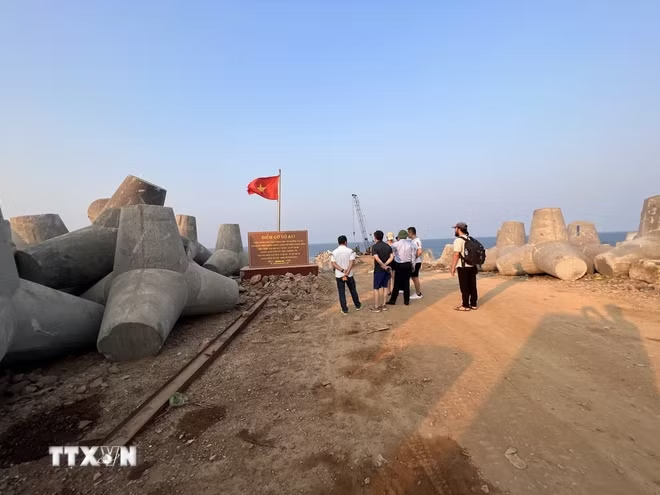
Support services are also gradually improving, including electric sightseeing vehicles, boat rentals, fishing, snorkeling, camping, and water sports . Some local products such as fish sauce, dried fish, Gynostemma pentaphyllum tea, sea grapes, and king oysters are beginning to make their own mark.
Mr. Tuan stated that in 2026, the locality will focus on renewing tourism products such as coral viewing by glass-bottom boats, bonfires, cultural exchanges, etc., with the goal of welcoming over 12,000 visitors and generating revenue of approximately 18 billion VND. Con Co Island is changing. But clearly, that is still not enough to create a turning point.
The "bottlenecks" behind the wave
In the development story of Con Co Island, there are some immediately visible problems – such as the dependence of boats on weather conditions. But there are also deeper, more subtle "bottlenecks."
Mr. Tran Xuan Anh, Secretary of the Party Committee and Chairman of the People's Committee of Con Co Special Zone, named four main "bottlenecks": transportation, fresh water, human resources, and mechanisms. Of these, transportation is the "root cause."
If the sea becomes rough, with winds reaching force 5-6, small boats have to stop. At that point, almost all plans are "frozen," tourists can't get to the island, and people on the island can't get back to the mainland. For tourism – an industry heavily dependent on stability – this is the most direct and obvious obstacle.
But behind transportation lies a whole other set of problems. The island's internal infrastructure – from electricity and water to environmental treatment and telecommunications – despite investments, still falls short of long-term development requirements. In particular, freshwater resources are limited during the dry season, a crucial condition for any type of accommodation.
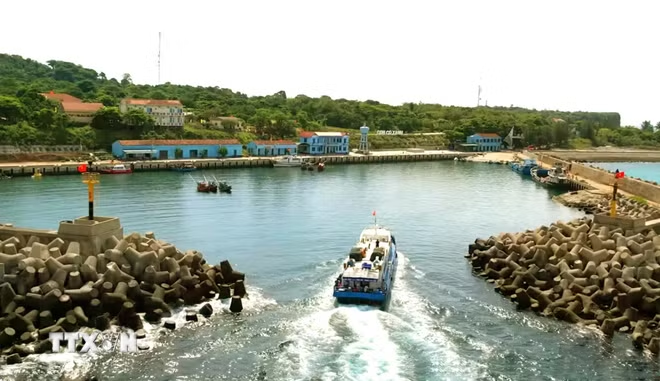
From a business perspective, Mr. Duong Ba Hung, General Director of Top Ten Travel Company, believes that the bottleneck lies not only in infrastructure.
Mr. Hung shared: "The effective operating period each year is short. Frequent disruptions to boat services make it difficult for businesses to develop stable products, especially for group tours or international partners. As a result, tour costs increase, while selling prices struggle to compete with developed destinations like Da Nang or Nha Trang – where infrastructure is complete and operations can be year-round."
Another "bottleneck" lies in the tourism products. Currently, most tourists visiting Con Co Island only stay one night. Their trip usually stops at sightseeing, swimming, snorkeling, exploring the forest, or learning about historical sites.
When night falls, the island almost "goes to sleep early," lacking experiential activities. Specialized products such as ecotourism, environmental education, and marine research are not yet systematically organized. As a result, the service chain remains fragmented and insufficient to retain tourists.
At a deeper level, policy mechanisms are the "soft bottleneck" but are ultimately decisive. While some incentives exist, they are not strong enough to attract strategic investors.
Some procedures related to investment, land, and construction—especially those involving defense and security—are still lengthy. These bottlenecks are not isolated issues. They are interconnected, forming a vicious cycle: Insufficient infrastructure makes attracting investment difficult; lack of investment hinders infrastructure improvement; unstable transportation hinders product development.
"Opening the way" is not just about trains.
Looking directly at the "bottlenecks," the question is no longer "whether to develop or not," but "how to develop." Mr. Nguyen Duc Tan, Director of the Investment, Trade and Tourism Promotion Center of Quang Tri province, said that the locality is making efforts to gradually remove obstacles. From investing in essential infrastructure such as electricity, water, and intra-island transportation, to improving service quality, the special economic zone's government is striving to create the initial foundation for a nascent destination.
Investment promotion and facilitation efforts have been intensified; coordination with transportation units to increase the frequency of ships to the island is maintained under favorable conditions. Simultaneously, plans to upgrade transportation vehicles are being studied to reduce dependence on weather conditions.
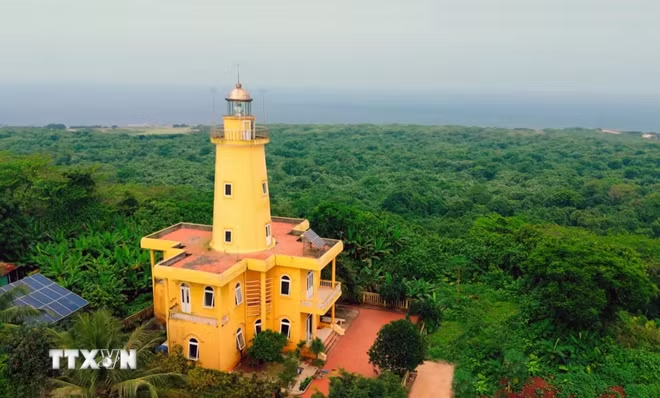
At the community level, according to the Director of the Quang Tri Provincial Center for Investment, Trade and Tourism Promotion, encouraging local people to participate in tourism – from homestays to food and beverage services and experiences – is gradually forming a local ecosystem.
In attracting investment, local authorities are actively reviewing and proposing mechanisms that are appropriate to the specific conditions of the frontier island, gradually removing barriers for businesses.
The development of tourism in an ecological and sustainable direction, linked to the conservation of resources and historical values, has also been clearly defined. While these movements have not yet created dramatic changes, they are contributing to laying the foundation.
From a planning perspective, Mr. Pham Hai Quynh, Director of the Asian Tourism Development Institute, believes that priority should be given to removing traffic bottlenecks – a key factor in forming a stable tourist market.
According to Mr. Quynh, it is necessary to increase the frequency and quality of high-speed boats, ensuring stable operation even in not-too-unfavorable weather conditions. Simultaneously, infrastructure should be developed in an ecological and environmentally friendly direction; prioritizing suitable accommodation models such as bungalows and homestays, incorporating green technology.
Another important direction is to develop in-depth tourism products, such as experiential tours like "A Day as an Island Soldier," "Journey to Discover the Green Island," or "Night Scuba Diving," in order to extend the length of stay and increase spending by tourists.
"When these elements are implemented in a coordinated manner, Con Co Island can absolutely become a unique destination – rich in historical value and attractive for its ecological experiences," Mr. Quynh commented.
Clearly, "opening access to the islands" is not just about adding a few more ferry trips; it's a comprehensive solution – encompassing infrastructure, products, mechanisms, and organizational approaches for development.
Recent developments are creating initial momentum. Con Co Island is no longer waiting, but is gradually "paving its own path." And if the "bottlenecks" are properly and effectively addressed, Con Co Island can completely move beyond its "slow-moving" state and embark on a different journey – a journey to assert its position on the map of Vietnam's island and coastal tourism./.
Lesson 1: "The Green Gem" in the Middle of the Ocean
Article 3: A mechanism to break free from limitations is needed for the "green gem" to shine.
Source: https://www.vietnamplus.vn/mo-loi-ra-dao-danh-thuc-tiem-nang-post1104971.vnp




































![[Video] Sunset at Lap An Lagoon – Where the sun sets over the fishing nets](https://vphoto.vietnam.vn/thumb/1200x675/vietnam/resource/IMAGE/2026/05/31/1780192137701_beach-landscape-sea-water-nature-grass-745871-pxhere-com.jpeg)
























Comment (0)