

A unique communication tool.
Located about 40km from the center of Hanoi , Da Chat village (Dai Xuyen commune, Phu Xuyen district, Hanoi) still preserves a unique language system that only the villagers understand. It's a type of slang, which the villagers call "Toi Xuon".
According to cultural researchers, the slang in Da Chat village is closely linked to the daily life of the rice mill makers. In the past, farmers had to use mills to separate the husks from rice grains, so the bamboo rice mill was an indispensable tool. That was also the period when Da Chat mill makers traveled far and wide to practice their craft. Each Da Chat mill-making team consisted of two people, often wandering through villages for months at a time. Traveling to many places, meeting many people, and relying on homeowners for food and lodging, they needed a "secret code" to protect each other and to minimize inconvenience and trouble when private communication was necessary.
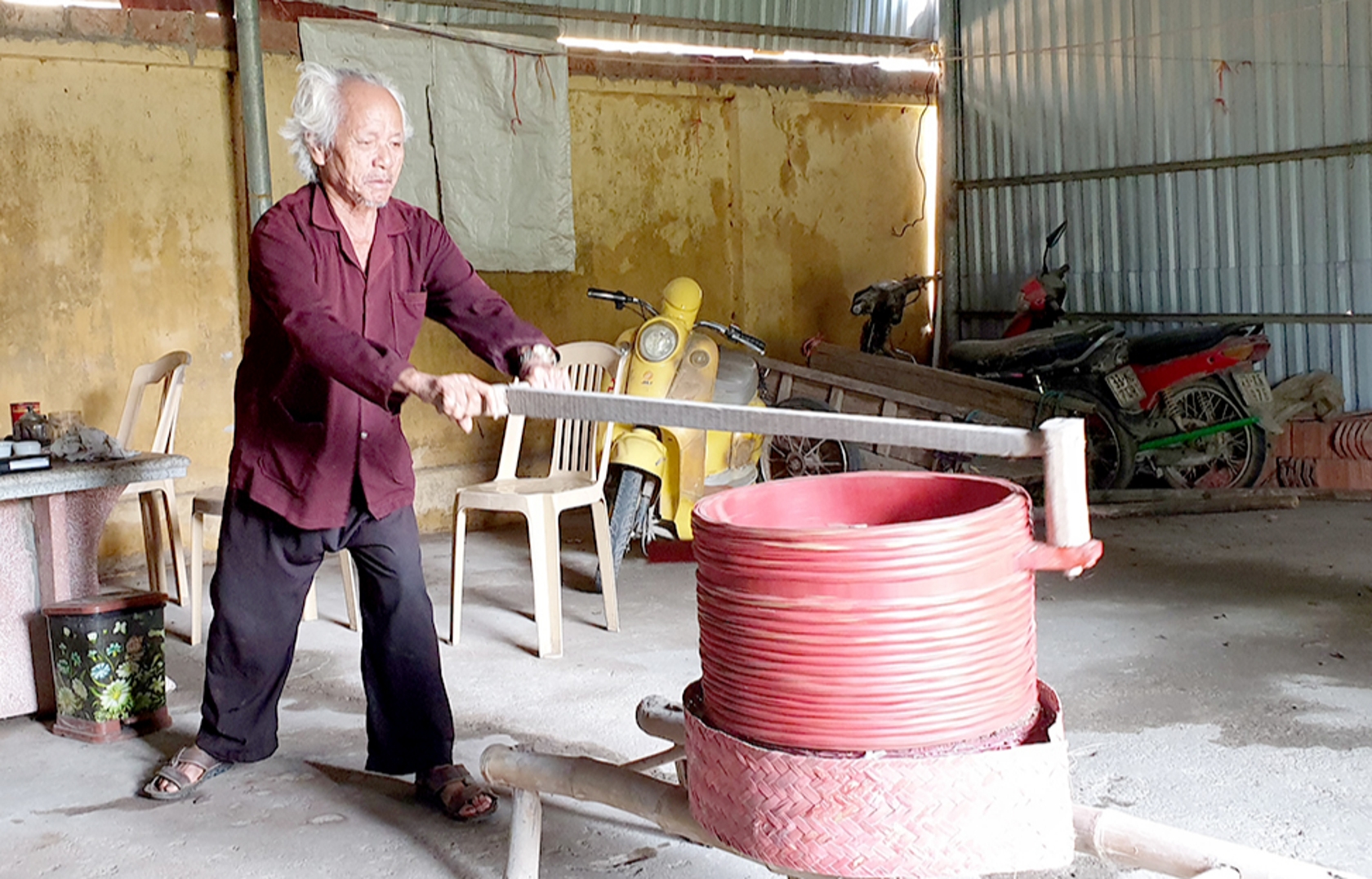
Mr. Nguyen Ngoc Doan, who was healthy a few years ago and could "demonstrate" the rice milling process, is now old and frail and can't remember many slang terms.
Having spent many years accompanying his father to various places to make mortars, Mr. Nguyen Van Tuyen, the head of Da Chat village, recounts that the equipment of two mortar makers always consisted of two baskets containing clothes, daily necessities, and a few knives, hammers, chisels, and other tools. The master craftsman carried a saw on his shoulder, and as they walked, they would call out, "Anyone need a mortar made...?" When someone called to hire them, along with negotiating the wages, they also had to agree on food and lodging. For two people, making a mortar could be completed in half a day, but the mortar makers had to work all day so they could sleep overnight at the employer's house and then leave the next morning to find another one. Living and sleeping on borrowed time like that, the mortar makers always had to be humble and discreet in their conversations.
It was in such an environment that slang was born and passed down among the mortar makers of Da Chat, gradually becoming a unique language over time. According to a survey by the Center for Research and Promotion of Cultural Heritage Values, although it is not an ancient language because it has no phonetic rules, the vocabulary of Da Chat slang is sufficient for daily communication.
The mortar makers can speak this language fluently based on oral tradition and apply it to specific situations. The Da Chat mortar makers say "bet" means house, "thit" means food and drink, "dum" means money, "man" means water, "choang" means beautiful, "em" means delicious, "thuon" means good, "son" means to go, "suon" means machinery… For example, if the host treats them to a delicious meal, the mortar maker will comment: "This 'bet' is very good, it's so 'thit' so smooth" (This house is very rich, they give such delicious food). When guests come to the house, the Da Chat people say "Xao son cho xi nhat dang" (Go buy your father a chicken, we'll butcher it). When traveling by train or bus, if the mortar makers see theft, they remind each other "xao top hach," meaning "there's a thief"…
In the 2000s, the cultural sector of Ha Tay (formerly) researched and collected slang from Da Chat village, compiling over 200 of the most commonly used words, which were printed in the book "Folk Culture of Da Chat Village". In 2014, the Center for Research and Promotion of Cultural Heritage Values came to Da Chat to carry out a research and preservation project on slang, collecting and adding 114 more slang words and phrases along with 35 contexts in which slang is used.
According to Mr. Tuyen, since 2000, when machines replaced bamboo mills, mill-making artisans no longer had a place to perform. The disappearance of the mill-making craft meant that the slang no longer had a suitable environment to exist and develop. However, the slang is still used by older people in Da Chat when they sit down for tea, reminiscing about old times, or by a few families when they have guests. Notably, when they leave the village, older people in Da Chat still use the slang to communicate with each other in necessary situations.
The risk of extinction is evident.
However, Mr. Tuyen, like many other residents of Da Chat, believes that the Da Chat slang is currently in danger of disappearing. The most experienced mortar makers who could speak the slang have either passed away or are too old and frail. The younger generation, who were once mortar makers, can only speak 50-60% of the slang as their predecessors. This number is small, perhaps only around 10 people left. The younger generation is not taught or practiced regularly, so they only use a very limited number of words.

Old-time millworkers like Nguyen Van Minh, Nguyen Van Tuyen, Do Duy Cu, etc., only used slang when sitting together drinking tea and reminiscing about the old days.
In 2016, the Hanoi City Department of Culture conducted an inventory of intangible cultural heritage in the area. The results showed that the practice space for the Da Chat slang had narrowed, and the number of people able to practice the heritage was decreasing. Therefore, the Hanoi Department of Culture and Sports included the Da Chat slang in the list of 11 cultural heritages requiring urgent protection. The agency also planned to prepare a dossier to propose to the Ministry of Culture, Sports and Tourism to include the Da Chat village slang in the National Intangible Cultural Heritage list.
However, since then, the slang heritage of Da Chat seems to have been forgotten. The people of Da Chat say that, except for a few visits by experts and researchers to survey the village and gather information, or occasional press visits to collect material for articles, there has been nothing new regarding the preservation of the slang. To this day, all they have is a single book, "Folk Culture of Da Chat Village," printed in 2007. Mr. Nguyen Van Phuong, former Chairman of Dai Xuyen commune, vaguely remembers that about 10 years ago, a delegation from the Center for Research and Promotion of Cultural Heritage came to the commune to study the slang.
“At the end of the project, at a conference held in the commune, they announced they had written a book and made a 20-minute video about the slang of Da Chat village. But that was all. We never saw the video, nor did we know what the book said. And for over a decade, no one has said anything more,” Mr. Phuong said.
According to Mr. Tuyen and Mr. Phuong, fundamentally, from ancient times to the present, the government has not implemented any methods of preservation; it has mainly been preserved by the people themselves through oral tradition passed down through generations. Recently, after recognizing the slang as a valuable local heritage, the villagers have widely taught it to everyone, including those traditionally forbidden by custom, such as daughters or women from outside the village who marry into the family. As a result, more people know the slang, but because it is a spontaneous activity, lacking a structured approach and regular practice, those who are taught can only speak a few words haltingly.
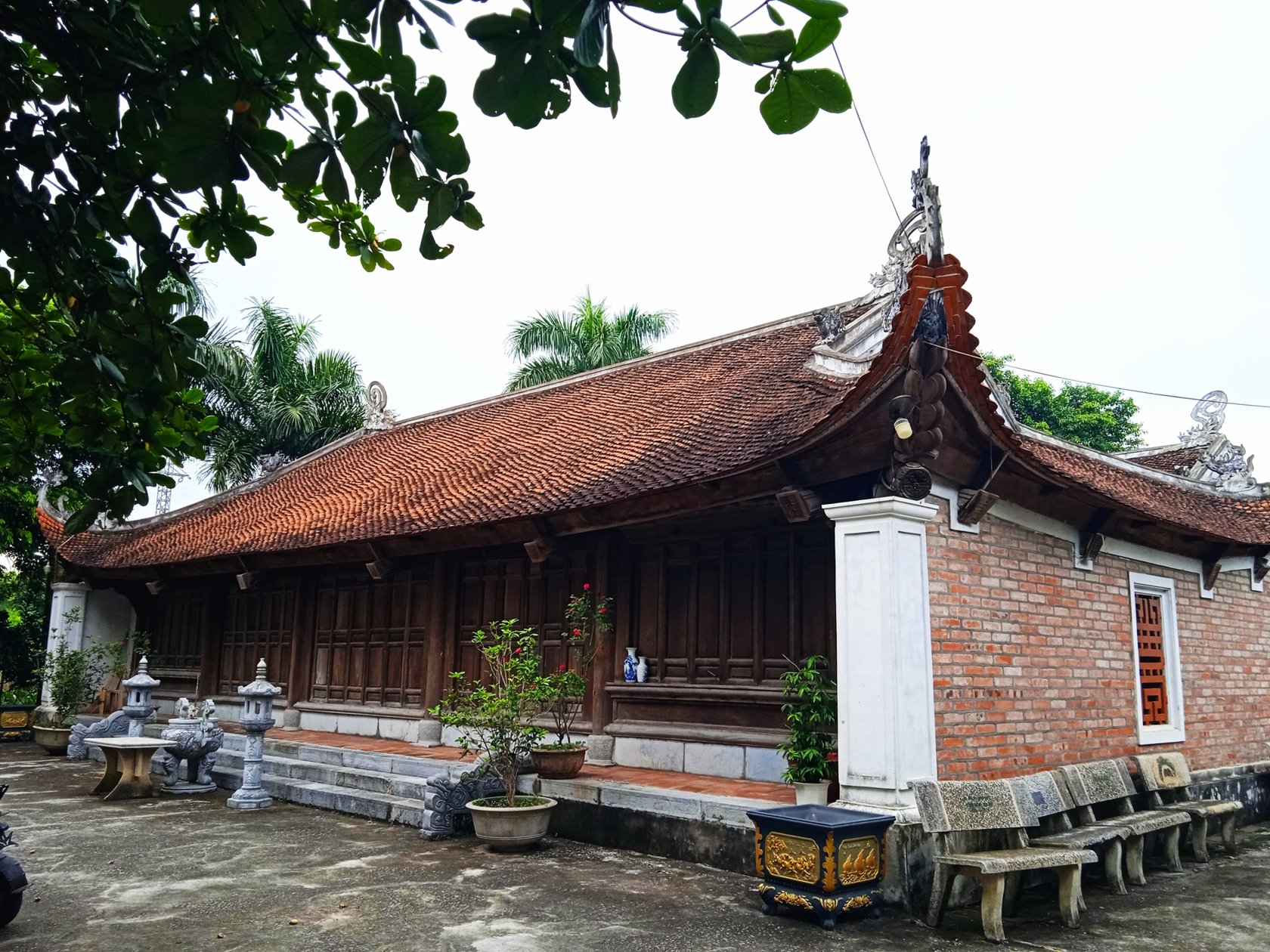
The communal house in Da Chat village is approximately 500 years old.
During a research trip to Da Chat to study slang, Associate Professor Dr. Nguyen Van Huy, Deputy Director of the Center for Research and Promotion of Cultural Heritage Values, suggested that the village could establish a slang club and organize regular activities and exchanges. He also suggested that the local government should plan to create a small space in Da Chat village to display and demonstrate the craft of mortar making and slang, so that cultural stakeholders can preserve and protect their heritage. However, according to Mr. Tuyen, these activities have not yet been implemented due to various obstacles.
“The people of Da Chat village are still deeply worried that their heritage will gradually fade away. Our wish is that one day, the slang will be included in the list of National Intangible Cultural Heritage. Only then will the difficulties and obstacles be removed, making it easier for us to preserve the precious heritage of our ancestors,” Mr. Tuyen shared.
The Vu
Source: https://www.congluan.vn/tieng-long-lang-da-chat-di-san-bi-bo-quen-post307771.html
![[Photo] Prime Minister Pham Minh Chinh receives the Chinese Ambassador to Vietnam](https://vphoto.vietnam.vn/thumb/1200x675/vietnam/resource/IMAGE/2026/04/05/1775397481797_ndo_br_dsc-5512-jpg.webp)

























































































Comment (0)