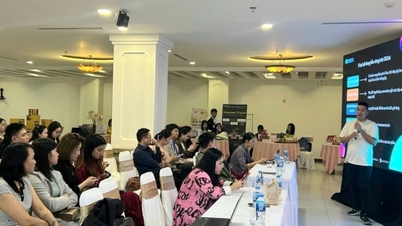
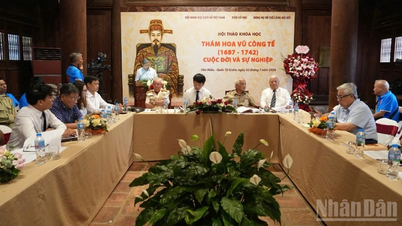
That was the opinion of most delegates at the seminar "Revenue in the Digital Age: Not just advertising, newspapers must sell more," held within the framework of the National Press Conference on the morning of June 20th.
Authenticity: The core strength of journalism.
Associate Professor Dr. Le Hai Binh, Permanent Deputy Minister of Culture, Sports and Tourism, shared his views on the rapid evolution of global journalism and media. He affirmed: "Currently, up to 40% of readers still prefer to seek out mainstream media."
The good news is that not only older readers but also young people want to hold a printed newspaper in their hands and feel the smell of fresh ink – an experience that seemed to belong only in nostalgia.
Deputy Minister Le Hai Binh cited the impressive story of a nearly 1km long line of people, mostly young people, queuing to receive a special edition of Nhan Dan Newspaper commemorating the 50th anniversary of the Liberation of the South and the reunification of the country. This is a clear sign that readers' trust and attachment to mainstream journalism remain very strong, not only among older readers but also among the younger generation.
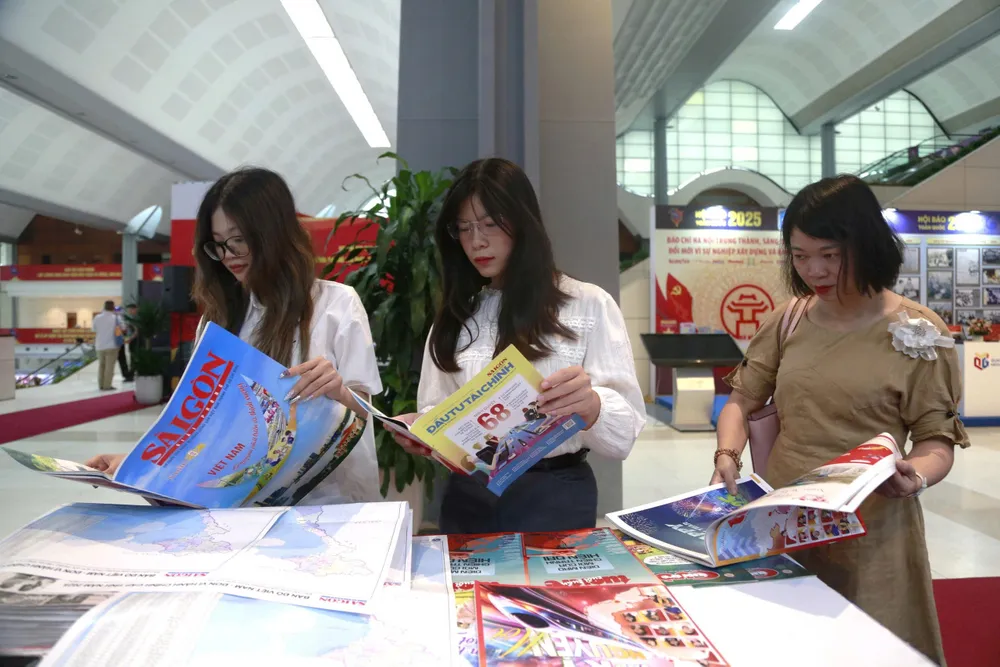
Continuing the discussion on trust, Dr. Le Quoc Vinh, a communications expert and Chairman of Le Group of Companies, pointed out that journalism is facing many major challenges, including the explosion of the digital space, changes in public information consumption habits, challenges regarding revenue and business models, and the issues of trust and fake news. However, in an era where speed of information is paramount on social media, traditional journalism has a significant advantage in terms of authenticity.
According to Mr. Le Quoc Vinh, the biggest challenge facing journalism today is "reclaiming public and reader trust based on truth." He explained: "Journalists cannot be as fast as those on social media, because every piece of information must go through a rigorous process of research, verification, and censorship. Meanwhile, on social media, anyone can post whatever they have, even sharing rumors they hear." It is this careful approach that creates the unique value of mainstream journalism.
"The press must also be a beacon when the public is uncertain, not knowing whether the information they read on social media is true or false. They must turn to the press to confirm whether that information is trustworthy. That is the power of the press...", emphasized Dr. Le Quoc Vinh.

From "writing well" to "making a living," journalism is forced to change.
In the context of declining traditional advertising revenue and increasingly fierce competition from digital platforms, journalism – while still considered an anchor of trust and a channel for verifying information – cannot simply remain a news outlet. Journalism must create value, proactively propose solutions, and reshape its business model to become self-sustaining.
Mr. Nguyen Van Ba, Editor-in-Chief of VietNamNet newspaper, emphasized: "If we consider journalism a profession, then like any other profession, it must be self-sustaining. It cannot live on ideals forever. It cannot survive without a cash flow." According to him, journalism is no longer just about "writing well and working quickly," but must solve the crucial problem of survival: how to survive on the value it creates?
"Journalism shouldn't just sell news; it needs to leverage additional services such as in-depth information, strategic consulting, event organization, data provision, brand building, and most importantly, selling trust," Mr. Bá emphasized. This represents a complete transformation in the operational and business mindset of journalism.
Further analyzing the business model, Ms. Phan Dang Tra My, Deputy General Director of Strategy at VCCorp, argued that the press currently lacks content but rather commercializable products. The traditional advertising sales model is outdated as users shift to interactive, two-way platforms, while businesses need measurable communication solutions.
"The press needs to shift its focus from publishing news and selling advertising to providing integrated marketing solutions and building brands for businesses. If the press itself doesn't properly value its own worth, don't expect the market to do it for you," Ms. My said.
Many new models have been suggested: charging membership fees for exclusive content, organizing in-depth events, developing e-commerce or affiliate marketing based on a loyal readership. Mr. Tran Xuan Toan, Deputy Editor-in-Chief of Tuoi Tre Newspaper, affirmed: "The sustainable revenue of journalism must come from reader payments. As was done with print newspapers before, online newspapers and digital platforms must also be able to do this."
However, according to Mr. Toan, this cannot be achieved by a single newspaper alone; it requires the joint efforts of the entire industry. "Clearly, international newspapers thrive thanks to their readers, generating millions of dollars in revenue each month. Why can't we do the same?" he questioned.
Meanwhile, Mr. Mai Ngoc Phuoc, Editor-in-Chief of the Ho Chi Minh City Law Newspaper, shared that in the context of difficulties faced by print newspapers, online newspapers and social media have become the main sources of revenue. “We have about 1-1.2 million readers per day on our online newspaper and 5 million views per day on social media. Thanks to this, we attract advertising and media coverage.”


Another source of revenue is collaboration with technology companies. However, "the biggest challenge is innovating technology to keep up with the needs of readers and businesses," Mr. Phuoc said.
Chairman of the Vietnam Journalists Association , Le Quoc Minh, also emphasized: "Promoting policy communication is necessary, but it should not become a 'request-and-grant' mechanism. Ministries and sectors that see effectiveness will proactively allocate communication budgets for the press."
He also urged Vietnamese businesses to allocate a reasonable advertising budget to domestic media: "If businesses only see short-term gains and spend on foreign platforms because they are cheaper, they will lose the place that can protect them. Nurturing the press is a practical way to invest in the safe and long-term development of the business itself."
Source: https://www.sggp.org.vn/diem-neo-niem-tin-cua-ban-doc-post800329.html