Providing a good quality of life is essential for effective teaching and learning.
Upon entering the school grounds, one is immediately greeted by a lush, clean environment. Shade trees are neatly arranged in rows. Flowerbeds and ornamental plants are meticulously trimmed and cared for. Inside the buildings, from the offices to the teachers' meeting room, everything is tidy and orderly. Notice boards, work schedules, and areas for storing documents and books are all neatly organized, with carefully written notes, setting a good example for the students. The classrooms and student dormitories, both indoors and outdoors, are spotless, free of dust, and the tiled floors are spotless. From the playground to the cafeteria and the clothes drying area, everything is clean. The school assigns each class responsibility for specific areas, and the students voluntarily maintain cleanliness and hygiene according to a schedule. Both the boys' and girls' dormitories are clean, shoes are neatly arranged, and blankets and sheets are folded according to a common pattern, a habit they have cultivated. The two classes share a washing machine so the children can take turns washing and wringing their clothes to dry quickly, especially in foggy and humid conditions. The kitchen has a charcoal stove to heat water for the children to take turns bathing every two days. In the dining hall, the tables are clean and neatly arranged. Plastic chairs are stacked tidily. The kitchen uses gas stoves, which are clean, tidy, and safe. The cooks, wearing protective clothing and aprons, are dividing rice and food into trays. Each child has their own tray with compartments for rice, soup, and savory dishes, all with lids. Opening one tray reveals perfectly cooked, fragrant white rice, a compartment for cabbage soup, and a compartment for braised tofu. The cooks say that providing enough rice and food for the children is essential – clean, relatively tasty, and something they constantly remind each other to do. After eating, the class on duty washes the trays and dishes under the guidance of the cooks. Leftover rice and food are neatly disposed of in a bin to feed the pigs. The kitchen regularly buys pigs to fatten them up, and the pigsty is very clean. Every two or three days, they slaughter a pig to provide meat and fat for meals. Because of this care in terms of food, shelter, and bathing, the children are all healthy and have rosy complexions. For several years now, none of them have dropped out of school or asked to leave to go home. On weekends, most of them stay at school to play and study, only occasionally visiting their parents. The school takes good care of their lives so that they love their school and class and excel in their studies.
A bright spot in terms of overall educational quality.
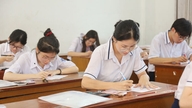

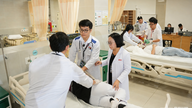
In the years when the quality of primary education in the mountainous areas was poor, the school faced great difficulties in providing the children with the necessary support to keep up with the curriculum. Some years, the school had to make the children relearn the knowledge from grades 4 and 5, and practice speaking, reading, and writing. In recent years, all the mountainous communes have achieved universal primary education at the appropriate age, and enrollment now combines selection based on academic records with knowledge tests, resulting in better quality in the first grade. However, the children... They still face many difficulties in establishing routines in the new environment and struggle to acquire knowledge and practice to achieve a solid foundation of knowledge and excel. After many years of effort, the school's teaching staff all possess solid knowledge, experience, and methods for educating and training students from ethnic minority groups in the highlands. Above all, the teachers love their students. Each teacher is committed to teaching subjects, providing extracurricular education, and caring for the students' well-being as professional activities. All teachers work two shifts at school, with assigned roles for managing and guiding students' self-study in the evenings. Outside of regular classes, the students study independently and are very self-disciplined. The school leadership stated: After one semester, the 6th-grade students recruited from the villages have developed good habits and routines. After completing the 6th grade, students' knowledge is supplemented and reinforced, ensuring they can absorb new material according to general requirements; some students begin to show strong abilities. From the 7th grade onwards, all students at the school meet the required knowledge and skills standards. They developed quite well, and many became good students.
Visiting any of the students' rooms, one can see that they live and work in an orderly manner. They know how to introduce themselves fully and clearly, using words and pronouncing them quite accurately, and each of them is innocent, smiling, and confident when chatting with visitors. Initially, they are educated and trained in life skills through in-class and extracurricular learning and through the organization of daily life activities. When they first... At the age of 11, living away from their parents with friends and teachers, these children have become well-behaved and disciplined, which is the result of the school's excellent education and upbringing.
In the first semester of the 2010-2011 school year, 88% of students received a good conduct rating, the rest were rated fair, only 1 student received an average rating, 15 students received an excellent rating, 121 students received a good rating, 48% received both good and excellent ratings, and only 6% received a poor rating. In 2009-2010, the school had 10 students participating in the district's team for the provincial-level excellent student competition, with 4 students winning awards, including 3 first prizes and 1 second prize. In the entrance exam for grade 10, the school ranked first among ethnic boarding schools and 24th among all junior high schools in the province. In this year's provincial-level excellent student competition for junior high school students, the school had 16 students participating in the Muong Khuong district team, the highest number among all schools in the district.
Looking back at the results from previous years, Muong Khuong Ethnic Boarding School has trained many excellent students who continued to excel in high school. Notable examples include Sung Sau, a Mong ethnic student from La Pan Tan, who went on to study at Viet Bac Ethnic Boarding School, won third prize in the National Biology Olympiad, and is currently studying at Hanoi Pedagogical University; and Vang Seo Quang. He passed the entrance exam to the Public Security University. Lu Van Duong, an orphan, passed the entrance exam to Northwest University, and is an example of overcoming hardship; to this day, he still receives encouragement and support from his teachers…
Through persistent and well-directed efforts, Muong Khuong Ethnic Boarding School has achieved National Standard School status, becoming a shining example of comprehensive educational quality among ethnic boarding schools and junior high schools in the province.



Cao Van Tu - Provincial Association for the Promotion of Learning
Source: http://laocai.edu.vn/tin-noi-bo/diem-sang-ve-chat-luong-giao-duc-142676











































































![[Live] Exchange program “80 Years of Keeping the Oath” commemorating the 80th anniversary of the People's Security Force's traditional day.](https://vphoto.vietnam.vn/thumb/402x226/vietnam/resource/IMAGE/2026/07/02/1782997764964_truc-tiep-nbsp-w1200t0-di2626d272d4194258t13840l1-banner-80-nam-n2.webp)