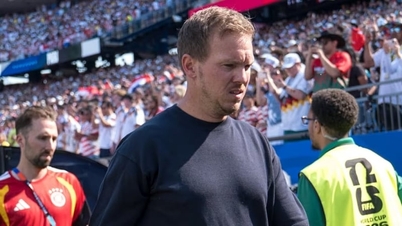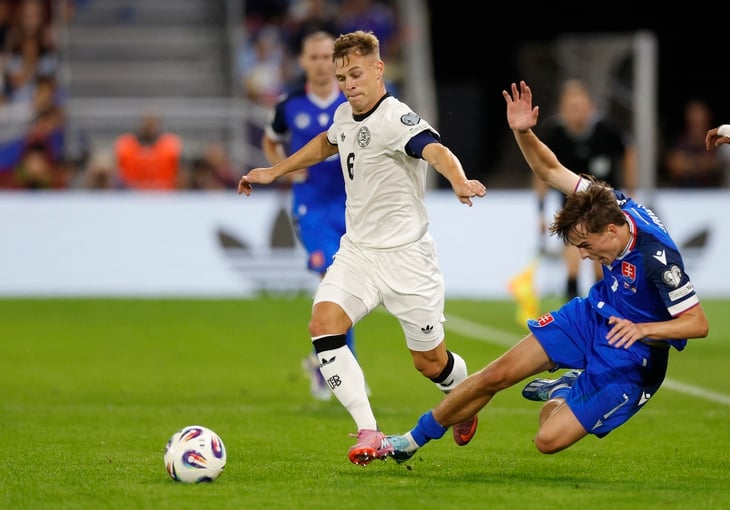
Even stars like Kimmich (left) were helpless - Photo: REUTERS
In the early hours of September 5th (Vietnam time), the German national team suffered a stunning 0-2 defeat against Slovakia in their first match of the 2026 World Cup qualifiers.
Risk of missing the World Cup
First, let's talk about the unpredictability of World Cup qualifiers. FIFA's increase from 32 to 48 teams also increased the number of qualifying spots for various regions.
Specifically, Africa's ticket allocation increased from 4 to 8.5; Asia's from 4.5 to 8.5; South America's from 4.5 to 6.5... But Europe's only increased from 13 to 16 tickets - an insignificant increase compared to the very uniform increase across the continent that leads the world of football.
Furthermore, UEFA has made the competition even more complicated by dividing the groups into smaller ones. In previous qualifying rounds, Europe was divided into 10 groups, with 5 to 6 teams in each. This time, however, there are 12 groups, with 4 to 5 teams in each group.
Although the overall standard of European football is becoming more even, one problem persists: there are still too many "underdog" teams. A prime example is Group I of Italy. Despite having five teams, two of them, Estonia and Moldova, only participate in the qualifying rounds to "make up the numbers."
Similarly, Germany's Group A includes Luxembourg, one of the weakest teams in Europe. And Northern Ireland is only slightly better.



Therefore, the match between the remaining two teams, Germany and Slovakia, will decide the top spot in the group, which means a direct ticket to the 2026 World Cup finals. Each group only has one direct ticket, and a single misstep will mean no chance of recovery.
The harshness of the European qualifiers is quite different from South America, where Brazil could comfortably play poorly throughout the first half of the season and still secure qualification a few matches early. Germany, on the other hand, is currently trembling at the prospect of having to play in the play-offs.
Coach Nagelsmann is in danger.
Furthermore, the 0-2 defeat against Slovakia was a heavy blow to hopes of a resurgence for German football.
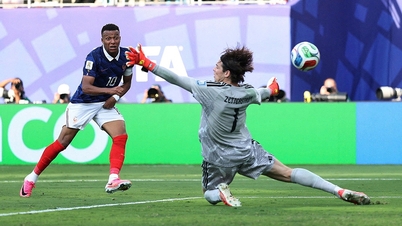
Before entering the 2026 World Cup qualifiers, Nagelsmann's team had already caused great disappointment with two consecutive defeats against Portugal and France in the UEFA Nations League. At that time, German fans were still patient because they were only losing to the strongest teams in the world. But losing to Slovakia was the final straw.
Coach Nagelsmann tried to inject new life into the national team. Against Slovakia, he fielded Collins, Stiller, and Woltemade – young stars who have emerged in the last year or so. The German strategist also ruthlessly dropped players who were no longer suitable, such as Sane and Can. But all of that remained the same; the German team still played completely poorly.
Their attack lacks a true playmaker with Musiala sidelined by a long-term injury. Their forwards are also struggling to score goals without Havertz for the same reason. And their defense consistently plays as if they're half-asleep.
German fans can't help but feel bitter when they look at the fact: they no longer have a striker who has ever scored... 15 goals for the national team. From Fullkrug, Woltermade to Beier, Undav... Havertz is often criticized for being "clumsy," but at least he scored 20 goals in 55 appearances for the national team, while the current German strikers are far inferior to Havertz.
While Germany's current generation of players may lack talent, that's no excuse for their convincing defeat to Slovakia. Across German fan forums and groups, coach Nagelsmann is beginning to face immense pressure.
There was a time when "Die Mannschaft" fans believed Nagelsmann was steering the team in the right direction, after a relatively impressive Euro 2024 campaign. But once again, Nagelsmann crumbled just as he was beginning to build trust.



At 38, Nagelsmann is even younger than many former star players when he embarks on his coaching career. But the Germans are beginning to question: Is their manager perhaps past his prime?
Nagelsmann rose to prominence in his early 30s managing Hoffenheim. He reached the pinnacle of success at the age of 35 with Leipzig, then unexpectedly failed at Bayern Munich. And now, he's running out of ideas at the age of 40.
Nagelsmann's decline is similar to the inexplicable slump of the German national team after Euro 2024 – something that the football world has yet to explain.
Source: https://tuoitre.vn/dieu-gi-dang-xay-ra-voi-tuyen-duc-20250906105552813.htm