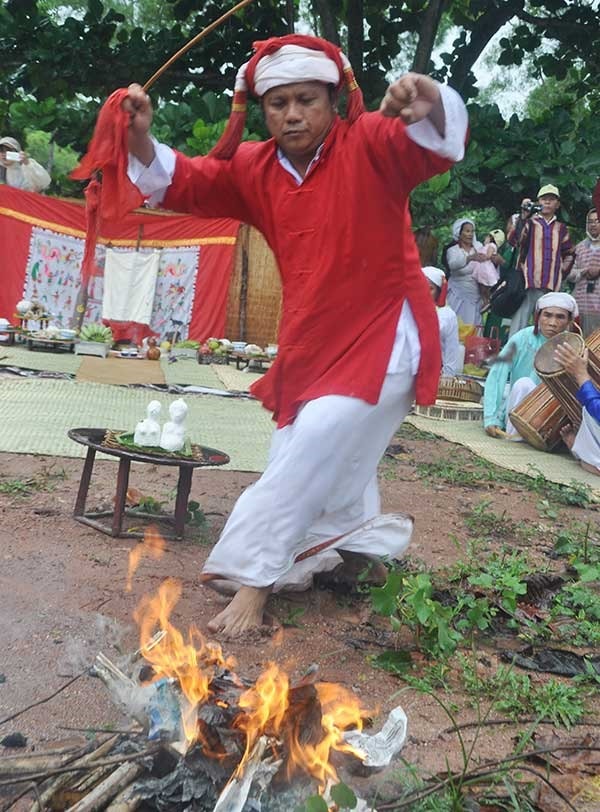
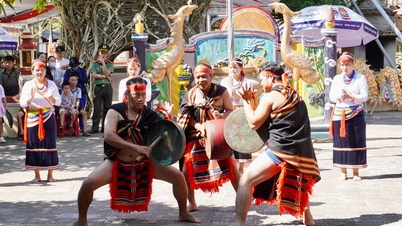
The whip dance or fire-stepping dance of the Cham people at My Son.

 Báo Quảng Nam•01/04/2025
The whip dance or fire-stepping dance of the Cham people at My Son.
In previous years, the My Son Relic Management Board invited researchers and artists to stage an art performance program integrating various forms of Cham folk performance such as chanting prayers, singing hymns to deities, ritual dances, and ceremonial music. These are folk art forms commonly performed at temples and towers during major community festivals. Performances are held almost daily at the performance hall and the G tower group, especially those catering to tours with many foreign tourists visiting the relic site. Notable performances showcasing the rich Cham culture include: offering dances, water-carrying dances, Apsara dances, fire-biting dances, Saranai horn playing, Ghi Nang drumming, and Paranung drumming…
The offering dance is a sacred dance performed in honor of the deities at the temples and towers. Cham dancers often carry candles, water, flowers, fruits, betel nuts, etc., on their heads to offer to the gods. The objects they carry are three-tiered Thong hala, also known as the "betel nut offering," because the offerings are mainly betel leaves shaped symmetrically like a work of art. This is the symbol of the great goddess Po Bar Gina of the Cham people. In the Ka Tê festival at the Po Klong Girai tower, the offering dance is a very important and sacred ritual. The girls dance in front of the tower, carrying offerings on their heads, scarves draped over their shoulders, and fans in their hands. The fan dance is also called Tamia tadik. The dancers move to the rhythm of drums and trumpets, their hands skillfully controlling the fans to open or close them, either in pairs or one open and one closed. The ceremonial dance has become the essence of the intangible cultural heritage of the Cham people, which is why choreographers have adapted it into unique dance performances at the My Son temple complex.
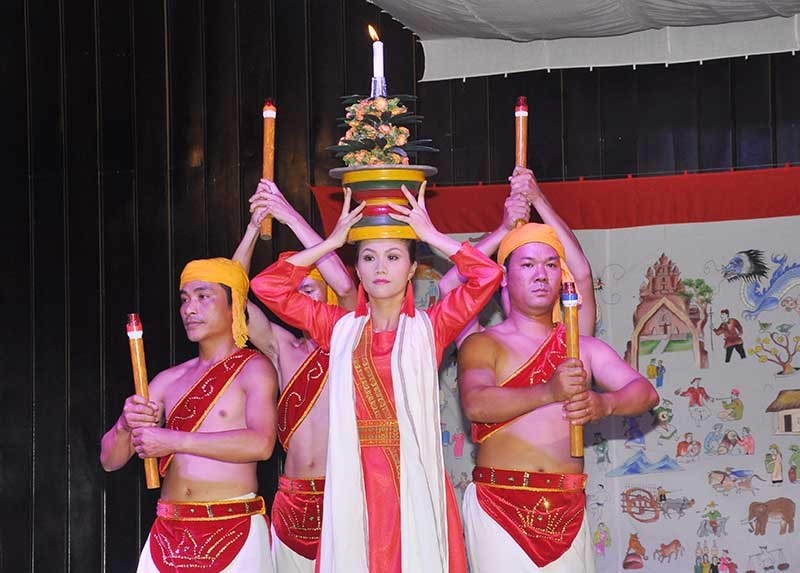
The ceremonial dances in the Ka Tê festival are performed at the My Son performance hall.
Another unique dance of the Cham people is the water-carrying dance, or the jar-carrying dance, which the Cham call Tamia dwa buk. Girls carry ceramic jars (pụ) or trays (ka ya) filled with fruit on their heads. According to researchers, this dance originated from the Thong hala dance (betel nut offering) during the ceremony of offering holy water to the tower, and then combined with the act of carrying water jars in daily life. Besides carrying offerings on their heads while walking and dancing, the Cham people often organize competitions to showcase their skill in carrying objects. Water-carrying and jar-carrying competitions are often held during festivals. This is a rather attractive and engaging game that young Cham girls offer to tourists during these celebrations.
Ritual dances also include Tamia carit - sword dance, Tamia jwak apwei - fire-stepping dance, or whip dance. The dancers are usually male, performing vibrant, powerful, and highly exciting movements, symbolizing a general charging into battle, ready to overcome all difficulties and hardships. Ritual dances also include three consecutive dances in the Cham festival called Pa déa, meaning hospitality - offering gifts to thank the king deity Pô Klong Girai and the Mother Goddess Pô Inư Nưng Cành. The female shaman (Mú Bajau) will perform the ritual and present three consecutive dances: Lang hláu dance (opening and closing skirt dance), a dance expressing the wish for life to flourish and procreate with a fertility meaning; Ké pui dance (fire-biting dance), a dance expressing a lifelong vow of loyalty to the community and the deities; The Choa Ba Tai dance (rice-trampling dance) is a dance performed by a deity named Po Ki Nonh Mu Tri, who tramples rice so that it falls to earth to nourish people.
The fire-biting dance is the most distinctive. The dancer holds three candles, each nearly half a meter long, bundled together in her palm. She holds the three candles in her left hand and measures their length with her right hand. After measuring, she brings the three wicks together and places them into the flame of another candle. When the three candles are burning brightly, the sounds of gongs and paranung drums begin. The dancer, playing the role of the spirit medium, starts dancing back and forth, spinning around with the three burning candles. Finally, the flame from the three candles is brought to her mouth, extinguished, and the sacred ritual concludes. Particularly noteworthy are the chanting and prayers, praising the deities, performed by elderly Cham palay performers from Ninh Thuan.
Cham art performances for tourists add to the attractiveness of the My Son relics. Contemporary Cham culture is contributing to the beautification of My Son, helping to preserve and promote the finest intangible cultural heritage of the Cham people.
Source: https://baoquangnam.vn/dieu-mua-cham-giua-my-son-3027597.html

























































Comment (0)