


The War Remnants Museum ( Ho Chi Minh City) - a place that exposes the crimes of the American imperialists during the war in Vietnam. Photo: Khoi Nguyen
Escalation of war
"Special War," a war strategy that the American ruling class hoped would lead to victory and the imposition of a long-lasting neocolonial regime on our country. This strategy rested on three solid pillars: the army, the puppet government, and the "strategic hamlets." These elements were sustained by abundant aid in money, weapons, and modern equipment, along with an increasingly large contingent of American advisors. However, facing the large-scale People's War, especially after the victories at Ap Bac (1963), and then Binh Gia, Ba Gia, and Dong Xoai (summer 1965) by the Liberation Army, the "Special War"—a form of "disguised" aggression by the American imperialists—failed. More importantly, the failure of the "Special War" also served as a warning about the failure of the United States in the Vietnam War.
Faced with this situation, President L. Johnson and key officials from the White House, the Pentagon, and the CIA agreed that maintaining the Saigon government was essential to demonstrate to the American people, allies, and enemies the image of a superpower. From then on, the US objective was to reverse the downward spiral of South Vietnam by using American troops to wage war in the South; simultaneously, expanding the bombing of North Vietnam until the US achieved victory. The US government believed that bombing would be a leverage to stabilize the Saigon government and boost the morale of the South Vietnamese army to continue the war. Along with bombing North Vietnam, combined with deploying US expeditionary forces and troops from dependent countries to directly participate in the South Vietnamese battlefield, the US completely replaced the "special war" strategy with a "local war" strategy.
On March 8, 1965, two US Marine battalions (numbers 1 and 3) of the 9th Marine Expeditionary Brigade landed in Da Nang, officially beginning the deployment of combat troops to South Vietnam. Following this, on April 1, 1965, L. Johnson decided to send an additional contingent of US combat troops to Vietnam and reinforce air and naval forces to attack North Vietnam. The US National Security Council concretized L. Johnson's decision into 11 implementation measures in Memorandum No. 328-NSAM dated April 6, 1965. Implementing the decisions in Memorandum No. 328-NSAM, by early May 1965, US combat forces present in South Vietnam included 7 Marine battalions, one ground artillery regiment, and one squadron of F4 (Phantom) fighter aircraft. Furthermore, on July 17, 1965, L. Johnson approved the proposal to increase troop numbers to 44 battalions and the "Search and Destroy" plan of General W. Westmoreland (at that time the head of the US Military Assistance Command in Vietnam), ordering the deployment of 34 US battalions (approximately 100,000 troops) to South Vietnam, with the remainder to be sent in later.
This decision by L. Johnson brought the United States "across the threshold of entering a land war in Asia." It was also a crucial turning point marking a shift in the US imperialist policy of escalating the war of aggression in Vietnam. With the "Limited War" strategy, in which the US military played the primary strategic role in directly conducting the war, the struggle between the Vietnamese people and the US imperialists became the culmination of a "historic confrontation."
With this extremely dangerous escalation of the war, the US imperialist plot was to create a new strategic position, proactively encircling and isolating the Vietnamese revolution in the South. From there, they aimed to create a strong impediment to prevent the collapse of the Saigon government and army in the shortest possible time. At the same time, they intended to intensify bombing of the North, exhausting the potential of the large socialist rear area and undermining the determination of the Party and people to fight for the liberation of the South and the reunification of the country.
Take the initiative and resolutely fight against the Americans.
Drawing on the experience of our ancestors' millennia-long tradition of fighting invaders and defending the country, and especially under the courageous and strategic leadership of the Party and President Ho Chi Minh, our people entered the "historic confrontation" with the American imperialists with a proactive and resolute spirit.
In early July 1965, the Politburo issued a resolution shifting the organizational focus, concentrating leadership on the economy and national defense. On July 20, 1965, President Ho Chi Minh issued an appeal clearly stating the determination of the entire Party, people, and army: “Faced with the threat of the American aggressors seizing our country, the people of the North and the people of the South unite as one, resolutely fighting; whether we have to fight for 5 years, 10 years, 20 years, or even longer, we are determined to fight until complete victory!” His appeal ignited the resistance determination of the entire nation.
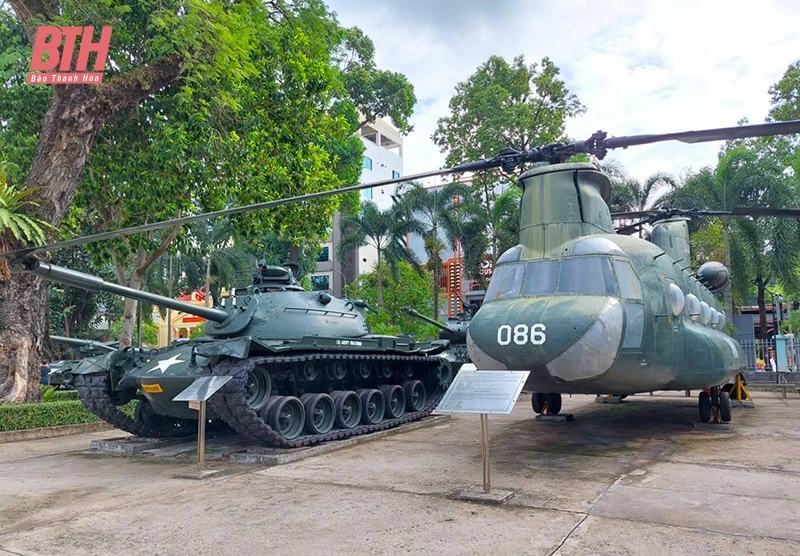
The M.48 A3 Tank and the CH-47 Chinook helicopter – modern weapons used by the US military in the Vietnam War (exhibits on display at the War Remnants Museum, Ho Chi Minh City).
To lay the foundation for the fierce and arduous struggle, the rear area was the decisive factor. Without a strong rear area, the front lines could not defeat the enemy – especially the American imperialists, the most powerful imperialist power in the world. President Ho Chi Minh clearly stated: “To build a good house, you must build a solid foundation. To have a strong tree, with fresh leaves, beautiful flowers, and good fruit, you must diligently care for and cultivate the roots. The North is the foundation, the root of the struggle to complete national liberation and achieve national reunification. Therefore, everything we do in the North is aimed at strengthening the forces of the North and the South.”
With that spirit, the northern localities were reorganized and streamlined to suit the wartime economic shift and readiness to fight and support the battlefields. A patriotic emulation movement, with each person working twice as hard for the beloved South, was vigorously launched. Movements such as "Three Ready" among youth; "Three Capable" among women; "Three Determined" among intellectuals; and "Emulation for Victory and Determination to Defeat the American Invaders" among the armed forces developed strongly. Millions of young men and women volunteered to join the army and the youth shock troops... In the South, responding to President Ho Chi Minh's call, 14 million people declared their stance: "We would rather die than be enslaved; we will fight to the end to defend the Fatherland and achieve complete independence... Whether they send 50,000 or 500,000 troops, regardless of their weapons, or wherever they set foot on Vietnamese territory, we will resolutely defeat them, fighting until not a single invader remains on our beloved land!"
Not only was the entire Vietnamese people united in their determination to fight the Americans and their will to win, but the preparation of forces was also particularly important. Given the urgent situation of the revolution in the South, the Party sent Comrade Nguyen Chi Thanh, a member of the Politburo; Comrades Tran Van Tra, Chu Huy Man, and Hoang Van Thai, members of the Central Committee; along with Comrades Le Trong Tan, Hoang Minh Thao, and several other high-ranking officials, to reinforce the South, Zone 5, and the Central Highlands. At the end of 1964, the main regiments from the North were also secretly ordered to march into the battlefield. Simultaneously, the Politburo and the Central Military Commission decided to open the Central Highlands Front, preparing in advance so that if the American troops entered the South, they could be stretched thin and drawn into the mountains and forests to fight.
In particular, by thwarting the US imperialist "Special War" strategy, a solid and interconnected people's war posture was established in all three strategic regions. Our armed forces, comprising three branches, developed proportionally and grew significantly stronger compared to the early years of the war. In 1964, the revolutionary armed forces of the South (including only the main forces) had 11 regiments and 15 battalions. By the end of 1965, this had expanded to 5 divisions and 11 infantry regiments, with many battalions and regiments of technical branches equipped with relatively modern equipment. In Zone 5, the Central Highlands, and Tri-Thien, special forces battalions 406, 407, 408, 409, 487... were units with extensive experience in attacking enemy rear bases. In addition to the mobile main force, each province had 1 to 2 battalions; Each district had one to two companies, along with hundreds of guerrilla platoons and squads operating alongside the enemy, supporting the political struggle movement and countering the enemy's pacification efforts...
When deploying American combat troops to Vietnam, US strategists calculated that at most 175,000 troops would be enough to win. However, by the end of 1965, the US and its allies had deployed 200,000 troops to South Vietnam, fully equipped with the most modern weapons and technical equipment. The US command in Saigon, under orders from President L. Johnson, launched the entire force into the first strategic counteroffensive (dry season 1965-1966), launching massive attacks in five directions across two battlefields: the southeastern region and Military Zone 5. But wherever they went, they were decisively defeated by our army and people. This initial victory firmly consolidated the confidence of our army and people in defeating the US imperialists and their puppets in any situation of the war.
With the proactive approach on the battlefield and the "interlocking" strategy of the three branches of the armed forces, we maintained the initiative in attacking the enemy, opening the Route 9 - Northern Quang Tri front. Building on this resounding victory, the Liberation Army continued to defeat the US's "two-pronged" search-and-destroy and pacification strategy in the 1966-1967 dry season counter-offensive. At the same time, we thwarted the US's escalating war of destruction against North Vietnam (1965-1966). With these extremely important and glorious victories, the army and people in both North and South Vietnam, under the leadership of the Party and President Ho Chi Minh, brilliantly accomplished their mission. This was winning the first round in the "historic confrontation" with the US imperialists, thereby creating a new strategic opportunity to shift the revolutionary war in the South to a period of decisive victory.
Khoi Nguyen
(This article uses material from the book "History of the Resistance War against the US, for National Salvation 1954-1975, Volume IV").
Source: https://baothanhhoa.vn/dinh-cao-cua-cuoc-dung-dau-lich-su-246043.htm
![[Photo] Prime Minister Pham Minh Chinh receives the Chinese Ambassador to Vietnam](https://vphoto.vietnam.vn/thumb/1200x675/vietnam/resource/IMAGE/2026/04/05/1775397481797_ndo_br_dsc-5512-jpg.webp)








































Comment (0)