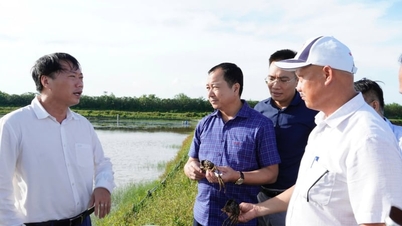
" The lute plays a resounding tune - I still love you, my friend, please don't get married yet."
For some inexplicable reason, while crossing the Vu Gia River, I stopped to rest, exhausted. A man selling "Saigon bread for three thousand dong a loaf" rode past, his loudspeaker, the size of a water jug hanging from the handlebars of his motorbike, blaring out a traditional Vietnamese folk song, specifically those two lines. Oh my God, instantly I was transported back to my days of wandering through the Mekong Delta...

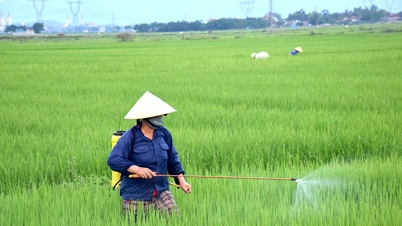
A woman who spent her life rowing a boat on the Vu Gia River - Photo: LTV
That day, we took a ferry across the Hau River from the northern bank of Can Tho . On the other side was Binh Minh commune in Vinh Long. Getting off the ferry, the engine roared, and there was a bustling crowd of people and vehicles. There was an old blind beggar playing a fiddle. His singing was emotionless but melancholic. My friend said, "I have a younger sister who married someone far away. She hasn't been back home for a long time. I occasionally ask her how she's doing, and she says it's all the same. Hearing the old man sing, I remember her marriage. Honestly, people in this world live full of illusions and suffer, but she's not delusional, yet she's still doing poorly. I know her way of saying 'it's all the same' so well."
Back then, she went to Saigon to study and then returned to her hometown to look for work. She passed the entrance exam, but somehow her boyfriend, who later became her husband, persuaded her to go back to Saigon. My hometown is full of red soil and rubber trees, really, my family is very poor. Buying a bicycle when I went to high school was a big deal for the whole neighborhood. But I hardly ever rode it; I mostly pushed it, rolling up my pants to shove it. Mud stuck from the rims to the seat, staining my white dress.
When she registered for the university entrance exam, my mother said, "What major should you study that will make it easy to find a job after graduation? I don't have any money to bribe anyone." She was pretty, intelligent, and stubborn, like a malfunctioning machine; sometimes she was as silent as a clam, her face as cold as a bomb's bottom, other times she spoke without restraint, her voice fluctuating between soft and sharp. A fortune teller said her fate was not good. But she passed. My mother and I went to find accommodation, wandering around Saigon for three days, and then we settled down.
I don't know what kind of side job she does to make a living, probably like other students from the provinces, studying during the day and working part-time at night, because the money back home is only enough for rent each month. Every time she comes home for Tet (Lunar New Year), her friends gather for class reunions and ask, "Hey, do you have a boyfriend yet?" She says, "There are plenty of guys, you guys worry about being single, not me!" A few years after graduating, she fell for a guy who also studied in Saigon. They got married.
That guy's hometown is way out in the Mekong Delta, my mother was in tears when she took her daughter to her husband's house. She said she had to cross the ferry several times, and she couldn't even remember the way to visit her daughter. Why did she have to go so far away? How would she find her daughter then?


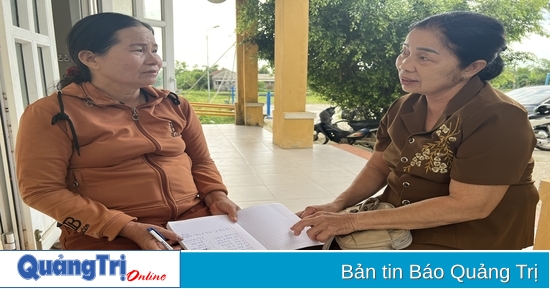
It was the first time I'd seen her sobbing. I only found out she was married, but back home she had a boyfriend. I don't know if they dated while she was here, but one day he got drunk and stood in front of my house singing, "The zither plays loudly on the lute - I still love you, my friend, don't get married yet..."
I was about to cross the river, my friend's voice echoed. The story had this epilogue: afterwards, my younger sister divorced her husband because they weren't compatible. When I asked her about her marriage, she said it was her private matter, and I shouldn't ask. I felt sorry for her, but I had no choice.
Well, I guess I have to accept it. Books are like life; there are private feelings that cannot be expressed. But now, like this river, or the northern bank of Can Tho, there are no more ferries or boats crossing.
The boats sank at the dock, literally and figuratively. It marked the end of a life of wandering the rivers and seas. I pictured that girl, her life like the monsoon season, the nights of heavy rain. Anyone who goes to the Mekong Delta during the rainy season will see endless fields shrouded in mist.
In a warm home, the hearth of husband, wife, and children lulls the wind and rain into a gentle comfort, while the songs and music create a tumultuous, turbulent rhythm. I wonder if she is like others, alone, braving the harsh winds, unable and not knowing where to lean, sometimes saying she doesn't need to, but I believe that's the AQ (a metaphor for self-preservation) of this earthly world: a boat without a crew will sink on its own. The shadow falls on the lamppost; looking at her own reflection on the wall, it will fade away when she can't resist the urge to sleep, but night after night, that shadow will eventually fade into the dawn.
Life, when we isolate ourselves, sometimes reveals the truth behind Che Lan Vien's lines, "Centuries crowded with people, yet humanity deserted," or Phu Quang's song, "The crowded streets are devoid of human faces." Many times, swept along by the torrent of people in Saigon, I see only shadows, illusions. Lonely shadows, unknown to one another, groping their way to some unknown destination, bestowing blessings or reproaching themselves.

Upstream of the Vu Gia River - Photo: LTV
Once, someone asked me, "Which came first, the shadow or the figure?" I was about to answer by considering the combination of parental DNA or the theory of heaven, earth, and humanity, but he laughed: "Try walking into a supermarket or office where the automatic doors open. Because of the cameras, you'll know immediately that the machines capture your moving shadow first, then identify you as someone else. From there, you'll know what came first." But life is like that. Knowing what old age will bring makes youth useless. Knowing love can be bitter, what's the point of being infatuated? Knowing life is full of sorrows, joy becomes meaningless. Oh, if you still love someone, hold off on getting married. Everyone regrets the golden days, but once you're involved, you'll face hardship, storms, and the ups and downs of life—who can say no?


What a pitiful fate for humanity. We set out on this journey without knowing the future. Life teaches us wisdom, and we should cherish what we learn; as for tomorrow and the day after, we'll deal with that later. Knowing we are like shadows, yet we cannot resist. There was a time when criticism of women drinking alcohol was rampant, especially in the city, when they were seen sitting, either with men or with other women, or even alone, smoking and drinking like everyone else. Vietnamese people have an unpleasant habit: if something seems strange or displeasing today, they bring up past events to preach morality.
Li Bai wrote, "Raising a cup to love the bright moon - Facing the shadow makes three people," speaking of the swaying loneliness of human existence in the presence of the moon, oneself, and one's shadow. He was intoxicated by the ethereal wine, a lifelong intoxication for him. But a woman like my friend, there are tens of thousands in this world like that. Who dares say that looking at one's own shadow cast upon a cup of sorrowful wine in the cold attic at midnight, one doesn't have the right to be sad, to live with one's own shadow, to invite oneself, without needing or needing the moon and stars, for they are meaningless? Sometimes the shadow guides them through the storms of everyday life to a distant place, sinking into infinity, or struggling to survive the sun and rain day and night, or they love themselves to live. My dear, don't get married yet, sometimes not because of me, because too much is too much burden...
Thinking of that, I stopped abruptly, looking down at the Vu Gia River during the flood season. The water was murky, slowly and relentlessly flowing towards the sea. There were no ferries crossing the river. It was evening. From the solitary bamboo grove on the Dai Lan side, a crow darted out, flying towards the mountains, and then, as if by magic, a small boat, like a leaf, leisurely rowed upstream. On the boat were a woman and a child. I mused that the high tide wouldn't begin until after the Hour of the Tiger tomorrow morning. There were two people on the boat, presumably mother and child. This stretch of the river was wide, not unlike a branch of the Mekong Delta I'd missed for years, a place I hadn't returned to drink wine and watch the water hyacinths drift by. I remembered that day at Phu Dinh wharf on Tran Xuan Soan street in District 7, sitting on a boat with Mr. Bay Huong, a merchant from Vinh Long who came to Saigon to sell flowers and fruits. Drunk and tipsy, his wife said, "Go to sleep, my dear," and then she started singing: "The bitterns call when the tide rises, my dear - Buying and selling, profit and loss, rowing is exhausting..."
Memoirs of Le Trung Viet
Source