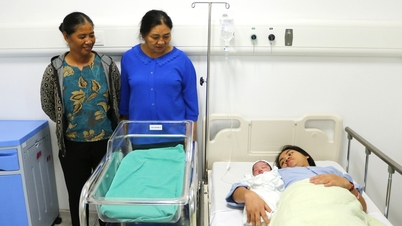
Although women can become pregnant from the time they start menstruating until before menopause, experts say that not all periods offer the same chance of conception. Age directly affects the ability to conceive as well as the risk of complications during pregnancy.
According to obstetrician-gynecologist Jacqueline Zuponcic of Cleveland Clinic (USA), the right time to have children depends on each family's health, financial situation, work, and plans.
Why does fertility change with age?
Women are born with a full complement of eggs they will use throughout their reproductive lives. At birth, the ovaries contain approximately 1 million eggs. By puberty, this number decreases to around 300,000 and continues to decline over time until menopause.
Not only the quantity, but also the quality of eggs gradually decreases with age.
According to Dr. Zuponcic, when women reach the age of 35 or 40, the eggs have been in the ovaries for decades, making it difficult to maintain the same quality as when they were younger.
"The microscopic machinery inside the ovaries responsible for dividing the egg's genetic material becomes less efficient with age. This increases the risk of producing eggs with chromosomal abnormalities, thereby increasing the likelihood of miscarriage or having a child with a genetic disorder," Dr. Zuponcic explained.
 |
If women plan to have children, they should do so early. Photo: Shutterstock. |



Is it harder to get pregnant after age 35?
According to the Cleveland Clinic, fertility begins to decline around age 30 and accelerates after age 35. However, Dr. Zuponcic emphasizes that 35 is not an absolute "boundary."
"Many people believe that it's almost impossible to get pregnant after turning 35, but that's not true. Nothing special happens exactly on your 35th birthday. However, the risk of pregnancy increases with age, and conception also becomes more difficult," the expert said.
Pregnancy after age 35 increases the risk of several complications for both mother and fetus. For the mother, the risks may include:
- Gestational diabetes.
- High blood pressure.
- Miscarriage.
Meanwhile, the fetus is at higher risk for:
- Congenital defects.
- Genetic disorders such as Down syndrome.
- Low birth weight.
- Premature birth.
- Treatment must be provided in the neonatal intensive care unit.
When should you see a doctor if you're planning to have a baby?
Experts recommend that those planning to become pregnant should discuss their pregnancy with their doctor from the very beginning of the planning process, especially if they have chronic illnesses or a history of conditions affecting fertility. The doctor can assess risk factors, provide reproductive health advice, and order necessary tests if appropriate.
For those who don't plan to have children right away but are concerned about future fertility, doctors can also advise on options such as preserving fertility. However, egg freezing is not recommended solely due to age, but is usually reserved for cases where there is a risk of ovarian damage due to chemotherapy or other specific medical conditions.
There is no "perfect age" for all women.
According to Dr. Jacqueline Zuponcic, biologically speaking, the late teenage years to the late 20s are the period of highest fertility because both the quantity and quality of eggs are at their optimal levels. However, the decision to have children is not solely based on age.



Physical and mental health, financial stability, family relationships, and personal desires are all important factors. Therefore, there is no "perfect age" that applies to all women; it's crucial to choose the time that best suits your circumstances and is fully prepared in terms of health and pregnancy planning.
Source: https://znews.vn/do-tuoi-sinh-con-tot-nhat-post1663995.html