


The province currently has nearly 700 businesses operating in the garment industry. Compared to other industries, the garment industry requires a large workforce due to its unique processing nature, demanding human skill in cutting, sewing, and finishing, which cannot be completely replaced by machinery. In recent years, the garment industry's production index has shown consistent growth. In the first quarter of 2026, the province's garment industry production index increased by over 5.2%; the consumption of ready-made clothing increased by 10% compared to the same period last year. The garment industry's labor utilization index in the first three months of 2026 showed an upward trend. However, compared to actual demand, the number of workers in the industry still does not meet the requirements of businesses (averaging about 80% of the businesses' labor needs). Many garment businesses report that they regularly post job openings, but at any given time, the number of workers available is always insufficient to meet demand. The main reason given is that garment businesses face fierce competition for labor from fast-growing businesses with better benefits for workers, such as those in electronics, electrical wiring, and household appliances. Another reason why workers are less enthusiastic about garment making is that this profession requires a longer apprenticeship period than other professions.
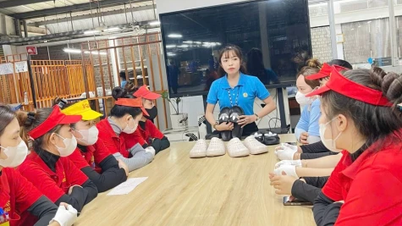
For example, at Seang Corporation Vietnam Co., Ltd., located in the Nhat Tan Industrial Cluster (Kim Thanh Ward), despite having over 300 workers, the company continuously recruits through various methods such as distributing flyers, posting recruitment notices, and broadcasting announcements on the ward's radio station. Over the years, the company has consistently lacked 15-20% of the workforce needed to meet production demands. Currently, the company needs to recruit approximately 200 more workers to meet order deadlines. Ms. Nguyen Thi Tuyet, Chairwoman of the Trade Union of Seang Corporation Vietnam Co., Ltd., stated: "To meet production needs, the company needs to recruit approximately 400 more workers by the end of 2026. Throughout its operation, the company has never been able to guarantee the required workforce, especially skilled workers in all positions, from cutting and sewing to product finishing." It is known that since its establishment, Seang Corporation Vietnam has always implemented good policies and regulations for its employees, such as paying social insurance, health insurance, and unemployment insurance; organizing annual vacations and health check-ups for employees. The company also maintains a system of gifts and rewards for employees during holidays and festivals, and monthly rewards for diligent workers who achieve high production output. However, the company still frequently faces labor turnover. This situation significantly impacts labor productivity as well as the company's expansion plans.
The labor shortage at Seang Corporation Vietnam Co., Ltd. is a common reality for garment businesses today. Investigations reveal that these businesses are also facing significant labor competition from small-scale, family-run garment factories. In rural areas, the number of cooperatives and family-run garment factories is increasing, attracting a large local workforce. While workers here don't receive the same benefits as those working in companies, they have the advantage of being close to home, convenient transportation, and, most importantly, less rigid working hours and company regulations. Women can use their lunch breaks to do housework and take their children to school. This is a major reason why garment businesses in the province are struggling to attract workers. Mr. Ngo Van Chung, Director of Dung Chung Co., Ltd. (Binh Son commune), stated: "In recent years, the number of workers at my company has continuously decreased." At one point, dozens of workers quit at once, significantly impacting production. In most of the workers' resignation letters, the reason given was a desire to work at a garment factory closer to home so they could better care for their families. The company plans to expand its factory and invest in additional production lines. However, recruitment remains challenging.
Investigations reveal that in some industries such as electronic component manufacturing, electrical wiring, paper production, and plastics manufacturing, the average basic salary and overtime pay for workers in the province's industrial zones reaches 7-10 million VND per person per month. Compared to this level, the wages of garment workers are uncompetitive; this is one of the reasons why the garment industry faces difficulties in attracting labor. To recruit and retain workers, garment businesses need to promote the application of technology in production processes to reduce costs and manpower. Besides paying attention to implementing good policies and regulations for workers, businesses should strengthen the promotion and introduction of recruitment policies to communes and wards in the area; actively coordinate with functional units, vocational training centers, and local political and social organizations to survey job needs, organize vocational training classes, and improve the skills of workers…
Source: https://baoninhbinh.org.vn/doanh-nghiep-may-mac-khat-nhan-luc-260413071532280.html

![[Image] Expediting land clearance at Alley 310 Nghi Tam to facilitate the construction of Tu Lien Bridge](https://vphoto.vietnam.vn/thumb/1200x675/vietnam/resource/IMAGE/2026/04/14/1776160406551_ndo_br_z7724148990408-9e5d4777e3c4504998b4286178b2e66e-jpg.webp)
![[Photo] General Secretary and President To Lam visits and delivers a policy speech at Tsinghua University.](https://vphoto.vietnam.vn/thumb/1200x675/vietnam/resource/IMAGE/2026/04/14/1776164592318_vna-potal-tong-bi-thu-chu-tich-nuoc-tham-va-phat-bieu-chinh-sach-tai-dai-hoc-thanh-hoa-trung-quoc-8700658-5437-jpg.webp)
![[Photo] General Secretary and President To Lam and his wife begin their state visit to China.](https://vphoto.vietnam.vn/thumb/1200x675/vietnam/resource/IMAGE/2026/04/14/1776133794926_z7723148772587-ffefa3c4b1e54e100de1554593a862c6-jpg.webp)














![[Photo] General Secretary and President To Lam receives Slovak Prime Minister Robert Fico](https://vphoto.vietnam.vn/thumb/1200x675/vietnam/resource/IMAGE/2026/04/13/1776080592076_a1-bnd-8227-6002-jpg.webp)



















































Comment (0)