

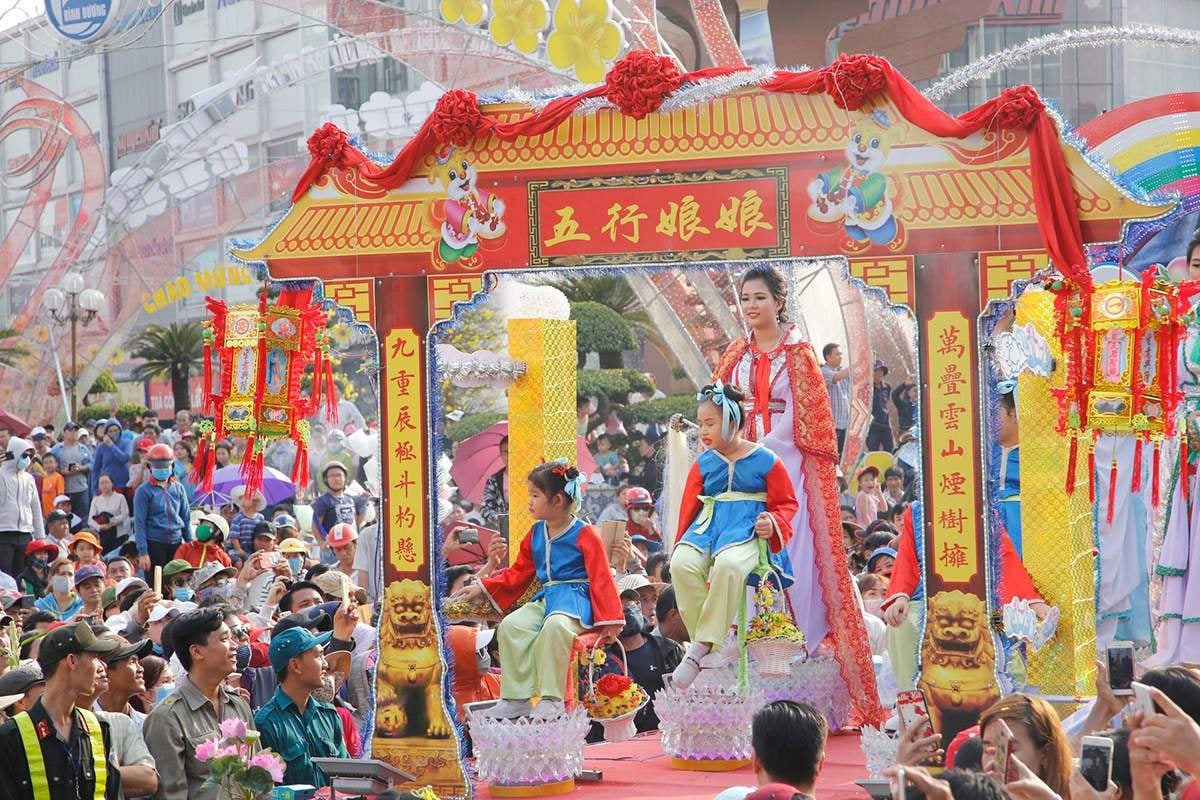
The Thien Hau Temple Festival is not just a simple ritual in the culture of the Chinese community in Binh Duong, but also reflects the profound gratitude of the people of this land towards their ancestors, demonstrating a righteous, peaceful, and enduring way of life, working together to preserve the beautiful spiritual and cultural aspects amidst the ever-changing modern pace of life.
The most famous temple in Binh Duong
The reputation of the Thien Hau Temple (also known as the Binh Duong Temple or Thien Hau Shrine) has long extended far beyond this land. The temple boasts ancient architecture with many distinctive patterns characteristic of Chinese architectural style.
Initially, Ba Pagoda was simply a shrine built to worship Thien Hau, a figure considered a goddess by the Chinese community for her merits in protecting and assisting fishermen at sea, helping them overcome rough seas and return safely to shore.
In 1923, after a fire, the temple was damaged, so the communities of four Chinese ethnic groups—Cantonese, Teochew, Fujianese, and Hakka—joined forces to rebuild the temple. After more than 100 years of existence, intertwined with the ups and downs of the Binh Duong pottery region, the Thien Hau Temple is not only a place of worship but also a tourist attraction thanks to the region's largest festival held annually on the 15th day of the first lunar month.
The festival is rich in cultural and religious traditions.
The Thien Hau Temple Festival usually begins on the 14th day of the first lunar month and lasts for three days, with the third day being the main day of worship. Preparations for the festival are even more bustling than during Tet (Lunar New Year).
Before Tet (Lunar New Year), the grounds of Ba Thien Hau Temple are decorated with flags and characteristic lanterns, stretching from the main gate to the interior of the temple. Twelve large lanterns, symbolizing the twelve months of the year, are hung in a long row, glowing red, in front of the main hall.
Rituals and offerings took place a week before the main procession. During these days, the people of Binh Duong lived in an atmosphere of joy and excitement, eagerly awaiting the region's biggest cultural and religious event.
The procession carrying the statue of Lady Thien Hau officially set off from Ba Pagoda, circling the streets. Crowds lined up to welcome her, forming a long procession accompanied by the lively sounds of drums and lion dances.
Leading the procession were four lion-dragon-shaped mascots – the kings of the beasts. Young men carrying banners and long swords, lion dance troupes, flower-decorated floats, and beautiful young women in vibrant costumes carrying baskets of colorful fabric flowers... all marched to the boisterous sounds of trumpets and drums, filling the entire area with their noise.
The boisterous atmosphere of a procession evokes hopes for an exciting start to the new year, kindling hope with the fragrant smoke of incense that has been burning for centuries.
It is believed that, at the beginning of each year, making a pilgrimage to Thu Dau Mot, and joining the hundreds of thousands of other people respectfully walking on tiptoe to welcome the Goddess, will bring a source of peace and good fortune for the entire year.
Source: https://baodanang.vn/doc-dao-le-hoi-chua-ba-thien-hau-3326117.html














































































Comment (0)