

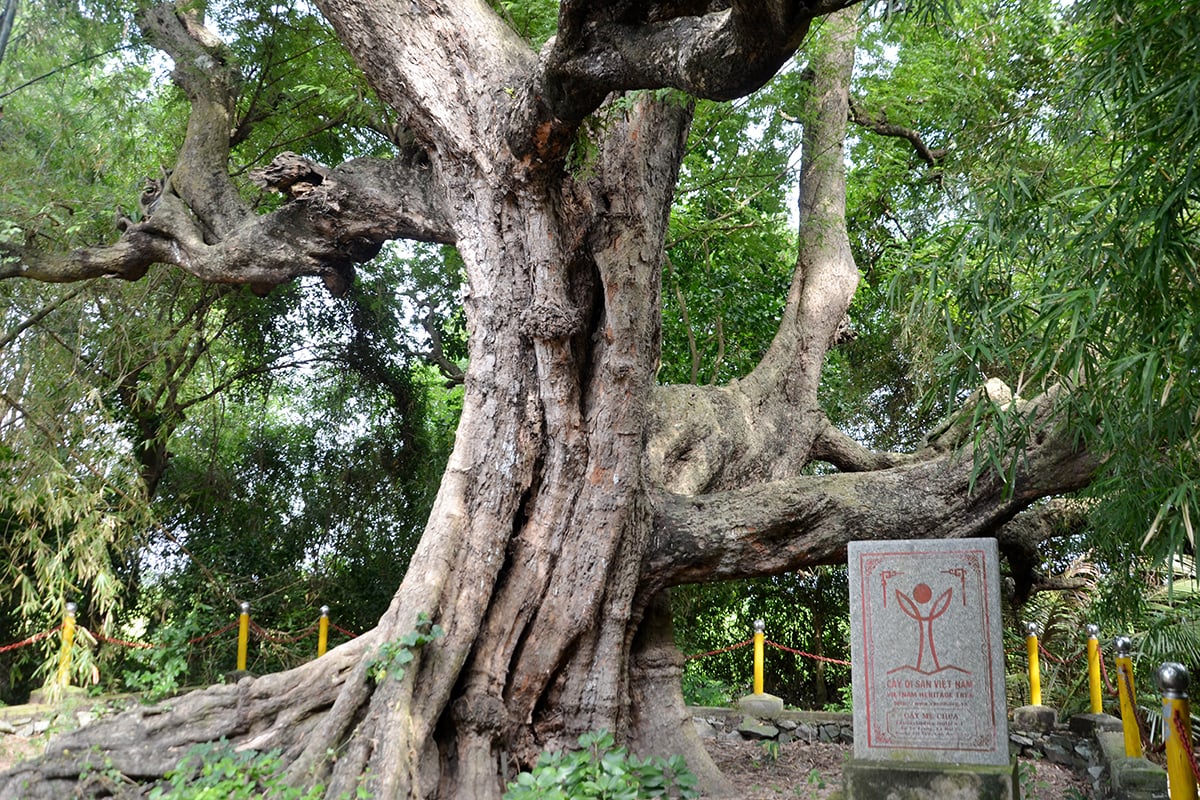
A tamarind tree over 600 years old in Nui To commune (Tri Ton district)
Upon arriving in Tri Ton, almost everyone is amazed by the ancient tamarind tree, over 600 years old, often called the "Big Tamarind Tree" by the locals in Nui To commune. According to the elders, no one remembers when the "Big Tamarind Tree" originated, who planted it, or whether it grew naturally. They only know that they have seen the tree since childhood. The "Big Tamarind Tree" has rough bark, a circumference so large that six adult arms cannot encircle it, and is over 20 meters tall. Its roots are large, protruding above the ground and forming unique shapes. The tree has a very wide canopy, capable of shading hundreds of people. The branches above are also home to many species of birds. Every year, the "Big Tamarind Tree" regularly flowers and bears fruit in abundance.
Many people recount that during the war, the "Big Tamarind Tree" helped shield and protect revolutionary cadres, soldiers, and civilians from enemy raids and sweeps. Over hundreds of years, enduring the harshness of time and countless bullet and artillery marks on its trunk, the tree still possesses immense vitality and stands tall and strong. The "Big Tamarind Tree" is considered a treasure by the local people. Beyond its historical and cultural value, the "Big Tamarind Tree" has also fostered a sense of community and solidarity among the people living together.
In their culture and spiritual life, the Khmer ethnic minority always considers the ancient tamarind tree a precious asset, a symbol of Mother Earth, of community spirit, and a source of spiritual support, protecting the peace and safety of their villages. Ms. Neáng Sóc Phol (Núi Tô commune) shared: “The people cherish the ‘Big Tamarind Tree’ because it has been around for a very long time. Everyone is very conscious of protecting and helping the tree grow. The children in the village occasionally come out to water it and pull weeds around its base… The care of the ‘Big Tamarind Tree’ has been passed down from generation to generation.”
Similar to the "Big Tamarind Tree," but considered the oldest Vietnamese Heritage Tree in the province, the oil tree in To An hamlet (Co To commune, Tri Ton district) has provided shade for over 700 years. The oil tree has few branches, a large trunk, and is over 30 meters tall, reaching straight up to the sky. From afar, its shade covers a large courtyard. Over hundreds of years, the tree's bark has hardened like stone, enveloping the trunk... Nature has also bestowed upon the people of An Tuc commune (Tri Ton district) two lychee trees over 300 years old, yet still bearing surprisingly sweet fruit. Each lychee tree has a trunk so large that it takes three people to encircle it, is over 15 meters tall, and its wide canopy shades a large area of the Svay-Ta-Hon pagoda courtyard. According to the monks and locals, these two lychee trees are very special; in years when both trees bear fruit, the weather is favorable and the harvest is bountiful...
Further south in the delta, there is a cluster of three ancient Lagerstroemia trees, over 300 years old, in Cho Vam town (Phu Tan district), recently recognized as a rare Vietnamese Heritage Tree. No one knows when these three Lagerstroemia trees were planted or grew naturally, but they stand in a perfectly straight line and are evenly spaced. One tree is over 215 years old, and the other two are over 300. Their trunks are large, forming hollow spaces large enough for adults to crawl through. According to elderly residents, the area where these three Lagerstroemia trees grow was once a hiding place for revolutionary cadres and documents during the war. Therefore, this cluster of three ancient Lagerstroemia trees is not only important in the cultural and spiritual life of the local people but also holds precious historical value. All the people here cherish, protect, and care for these Lagerstroemia trees.
Source: https://baoangiang.com.vn/doc-dao-nhung-cay-di-san-o-an-giang-a423227.html


![[Photo] National Assembly Chairman Tran Thanh Man attends the policy seminar to promote Vietnam-Türkiye cooperation.](https://vphoto.vietnam.vn/thumb/1200x675/vietnam/resource/IMAGE/2026/04/16/1776351415367_vna-potal-chu-tich-quoc-hoi-tran-thanh-man-du-toa-dam-chinh-sach-thuc-day-hop-tac-viet-nam-tho-nhi-ky-8705791-jpg.webp)












![[Image] Bridges and roads connecting the eastern part of Ho Chi Minh City](https://vphoto.vietnam.vn/thumb/1200x675/vietnam/resource/IMAGE/2026/04/16/1776328595108_ndo_br_bh-vt5-jpg.webp)





























![[Infographic] Details of the Hanoi-Quang Ninh High-Speed Railway Project](https://vphoto.vietnam.vn/thumb/402x226/vietnam/resource/IMAGE/2026/04/16/1776338188424_anh-man-hinh-2026-04-16-luc-18-16-10.png)
![[Photo] National Assembly Chairman Tran Thanh Man meets with the Speaker of the Georgian Parliament](https://vphoto.vietnam.vn/thumb/402x226/vietnam/resource/IMAGE/2026/04/16/1776338494029_anh-man-hinh-2026-04-16-luc-18-21-21.png)
















Comment (0)