After a year of transitioning the curriculum and examination methods, the efforts of the education and training sector deserve recognition.
The direction of this year's high school graduation exam questions has also shown positive signs. The exam questions for all subjects are gradually reducing rote memorization and focusing more on the application of knowledge and the students' ability to express themselves.
The most noteworthy issue regarding the 2026 high school graduation exam is perhaps the literature subject. While the exam aims for an "open" format, the way the questions are framed might lead students into a familiar pattern: praising efforts to overcome difficulties and achieve success, and then drawing moral lessons from the answers.
When the exam implicitly sets a model for students to strive for, the space for independent thinking is narrowed. Many students easily write in the same style as the model, emphasizing the need to strive, to practice, and to live with dreams – while not wrong, it's difficult to discern whether this is genuine thinking or just pre-rehearsed phrases.
With such an exam format, grading is not easy. The Ministry of Education and Training requires grading "using rubrics and open-ended answers," but how "open" should this be, to what extent should different interpretations be accepted, and how should one distinguish between creative reasoning and arbitrary speculation be distinguished? This is not a simple matter.
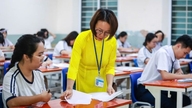
A national exam cannot simply be judged based on whether it is "interesting" or "topical," but must be able to measure, evaluate, and differentiate candidates. If the grading criteria are not clear enough, examiners will inevitably be confused, and exam results may be influenced by regional backgrounds, life experiences, and access to information of the candidates.
Therefore, the distribution of scores in the Literature subject is unlikely to be shocking. Average scores will likely remain dominant, below-average scores will not be too numerous, and good/excellent scores will be very few. What needs attention is the differentiation in the 7-8 point range and the number of papers scoring above 8.5 points. If the score distribution is wide in the average range while high scores are few, it indicates that while the exam helps students avoid low scores, it doesn't necessarily measure independent thinking ability. If an "open-ended" exam ultimately leads to many similar answers, then the exam reform hasn't met expectations.
Therefore, the issue is that exam reform must go hand in hand with testing techniques. High-quality exams should not only inspire students to answer but also accurately measure their abilities. Exams need to be tested with different groups of students, assessing difficulty, differentiation, reliability, and any barriers beyond their academic capabilities. Specifically for the literature exam, the argumentative requirements should be appropriate to the life experiences, practical knowledge, and reasoning abilities of high school students.
After the exam, the score distribution for each subject is important data for reviewing the quality of the exam questions and the grading process. While the score distribution doesn't tell the whole story, it can indicate whether the exam was too easy or too difficult, whether it effectively differentiated candidates, and whether it served both objectives of the exam – fairly certifying high school graduation and providing reliable data for university admissions.
Reforming the examination system is absolutely necessary, but the more reforms there are, the more rigorous they must be. Reformed exam questions cannot simply be "open" in terms of inspiration; they must also be "open" in thinking, clear in grading criteria, and fair in measuring the quality of candidates.
Dr. HOANG NGOC VINH
Former Director of the Department of Professional Education - Ministry of Education and Training

(Source: NLDO)
Source: https://baogialai.com.vn/doi-moi-thi-cu-can-phai-chat-che-post590059.html
![[Photo] Opening Ceremony of the 13th National Congress of the Ho Chi Minh Communist Youth Union](https://vphoto.vietnam.vn/thumb/1200x675/vietnam/resource/IMAGE/2026/06/24/1782286753905_ndo_br_1-8510-jpg.webp)
![[Photo] General Secretary and President To Lam attends the Central Public Security Party Committee Conference](https://vphoto.vietnam.vn/thumb/1200x675/vietnam/resource/IMAGE/2026/06/24/1782302063612_a1-bnd-9302-9166-jpg.webp)

![[Photo] The 13th National Congress of the Youth Union conducts personnel work.](https://vphoto.vietnam.vn/thumb/1200x675/vietnam/resource/IMAGE/2026/06/24/1782299943080_ndo_br_1-6868-jpg.webp)