

The issuance of the Resolution aims to institutionalize the Politburo 's guidelines and address the urgent practical need to remove bottlenecks hindering Hanoi's development. Given that Hanoi is positioned as the political, economic, cultural, and scientific-technological center, playing a pivotal role and acting as a key growth engine for the Red River Delta region and the entire country, piloting new mechanisms is absolutely essential for the capital to successfully fulfill its role.
The draft Resolution proposes many outstanding mechanisms for implementing large and important projects in the capital city, involving many key sectors, with large investment capital, wide scope of impact, and direct influence on socio-economic development. These are groundbreaking policies on decentralization and delegation of power to the capital city's government.
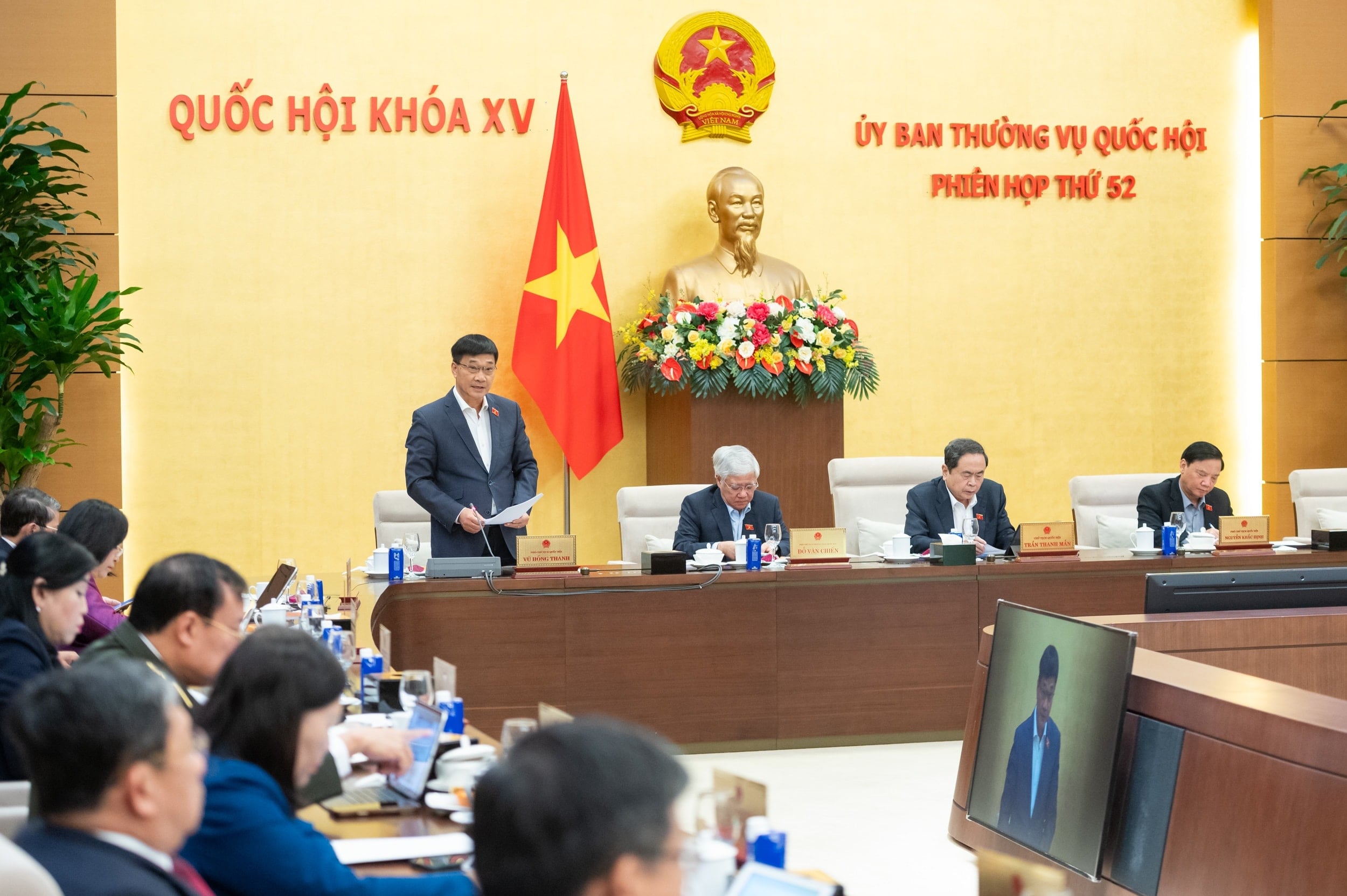
However, at its 52nd session, the Standing Committee of the National Assembly also pointed out many issues that need careful consideration to ensure constitutionality, legality, consistency within the legal system, and to control potential risks arising from granting excessive powers to the capital's government.
For example, a prominent proposal is to significantly decentralize the authority to decide on investment policies to the Hanoi People's Council and the Chairman of the Hanoi People's Committee. This is a reasonable approach to shorten the process, increase proactiveness, and reduce overlap between existing laws. However, such a superior level of decentralization requires extremely strict and effective monitoring mechanisms, especially for projects with large-scale land acquisition and far-reaching impacts on the population, environment, and regional food security. Therefore, reviewing the compatibility of the mechanisms in the draft Resolution with the Capital City Law and related laws and resolutions, as well as draft laws and resolutions to be passed at this session, is a mandatory requirement before the draft Resolution is submitted to the National Assembly for approval.
The proposal to integrate the Capital City Planning and the General Capital City Planning into a single unified plan would help overcome long-standing shortcomings in planning work over the past period. While strongly supporting this proposal, the Economic and Financial Committee, after review, also pointed out several issues that need improvement.
Specifically, it is necessary to review the draft Planning Law and the draft Urban and Rural Planning Law to clarify the position and relationship of the Capital City Master Plan within the planning system, thereby clearly defining the hierarchy and avoiding legal loopholes when conflicts arise between different types of plans. Further review of relevant legal regulations, especially the Land Law, is needed to ensure policy consistency and avoid conflicts and obstacles during implementation. In addition, allowing some projects to proceed before being updated in the plan, while potentially accelerating progress on urgent tasks, also carries the risk of deviating from development direction and disrupting the urban spatial structure.
The draft Resolution also proposes several special, important, and complex mechanisms and policies with a large scope of impact, such as: expanding the cases for land reclamation compared to Article 79 of the Land Law (Clause 2, Article 7), the Governor of the State Bank of Vietnam deciding on the total outstanding credit balance exceeding the ratio prescribed by law on credit (Clause 2, Article 8) and enforcing the debt when 75% consensus is reached (Clause 4, Article 10)...
These issues directly affect the legitimate rights and interests of citizens, national financial and monetary security, and macroeconomic stability. Therefore, a thorough assessment of the legal, economic, social impacts and risks before submitting them to the National Assembly for approval is a prerequisite for ensuring that policies are implemented effectively, without complex complaints or disputes that could affect social stability, public order and security, and public trust, and in accordance with the Constitution.
Overall, the pilot proposals in the draft Resolution are all groundbreaking policies. If well-designed, objectively and comprehensively evaluated, and carefully considered – as requested by National Assembly Chairman Tran Thanh Man – "focusing only on regulating truly outstanding mechanisms and policies that effectively remove bottlenecks, avoiding arbitrary expansion, scattered regulations, and formalism," with transparent conditions and criteria, the Resolution will not only be a catalyst for the strong development of the Capital in the coming period but also ensure the principle of the rule of law and social stability.
In addition, it is necessary to supplement mechanisms for timely post-audit, reporting, and accountability to ensure that decentralization goes hand in hand with the control of power. These are principles aimed at maintaining the unity of the legal system and ensuring that pilot mechanisms truly achieve their stated objectives.
Source: https://daibieunhandan.vn/don-bay-cho-su-phat-trien-cua-thu-do-10399514.html





















































































Comment (0)