


The "Deer farming for antler velvet" model is being implemented for the first time in Tra Tap commune. Photo: MINH TRANG
The people are determined.
Tra Tap commune has a natural area of over 183 square kilometers, mostly covered by forests and vast grasslands, creating a favorable environment for the development of flora and fauna. Recently, the Ca Dong and Xo Dang ethnic groups have taken advantage of this to raise deer, cattle, and goats, and cultivate pineapples and medicinal plants under the forest canopy. In Hamlet 4, Tra Tap commune, a barren field of over 5 hectares has been cleared, and people have cut grass and prepared holes to plant nearly 100,000 pineapple seedlings. Although introduced here many years ago, the pineapple plants have not yet become a commercial product because the people grow them for "self-sufficiency".
According to Ms. Ho Thi Ve, Head of the Front Committee of Hamlet 4, the Tra Tap commune government has implemented a project to support seedlings, provide technical guidance, and encourage people to plant pineapples in a concentrated manner, linking households in groups, aiming to form a specialized cultivation area in the near future.
“By participating in this project, households in village C72 have shown high determination in improving their farmland and investing effort in caring for their crops, hoping that honey pineapples will become their main crop, bringing stable income. The Front Committee of Hamlet 4 has also been assigned the task of supervising and accompanying the households throughout the implementation process, from planting and caring to monitoring growth, to ensure the project achieves tangible results,” Ms. Ve said.
Meanwhile, the people of Mo Roi village (Hamlet 6, Tra Tap commune) eagerly welcomed a herd of 12 deer, the first of their kind brought to the village for breeding. Prior to this, commune officials visited each household, providing guidance on building enclosures, planting grass, preparing feed, and caring for the animals. Mr. Ho Van Hang, head of the deer farming group in Mo Roi village, said that in the past, the villagers mainly raised pigs, chickens, and ducks. Now, receiving a herd of deer for the first time, although somewhat new, has given them considerable reassurance thanks to the training and guidance they received.
“With guidance from commune officials, the people are no longer hesitant to adopt the new model. Through the training process, people understand better how to do business systematically and planfully, no longer raising deer out of habit as before. We expect that the deer farming model will open up new production directions, create more sustainable livelihoods, and allow people to confidently commit to it in the long term,” Mr. Hang shared.

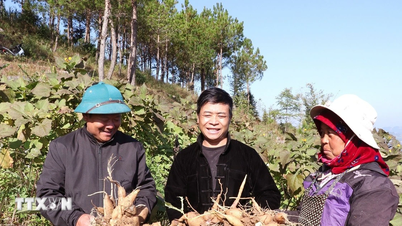
Residents of Tra Tap are enthusiastically participating in the model of growing honey pineapples. Photo: MINH TRANG
Government support
According to Mr. Le Trung Thuc, Chairman of the People's Committee of Tra Tap commune, from national target programs for sustainable poverty reduction and socio -economic development in ethnic minority areas, Tra Tap commune has implemented 10 economic models for nearly 400 participating households, with a total support capital of over 13.5 billion VND. In addition to prioritizing the development of Ngoc Linh ginseng, goat and cattle farming, the commune is also researching new breeds that meet standards for adaptability and economic efficiency.
“The potential is great, but the poverty rate in Tra Tap commune is quite high (32.75%), requiring us to research and implement new models that are both adaptable to nature and create sustainable livelihoods for the people. After sending officials for training and surveying the farming areas, we chose to introduce spotted deer and honey pineapple varieties to the area. Along with that, we mobilized the entire political system to participate in providing technical assistance, encouragement, monitoring the implementation process, and finding suitable markets for the people,” Mr. Thuc said.
In particular, over the past period, the Vietnam Fatherland Front Committee of Tra Tap commune, along with political and social organizations, has implemented a comprehensive and rigorous propaganda work, linking poverty reduction goals with production development orientations suitable to the actual conditions of each village and residential area.
This approach demonstrates the consistent and substantive support of the political system in the context of the two-tiered government becoming increasingly closer to the people, especially in areas inhabited by ethnic minorities who have limited education and production capacity.
According to Mr. Dinh Van Thanh, Chairman of the Vietnam Fatherland Front Committee of Tra Tap commune, as the leading agency, the commune's Fatherland Front has proactively developed a comprehensive plan, clearly assigning responsibilities to specific individuals and tasks, and delegating specific models and projects to political and social organizations and officials in charge of the area, ensuring uniformity in direction and implementation.
“We held meetings and specifically assigned projects to each socio-political organization and individual. This is one of our ongoing tasks, so officials and members have stayed close to the villages, participated in community meetings, and gathered people's opinions. As a result, the implementation of the projects has received high levels of support, and people have actively participated in the models. This is an important foundation for the economic models to be effective in the future,” Mr. Thanh said.
Source: https://baodanang.vn/dong-luc-giam-ngheo-o-tra-tap-3318916.html



![[Photo] General Secretary and President visit the China-ASEAN AI Application Cooperation Center](https://vphoto.vietnam.vn/thumb/1200x675/vietnam/resource/IMAGE/2026/04/17/1776404277677_vna-potal-tong-bi-thu-chu-tich-nuoc-tham-trung-tam-hop-tac-ung-dung-ai-trung-quoc-asean-8706616-2286-jpg.webp)














![[Photo] National Assembly Chairman Tran Thanh Man attends the policy seminar to promote Vietnam-Türkiye cooperation.](https://vphoto.vietnam.vn/thumb/1200x675/vietnam/resource/IMAGE/2026/04/16/1776351415367_vna-potal-chu-tich-quoc-hoi-tran-thanh-man-du-toa-dam-chinh-sach-thuc-day-hop-tac-viet-nam-tho-nhi-ky-8705791-jpg.webp)

















































Comment (0)