

With the involvement of the entire political system, along with support from specific programs, projects, and policies, the socio-economic development of the mountainous region of Thanh Hoa province is being promoted.
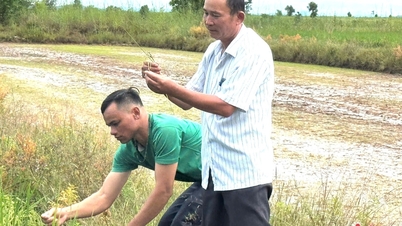
 Ms. Ha Thi Men, from Ban village, Quang Chieu commune (Muong Lat district), is harvesting Cay Noi sticky rice.
Previously, the family of Ms. Ha Thi Men, from Ban village, Quang Chieu commune (Muong Lat district), was among the poorest in the commune. After participating in the Cay Noi sticky rice cultivation model, their economic conditions have improved significantly. Ms. Men said: "My family escaped poverty thanks to growing Cay Noi sticky rice. With 5 sao (approximately 0.5 hectares) of Cay Noi sticky rice, harvested once a year, the yield reaches about 15-20 quintals. After deducting expenses, I save about 20 million VND, which is much more economically valuable than growing corn or cassava."
Muong Lat district has nearly 800 hectares of paddy fields, of which about 500 hectares are planned for growing Cay Noi glutinous rice, concentrated in Quang Chieu and Muong Chanh communes. In 2021, the district's specialty Cay Noi glutinous rice was recognized as a 3-star OCOP product. Currently, the district is implementing policies to support people in building a "Production, processing, and consumption chain for safe Cay Noi glutinous rice" model to help the product gain a foothold in the market.
According to statistics, from 2018 to the present, thanks to government support policies, Muong Lat district has implemented more than 100 projects and production models, including livestock, crop, and forestry projects. These projects have supported thousands of livestock and poultry breeds, such as breeding buffaloes and cows, pigs, chickens, and various plant varieties such as oranges, hybrid peaches, wild apples, taro, lychees, plums, and bitter bamboo. Muong Lat district has also issued a socio-economic development and national defense and security plan for the 2021-2025 period. Accordingly, the district is building production models based on linkages between household economies and businesses, connecting with product consumption on the basis of harmonizing the interests of the "five stakeholders" (farmers, the State, scientists , investors, and businesses); structuring crop areas to suit local conditions; and encouraging and supporting people in livestock farming in the form of farms and family farms. Forestry development should focus on increasing the area of economic forests, reducing the area of biomass forests, and increasing the area of large timber forests to create jobs and improve people's incomes...
With practical and effective solutions, the socio-economic situation of Muong Lat district has seen positive developments. The poverty rate according to the multidimensional poverty standard for the 2021-2025 period (new standard) is 56.18%; the near-poverty rate is 12.64%; over 45,000 disadvantaged ethnic minority households have received housing support; more than 80% of villages have roads leading to the village center; 100% of communes have paved or concrete roads leading to the commune center; nearly 14,000 households have switched to other occupations; over 3,000 essential infrastructure projects have been built and put into use, including 22 commune cluster centers and over 200 centralized water supply projects in villages...
Not only Muong Lat district, but many mountainous localities in the province have benefited from support policies from the central and provincial governments, which is the driving force for the mountainous districts of Thanh Hoa to break through and develop. Among them, the Thanh Hoa Mountainous Region Socio-Economic Development Program for the period 2021-2025 has brought new vitality to the ethnic minority communities in the highlands. Of the 28 targets of the program, 11/28 targets have been achieved or exceeded the plan (equivalent to 39.28%)...
During the period 2011-2023, our province also issued a series of specific mechanisms and policies to support mountainous areas, such as: the Project "Building model sites for rapid and sustainable poverty reduction in poor districts of Thanh Hoa province, 2016-2020"; the Project implementing specific policies to support socio-economic development in ethnic minority and mountainous areas of Thanh Hoa province, 2018-2020; the Project on developing crops and livestock with development advantages in mountainous districts of Thanh Hoa province until 2020; the Project on stabilizing the lives and socio-economic development of the Khơ Mú people in Thanh Hoa province until 2020; Resolution No. 11-NQ/TU dated September 29, 2022 of the Standing Committee of the Provincial Party Committee "On building and developing Muong Lat district until 2030, with a vision to 2045"; Program for socio-economic development of the mountainous region of Thanh Hoa province for the period 2021-2025...
In addition, provincial departments and agencies have also joined hands to help mountainous districts build programs, plans, and projects on transportation infrastructure, irrigation, schools, medical facilities, resettlement, and the development of agricultural and forestry extension models... These include the project to upgrade National Highway 15 section through Hoa Binh and Thanh Hoa provinces; upgrading National Highway 15C through Quan Hoa and Ngoc Lac districts; upgrading inter-district roads in Ngoc Lac and Cam Thuy districts; the mobile border patrol road combined with socio-economic development from Km42 of National Highway 217 to border marker H5 (Quan Son); the Na On to Ta Com road in Trung Ly commune (Muong Lat) with a total length of 25.42km; the Ten Tan - Muong Chanh - Border Marker G7 road (Muong Lat)...
In the agricultural sector, many mountainous districts have received support from the provincial agricultural sector in training and guidance on scientific and technical knowledge in crop cultivation, animal husbandry, forest management and protection, and the development of agricultural models, such as: high-yield rice production models in Yen Khuong commune (Lang Chanh district) and Trung Ly commune (Muong Lat district); bamboo cultivation (Quan Son district); sturgeon farming in Bat Mot commune (Thuong Xuan district); models for growing three medicinal plants under the forest canopy in the Nam Dong Species Conservation Area and the plants *Huyết Đằng* and *Ngũ Gia Bì* in Quan Hoa district; *Sâm Ngọc Linh* and *Lan Kim Tuyến* orchids of Song Ma Joint Stock Company in Nang Cat village, Tri Nang commune (Lang Chanh district); and a scientific project applying scientific and technical advancements to build models for planting, processing, and consuming medicinal plants such as *Giao Co Lam*, *Ha Thu O Do*, and *Dang Sam* in Ba Thuoc and Quan Hoa districts...
With practical mechanisms and policies designed for the mountainous areas of Thanh Hoa province, it is believed that this will be the driving force for mountainous districts to leverage their advantages and create breakthroughs to promote socio-economic development.
Text and photos: Xuan Minh
Source: https://baothanhhoa.vn/dong-luc-thuc-day-kinh-te-xa-hoi-nbsp-cac-huyen-mien-nui-phat-trien-221568.htm

![[Image] "Journey of Hope" promotes the organ and tissue donation movement in Vietnam.](https://vphoto.vietnam.vn/thumb/1200x675/vietnam/resource/IMAGE/2026/05/20/1779294400833_1-8910-jpg.webp)
![[Photo] General Secretary and President To Lam works with the Party Committee of the Ministry of Health on the work of Vietnamese traditional medicine.](https://vphoto.vietnam.vn/thumb/1200x675/vietnam/resource/IMAGE/2026/05/20/1779294323718_a1-bnd-2978-3319-jpg.webp)





















![[Photo] National Assembly Chairman Tran Thanh Man working with the Standing Committee of the National Assembly's Delegation Affairs Committee.](https://vphoto.vietnam.vn/thumb/1200x675/vietnam/resource/IMAGE/2026/05/20/1779294340023_ndo_br_1-1691-jpg.webp)



















































Comment (0)