

In the context of a rapidly booming digital economy , cashless payments are no longer just a trend but have become an essential need. The latest and most notable step in this process is the connection of bilateral payments via QR codes between Vietnam and neighboring countries, especially the enormous Chinese market.
The boost from the billion-person market.
The news that China has officially become the next country to implement bilateral retail payment connectivity via QR code with Vietnam has created a positive wave in the tourism and retail industries. This is the result of a strategic cooperation between the Vietnam National Payment Corporation (NAPAS) and UnionPay International (UPI), with the participation of major banks such as the Industrial and Commercial Bank of China (ICBC) and the Vietnam Foreign Trade Bank ( Vietcombank ).
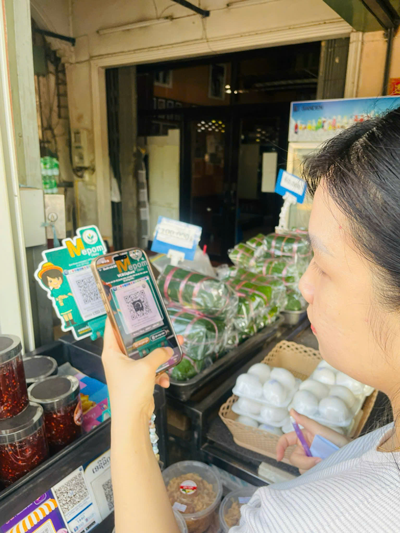
Vietnamese tourists scan QR codes to pay in Laos. Photo: HOANG QUYNH
Accordingly, Chinese tourists or business travelers visiting Vietnam can now use their familiar banking apps or e-wallets to scan the VIETQRGlobal code. The payment acceptance range is extremely wide, covering most essential needs of a traveler: from bustling shopping malls and popular tourist attractions to restaurants and retail stores.
Currently, a range of leading retail, food and beverage (F&B), and tourism brands in Vietnam, such as GO! supermarket chain, Big C (owned by Central Retail Vietnam), Highlands Coffee chain, and Sun World entertainment complexes, have already prepared the infrastructure to serve customers who scan QR codes.
This event is particularly significant when viewed in the overall context of the tourism industry. Data from the Vietnam National Tourism Administration shows that in the first 11 months of 2025, Vietnam welcomed over 19.1 million international visitors, an impressive 20.9% increase compared to the same period. Of these, visitors from China accounted for the overwhelming majority, with nearly 4.8 million arrivals, a significant increase of 43%.
Mr. Pham Anh Tuan, Director of the Payment Department (State Bank of Vietnam), noted that China is currently the largest source market for tourists to Vietnam. Therefore, facilitating payments via QR code will not only bring great convenience to millions of tourists but also act as a lever to boost revenue for Vietnamese businesses.
Prior to connecting with China, the VIETQRGlobal system had already been successfully deployed in the markets of Thailand, Laos, and Cambodia. This network expansion has made Vietnam a friendly destination for fintech in the eyes of the international community.
BVBank, one of the pioneering banks in implementing this service, stated that tourists from the aforementioned countries can easily make payments at stores using BVBank's VIETQRGlobal code. "Tourists only need to scan the code on the screen and complete the transaction in seconds. This convenience frees tourists from the worry of carrying cash, the risk of loss, or the burden of high foreign exchange conversion fees when using international cards. All costs are managed transparently right on the application," said Mr. Nguyen Thien Tam, Director of BVBank's Digital Banking Center, speaking about the outstanding convenience of this solution.
The fees are much lower than currency exchange.
Beyond simply welcoming tourists, cross-border payments via QR codes offer significant benefits to Vietnamese people traveling abroad. In countries like Thailand and Laos, the Vietnam Industrial and Commercial Bank (VietinBank) has implemented cross-border payment services, facilitating smooth transactions. Mr. Tran Cong Quynh Lan, Deputy General Director of VietinBank, stated that Vietnamese travelers no longer need to exchange foreign currency beforehand or use credit cards with high fees; they can simply scan QR codes for seamless payments, just like in Vietnam.
In particular, targeting the Chinese market, known as a "cashless society," Zalopay has announced an international QR code scanning feature, allowing Vietnamese users to easily make direct payments using VND from their wallet at a wide range of acceptance points, from luxury shopping malls to small retail stores. The system will display the converted amount and transparent fees, helping users proactively and easily control their spending.
According to our research, the current service fees applied by banks and e-wallets in China are around 1.5%, which is significantly lower than the foreign currency conversion fees when paying with credit cards, which are 2.5%-3%.
Most recently, Zalopay has also expanded this feature to Singapore. Users can scan QR codes at transaction points displaying the NETS and Alipay+ logos, and especially pay for Grab's ride-hailing services right in the Lion City.
According to the roadmap, NAPAS and UPI are expected to complete the reverse payment connection by the beginning of 2026. At that time, Vietnamese users will also be able to use the applications of NAPAS member banks to scan QR codes within UnionPay's vast network throughout China.
Larry Wang, Vice President and CEO of UnionPay International (UPI), emphasized that this project leverages the mechanism of payment in local currencies, thereby facilitating economic, trade, and people-to-people exchanges.
Promoting regional financial connectivity
Mr. Nguyen Quang Minh, General Director of NAPAS, believes that this service not only provides a seamless and convenient payment experience for people in both countries but also contributes to strengthening financial connections and promoting the use of local currencies in cross-border payments. This, in turn, fosters the development of trade, tourism, and broader economic cooperation between the two nations.
Speaking with a reporter from Nguoi Lao Dong Newspaper, Mr. Pham Duc Duy, Deputy Director of the Personal Banking Division of Saigon Thuong Tin Bank (Sacombank), said that the implementation of cross-border QR payment in Laos, Cambodia, Thailand, and Singapore has demonstrated that the core value of this model lies in enhancing user experience and increasing convenience. As a result, small businesses and household businesses, which rely heavily on cash payments, have more opportunities to reach international customers, expand their customer base, and improve revenue.
According to Mr. Duy, the mechanism of payment in local currency helps reduce foreign exchange conversion costs, shorten transaction processing time, and improve liquidity efficiency, thereby promoting regional financial connectivity. For users, this method offers convenience, speed, and security as it eliminates the need for currency exchange, avoids conversion fees, reduces the risks of carrying cash, and contributes to the formation of digital payment habits in cross-border transactions.
Vietnam is expected to welcome its 20 millionth international visitor in 2025.
On the afternoon of December 15th, at Phu Quoc International Airport, the Ministry of Culture, Sports and Tourism, in coordination with the People's Committee of An Giang province and various businesses, held a ceremony to welcome the 20 millionth international tourist to Vietnam in 2025. This marks a significant milestone in the 65-year history and development of Vietnam's tourism industry.
The 20 millionth tourist of 2025 was recorded as Ms. Karolina Agnieszka from Poland, who was welcomed with formal ceremonies and gifts worth nearly 500 million VND, sponsored by Sun Group and Ngoc Hien Pearl. The 19,999,999th and 20,000,001st tourists also received gifts worth over 200 million VND each. In addition, all passengers on the lucky flight received flowers and tickets to the "Kiss of the Sea" show at "Phu Quoc Sunset Town".
D. Nhân
Be aware of data security risks.
According to Mr. Nguyen Thien Tam, cross-border payments using QR codes also pose a significant challenge to information security, as transactions must pass through many different technical systems and legal infrastructures between countries. In the context of security standards and data management regulations not being fully synchronized, the risk of leakage of personal data and transaction information is a noteworthy issue.
Furthermore, fraudulent activities such as QR code forgery at point of sale or exploiting small, high-frequency transactions for money laundering could increase if there is a lack of strict monitoring mechanisms. Reliance on foreign systems and partners also increases operational risks in the event of technical failures or disputes.
According to Mr. Tam, controlling these risks requires the simultaneous implementation of multiple solutions, from standardizing security requirements, encrypting data, hiding sensitive information, to verifying transactions based on risk levels. Simultaneously, real-time transaction monitoring, sharing fraud alerts, and enhancing training for payment acceptance units are key factors.
Mr. Nguyen Duc Huy stated that the solution adopted by banks and financial institutions is the use of dynamic QR codes, generated in real time and fully integrated with transaction information, thereby minimizing risks, increasing transparency of cash flow, and supporting management and compliance with tax regulations.
Source: https://nld.com.vn/du-lich-khong-tien-mat-se-len-ngoi-196251215214022328.htm





![[Photo] General Secretary and President visit the China-ASEAN AI Application Cooperation Center](https://vphoto.vietnam.vn/thumb/1200x675/vietnam/resource/IMAGE/2026/04/17/1776404277677_vna-potal-tong-bi-thu-chu-tich-nuoc-tham-trung-tam-hop-tac-ung-dung-ai-trung-quoc-asean-8706616-2286-jpg.webp)


























![[Photo] National Assembly Chairman Tran Thanh Man attends the policy seminar to promote Vietnam-Türkiye cooperation.](https://vphoto.vietnam.vn/thumb/1200x675/vietnam/resource/IMAGE/2026/04/16/1776351415367_vna-potal-chu-tich-quoc-hoi-tran-thanh-man-du-toa-dam-chinh-sach-thuc-day-hop-tac-viet-nam-tho-nhi-ky-8705791-jpg.webp)

































































Comment (0)