

In 2021, the former Chư Păh District Agricultural Service Center implemented the model "Application of greenhouse technology and substrate for growing netted melons" in Ia Sik village and village 2 (Ia Phí commune) with an area of 0.75 hectares and a total cost of over 1.8 billion VND.
The government provides support in terms of seeds, fertilizers, pesticides, and some essential supplies; the people contribute in terms of building greenhouses, irrigation systems, and labor, and receive 100% of the produce.
The model has shown remarkable effectiveness: the cantaloupe plants grow steadily, are less susceptible to pests and diseases, yield superior productivity and quality, and command stable prices. The success of this pilot model has created a strong ripple effect, encouraging many households to invest in expanding their cultivation area, making cantaloupe a promising crop in the locality.
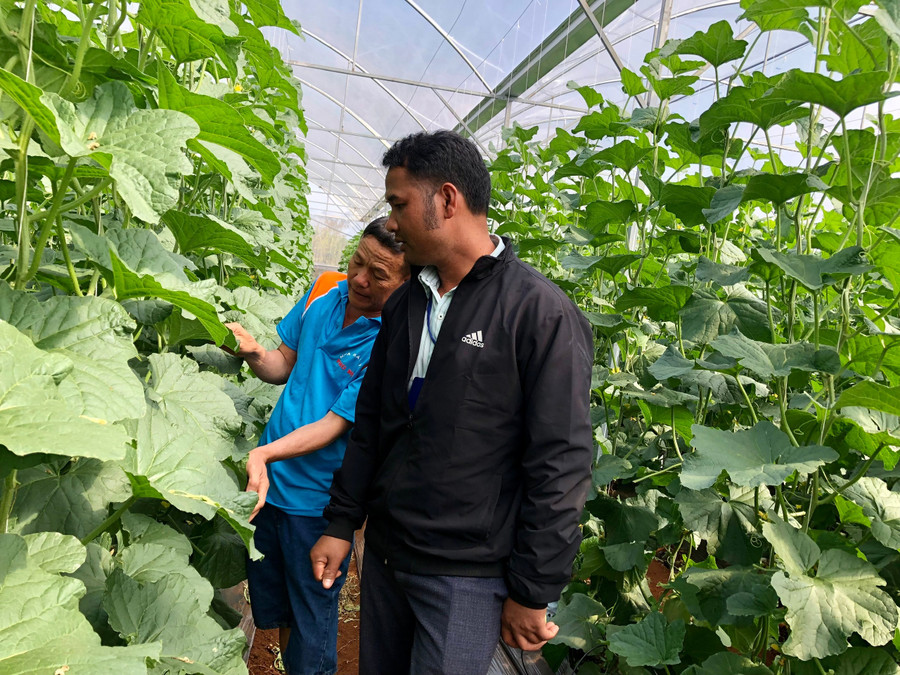
The family of Mr. Phan Van The (Ia Sik village) is one of the pioneering households in growing cantaloupe. In 2021, his family invested approximately 200 million VND to build a 1,000 m² greenhouse and install a water-saving irrigation system for growing cantaloupe.
Thanks to adhering to proper technical procedures, the melons grew well, yielding 3.5-4 tons per sao (approximately 1000 square meters), with selling prices ranging from 20,000-30,000 VND/kg depending on the time of year. After deducting expenses, the profit per crop is about 50 million VND per sao. Seeing the effectiveness, Mr. The expanded his cultivation to 4 sao, creating a stable source of income.
“Cantaloupe has a short growing season and is more economically efficient than many other crops. Each melon crop only takes about 65-70 days, so it can be rotated four times a year. This is a favorable condition for farmers to quickly recover their investment and accumulate capital,” Mr. The shared.
Not just a few households experimenting with it, now dozens of households in Ia Phi commune have invested in growing cantaloupe in greenhouses, covering an area of nearly 7 hectares. This model helps farmers proactively control pests and diseases, reduce pesticide costs, minimize the impact of extreme weather, and bring more sustainable value compared to traditional production.
Recognizing the effectiveness of the model, Mr. Hoang Ngoc Khang (village 6) decided to remove 2.5 acres of old coffee trees to invest in growing organic cantaloupe. Although the investment in greenhouses, at about 200 million VND per acre, is quite large, the economic efficiency has proven this choice to be correct.
“I’m currently cultivating my third cantaloupe crop this year. Cantaloupes have a short growing season, an average weight of 1.3-1.6 kg per fruit, and a yield of 3-3.5 tons per sao (approximately 1000 square meters) per crop. With a stable selling price of over 20,000 VND/kg, each sao of cantaloupe brings in a profit of 30-50 million VND per crop. Compared to coffee, the income from cantaloupe is many times higher on the same area,” Mr. Khang explained.
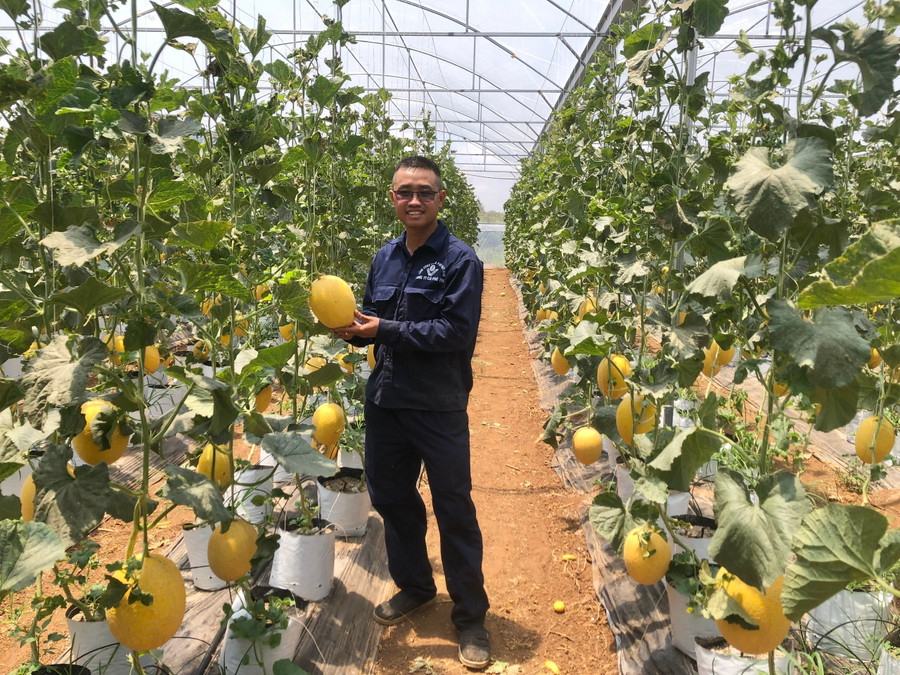
From a small-scale experimental model, the cantaloupe crop has taken root in the fields of Ia Phi, becoming a high-income crop and motivating farmers to diversify their production. Thanks to the application of greenhouse technology and water-saving irrigation systems, farmers have proactively produced safe, high-quality products, building trust with the consumer market.
According to Mr. Nguyen Cong Son, Chairman of the People's Committee of Ia Phi commune, the practical experience of recent years has proven that, despite difficulties in initial investment capital, technical infrastructure, and product output, the high-tech cantaloupe farming model still shows great promise.
“In the coming time, the locality will continue to work alongside farmers, support the development of new models, encourage production in the direction of organic and circular farming; high-tech, clean agricultural production, greenhouse farming, hydroponics... We will promote the restructuring of the agricultural sector, transform the crop structure, and diversify products. The goal is to help farmers create products with high added value,” Mr. Son emphasized.
Source: https://baogialai.com.vn/dua-luoi-cay-trong-trien-vong-o-ia-phi-post565049.html

![[Photo] The moment of seasonal change at Thong Nhat Park](https://vphoto.vietnam.vn/thumb/1200x675/vietnam/resource/IMAGE/2026/03/30/1774870546141_ndo_br_b773e4e7b1a230fc69b313-jpg.webp)
![[Photo] General Secretary To Lam attends the ceremony commemorating the 75th anniversary of the founding of the Central Military Hospital 108.](https://vphoto.vietnam.vn/thumb/1200x675/vietnam/resource/IMAGE/2026/03/30/1774866343623_a1-bnd-5435-7415-jpg.webp)
![[Photo] General Secretary To Lam presents the Military Merit Order and Party Badge to senior leaders.](https://vphoto.vietnam.vn/thumb/1200x675/vietnam/resource/IMAGE/2026/03/30/1774878643606_a1-bnd-5651-8284-2398-1124-jpg.webp)






![[Photo gallery] Loc Ninh will become a leading urban center in the border region.](https://vphoto.vietnam.vn/thumb/402x226/vietnam/resource/IMAGE/2026/03/30/1774883149722_1_20260330212248.jpeg)





















































Comment (0)