In reality, summer is also a time when conflicts between parents and children increase. With children spending more time at home, their mischievous and hyperactive behaviors, typical of their age group, become the cause of numerous arguments. From initial gentle reminders, many families quickly resort to scolding, punishment, or other disciplinary measures when children repeatedly repeat the behavior.
Behind the familiar shouts in every family lies not only the story of children's mischief, but also the reflection of the pressures of childcare, differences in educational philosophies, and the silent stresses of adults in modern life.
A clash between generations
According to psychologists, what adults call "mischievous behavior" is sometimes a very natural expression of development. Experts say that children, especially those in preschool and elementary school, have a need to explore the world through action. They often want to touch objects, take things apart, experiment, or find out how things work.
Associate Professor Pham Manh Ha, lecturer at the Faculty of Educational Science and Technology, Hanoi University of Science and Technology, said: “Many parents, upon seeing a disassembled remote control, will think their child intentionally broke something. But for children, it could simply be curiosity. They want to know what's inside and why it works. Adults see the consequences, while children see it as an exploratory experience.”
According to him, children's ability to control their behavior and predict consequences is not as fully developed as that of adults. Therefore, children are not always aware that their actions may cause trouble or harm.
From an educational perspective, Ms. Le Thi Nhan, a primary school teacher in Hanoi, believes that the school environment inadvertently helps children expend a large portion of their daily energy. They have a clear schedule, friends to interact with, and always have activities to participate in. When summer vacation arrives, many children suddenly lose their familiar routines.
Therefore, without alternative activities, children easily become bored. Their inherent hyperactivity will become more pronounced. This explains why the same child's behavior during the school year and during summer vacation can differ significantly.
If we only look at children's behavior, it's difficult to explain why family conflicts increase during the summer. Experts suggest that behind the shouting and scolding often lies the pressure from the adults themselves.



With most parents still having to maintain their normal jobs, caring for children throughout the three summer months becomes a difficult problem to solve. Not every family has the means to enroll their children in courses, skills classes, or send them to live with grandparents in the countryside.
According to psychologists, parents' negative emotions can accumulate from various sources such as financial pressure, work stress, household chores, or lack of rest. When children constantly create unexpected situations, this stress easily manifests as strong reactions.
A study on family psychology once indicated that children's behavior isn't the only factor leading to conflict. The emotional state of the caregiver plays an equally important role. In other words, many family clashes each summer stem not only from children being more mischievous, but also from adults being more tired.
The cycle of punishment and its consequences.
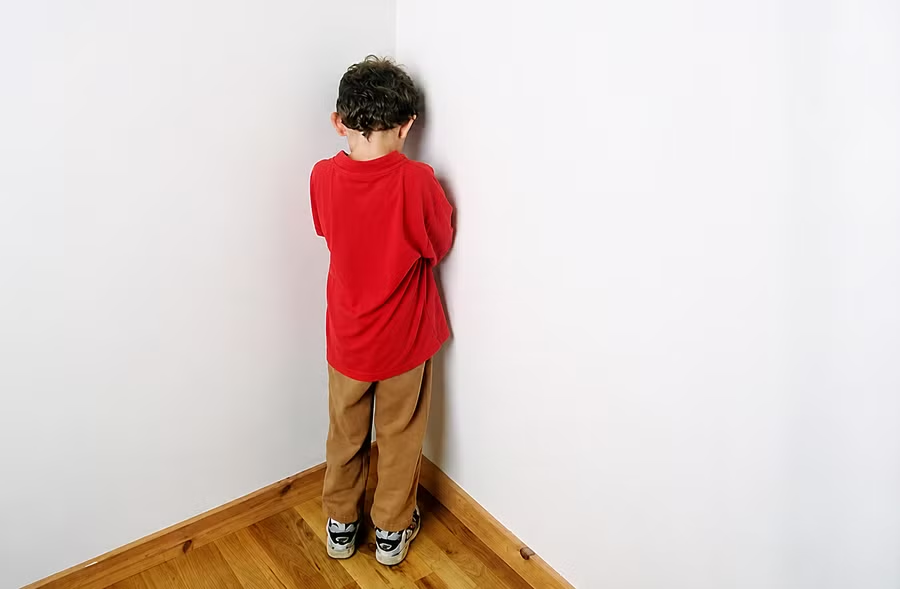
When asked about how they handle their children's misbehavior, many parents admit they often choose familiar methods such as scolding, making them stand still, banning them from watching TV, or confiscating their toys. In addition, some families still maintain the practice of corporal punishment, although not as frequently.
According to Associate Professor Pham Manh Ha, most parents don't choose punishment because they want to hurt their children, but because they want the behavior to stop immediately. "When a child spills water, breaks something, or creates danger, the emotional reaction of adults usually comes first. In that moment, many people don't think about educating their children but only want to handle the situation as quickly as possible," the expert analyzed.
It's noteworthy that many parents are repeating the very ways they were raised. Many were physically punished or scolded by their parents as children, so they sometimes unconsciously do the same to their own children. Experts believe this is a common cycle in many Vietnamese families. Educational experiences are passed down from generation to generation, even when they are controversial.
Conversely, children also have their own reactions to forms of discipline. Some become fearful and withdrawn, while others resist, argue back, or repeat the behavior after a short time. This confrontation can therefore become a vicious cycle: Child misbehaves - adult punishes - child reacts - adult continues to punish.
Many experts argue that the real issue isn't whether a child stains a wall or damages an object. What matters is how these conflicts affect the parent-child relationship. When family conversations revolve primarily around reprimands, criticisms, or punishments, children may develop a feeling that they are always in the wrong.



Associate Professor Pham Manh Ha stated: "If children are constantly labeled as naughty, stubborn, or excessively mischievous, they may gradually develop a negative self-image. This affects their self-confidence and their ability to share with their parents."
From a sociological perspective, the story of children's mischievous behavior during the summer also reflects another reality: the amount of time spent with children is becoming increasingly limited. Public play spaces are lacking in many residential areas. Many families live in small apartments. Parents are busy with work. Grandparents cannot always help care for their grandchildren.
In this context, summer vacation, which is supposed to be a time for children to rest and explore, can easily become a stressful period for the whole family. And with each passing summer, the question of "punishment or guidance" continues to be raised, not only as a choice in parenting methods, but also as a test of understanding between generations under the same roof.
Source: https://giaoducthoidai.vn/dung-bien-mua-he-thanh-cuoc-chien-post783164.html