

According to MXV, at the end of the week, Arabica coffee prices increased by 3.84%, surpassing the $7,200/ton mark. Robusta coffee prices decreased by 4.73% compared to their historical peak.
According to the Vietnam Commodity Exchange (MXV), green dominated the global raw material price chart last week (December 2-8). At closing, the MXV-Index rose 0.17% to 2,188 points. Notably, industrial raw materials led the market's upward trend, with 7 out of 9 commodities experiencing price increases. In particular, Arabica coffee prices surpassed US$7,200/ton, reaching their highest level in 47 years. Following this trend, many agricultural products also saw price increases.
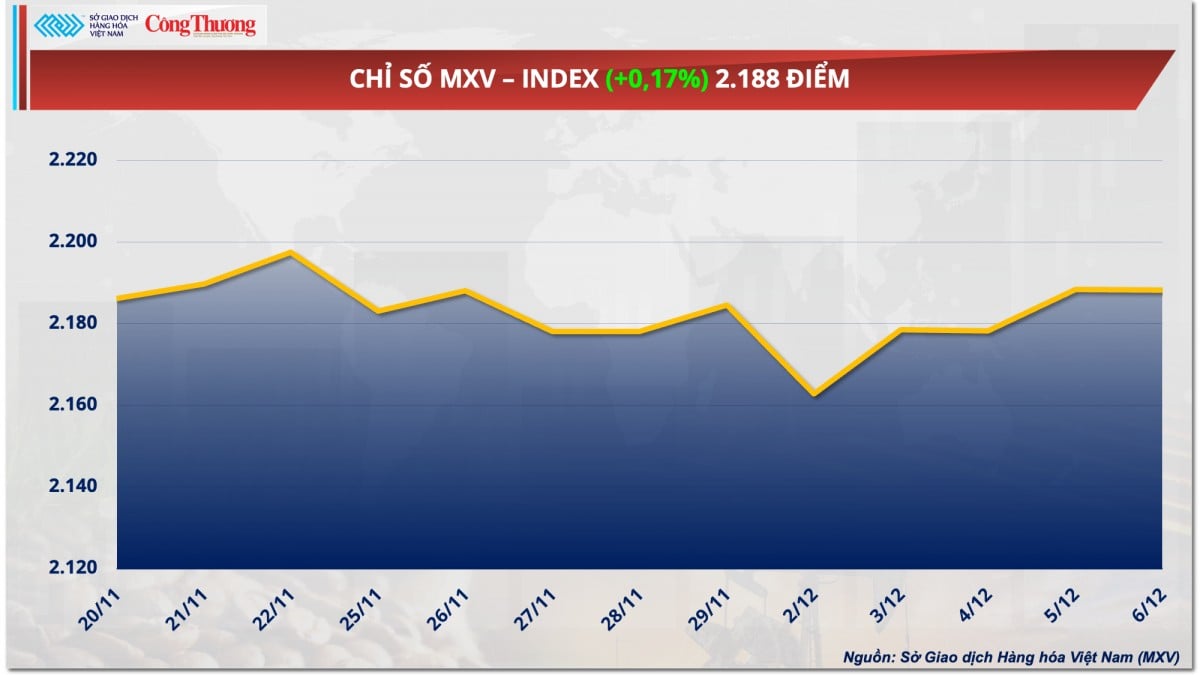 |
| MXV-Index |
World coffee prices are showing mixed trends.
Closing out the past trading week, green dominated the price charts for industrial raw materials. The market's focus remained on coffee price movements.
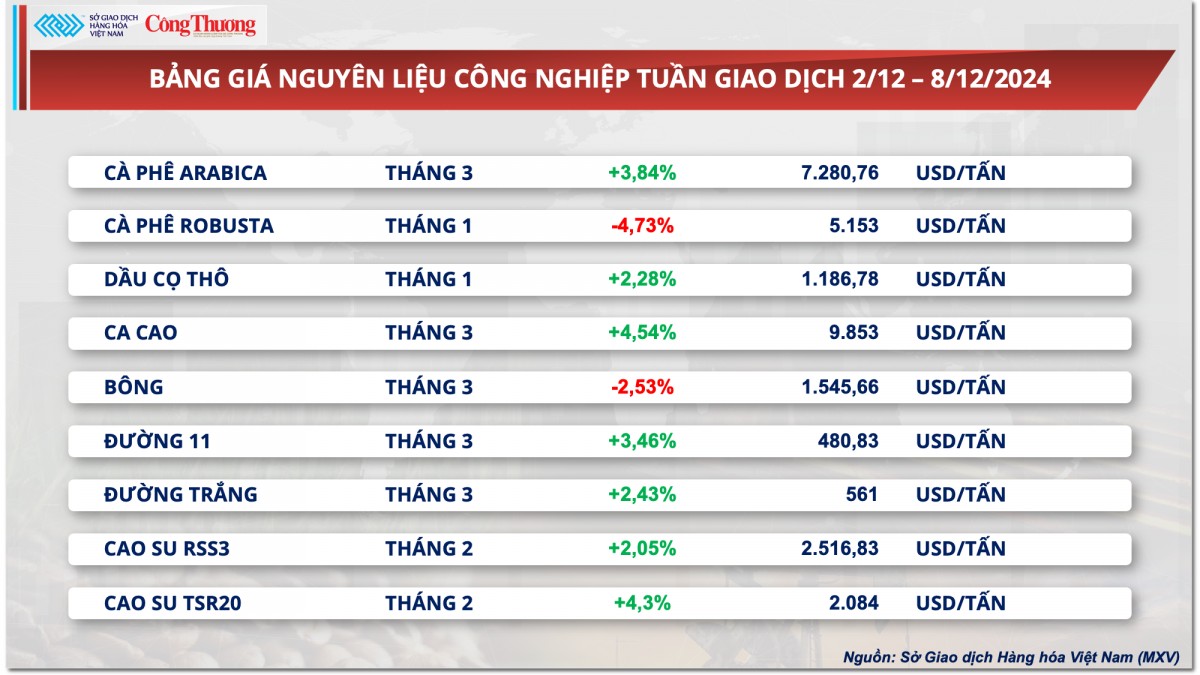 |
| Industrial raw material price list |
Coffee prices experienced a volatile week, plummeting in the first two sessions but quickly recovering in the final three. At the end of the week, Arabica coffee prices rose 3.84%, surpassing $7,200 per ton and setting a new 47-year all-time high. Meanwhile, Robusta coffee prices fell 4.73% from their all-time high set the previous week.
At the beginning of the week, the prices of both coffee commodities unexpectedly fell sharply, especially Robusta coffee, which lost more than 15% in just two trading sessions. Fundamental information remained unchanged; prices were pressured by profit-taking from investors and the USD/BRL exchange rate. On December 2nd, the Dollar Index surged nearly 1% after President Trump announced on social media that he would impose 100% tariffs on BRICS countries if they attempted to create a new currency to replace the USD. Meanwhile, the Brazilian Real weakened, causing the USD/BRL exchange rate to jump 1.42% to a historical high. The widening gap fueled concerns that Brazilian farmers might increase coffee sales to take advantage of the situation. This drew capital out of the coffee market, causing prices to fall sharply.
However, prices quickly reversed course and recovered from mid-week as concerns about supply once again dominated the market. Persistent rainfall below historical averages in Brazil's main coffee-growing region continues to cast a negative outlook on the 2025-2026 crop year. Somar Meteorologia reported 17.8 mm of rainfall in Minas Gerais, Brazil's largest Arabica coffee-producing state, last week, equivalent to 31% of the historical average.
In addition, according to the General Statistics Office of Vietnam (GSO), preliminary estimates indicate that Vietnam exported 60,445 tons of coffee in November, equivalent to 50.87% of the amount exported during the same period in 2023. Overall, in the first 11 months of the year, Vietnam exported 1.21 million tons of coffee, a decrease of 14.26% compared to the same period last year. This data also contributed to the upward trend in prices.
Over the past week, the market also received some important coffee supply and demand information. Notably, the Vietnam Coffee and Cocoa Association (VICOFA) raised its forecast for Vietnam's 2024-2025 coffee production to 28 million bags, 1 million bags higher than its previous forecast. The Colombian Coffee Federation (FNC) also estimated its 2024 coffee production at 13.6 million 60kg bags, a 20% increase compared to 2023 and 600,000 bags higher than its previous prediction, thanks to disease control and adaptation to climate change. Additionally, FNC reported that in November, the country produced 1.76 million 60kg bags of washed Arabica coffee, a 37% increase compared to the same period in 2023. For the first 11 months of the year, exports increased by 8% year-on-year, reaching 1.19 million bags. Furthermore, according to data from the Brazilian government , Brazil exported 285,447 tons of green coffee beans in November, a 21.6% increase compared to the same period in 2023.
In the domestic market, coffee prices in the Central Highlands and Southeast regions this morning (December 9th) were recorded at 123,000 - 124,000 VND/kg, unchanged from December 8th. However, compared to the same period last year, coffee prices have now doubled.
Soybean prices record their second consecutive week of recovery.
According to MXV, buying pressure prevailed in the agricultural commodities market last week. The soybean market experienced fluctuating price movements, but prices recorded their second consecutive week of recovery. Positive demand and favorable weather prospects in major South American producing countries were the factors influencing the performance of this commodity.
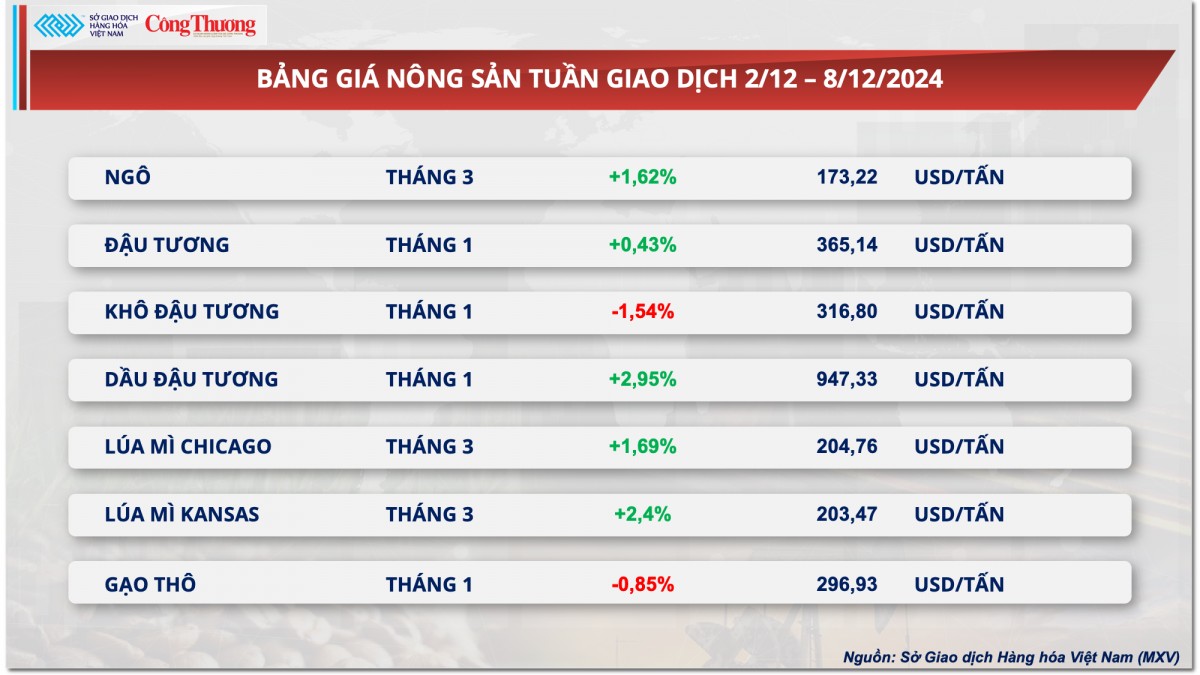 |
| Agricultural product price list |
According to the U.S. Department of Agriculture 's (USDA) weekly Export Sales report, soybean sales last week reached 2.3 million tons, exceeding expectations and 17% higher than the average of the previous four weeks. Soybean shipments for the reporting week totaled 2.4 million tons, a 17% increase from the previous week, indicating a surge in U.S. exports. Furthermore, the inclusion of new orders in the Daily Export Sales report bolstered market demand, supporting soybean prices.
Furthermore, according to data from the National Association of Grain Exporters (ANEC), Brazil is expected to export only 1.24 million tons of soybeans in December, a sharp decrease from 3.79 million tons in the same period last year. Total soybean exports for 2024 are estimated at 97.1 million tons, lower than the 98 million tons forecast released in early November. The decline in exports from Brazil suggests that the market remains heavily focused on supply from the US, driving buying pressure on prices.
Conversely, favorable weather in South America, particularly in Brazil and Argentina, is increasing pressure on the market. Regular rainfall in key producing regions is considered sufficient to support crops without causing serious problems. Some traders believe that improved weather conditions in South America are evident. Although drought is possible in some areas over the next two weeks, the overall crop outlook remains positive. This is a factor restraining price increases.
On the domestic market, as of December 6th, the price of South American soybean meal imported to Vietnam has reversed its upward trend. At Vung Tau port, the price for soybean meal futures for January 2025 delivery was 10,400 VND/kg, while the price for February 2025 delivery fluctuated around 10,450 VND/kg. At Cai Lan port, the selling price was about 100-150 VND/kg higher than at Vung Tau port.
Prices of some other goods
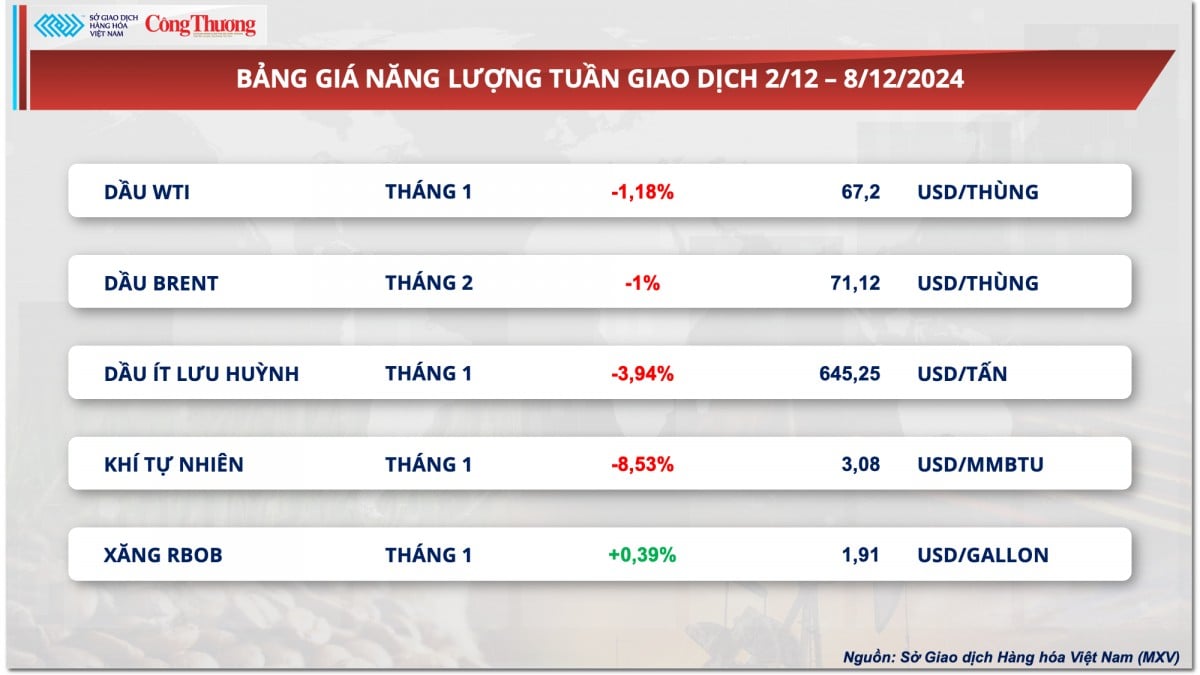 |
| Energy price list |
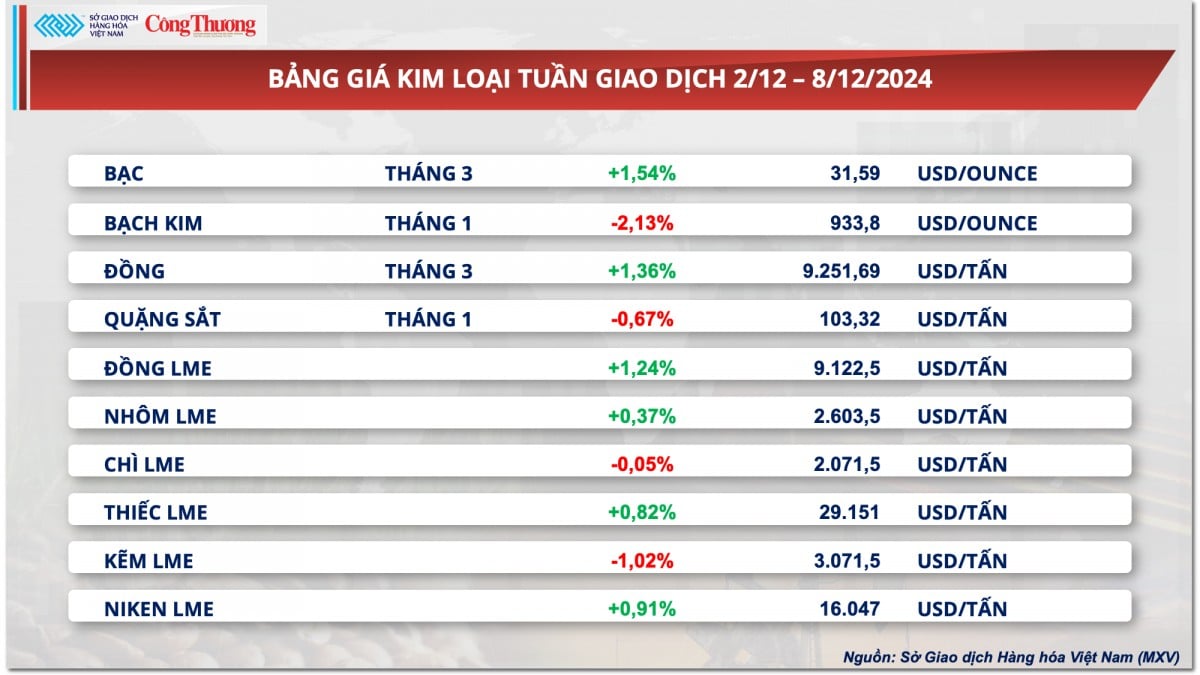 |
| Metal price list |
Source: https://congthuong.vn/thi-truong-hang-hoa-hom-nay-912-gia-ca-phe-the-gioi-dien-bien-trai-chieu-363259.html
![[Photo] The courage of new recruits of Brigade 144 on the training ground.](https://vphoto.vietnam.vn/thumb/1200x675/vietnam/resource/IMAGE/2026/05/27/1779881651341_anh-man-hinh-2026-05-27-luc-18-32-52.png)


![[Photo] The heat at the fireworks display site on the opening night of the Da Nang International Fireworks Festival 2026](https://vphoto.vietnam.vn/thumb/1200x675/vietnam/resource/IMAGE/2026/05/27/1779889741485_ndo_br_z7872039145157-fecaba5112f39e8352544099d7ef4738-5140-jpg.webp)






























































![[Photo] The courage of new recruits of Brigade 144 on the training ground.](https://vphoto.vietnam.vn/thumb/402x226/vietnam/resource/IMAGE/2026/05/27/1779881651341_anh-man-hinh-2026-05-27-luc-18-32-52.png)






























Comment (0)