The global commodities market saw mixed performance during the trading session on June 10th. At closing, the MXV-Index rose 0.2% to 2,722 points.
Notably, investment flows on the Vietnam Commodity Exchange (MXV) showed a strong shift towards industrial raw materials, with trading value in this group increasing by more than 25% compared to the previous session. Coffee continued to be the focus of investor attention, accounting for approximately 90% of the total trading value of the group.
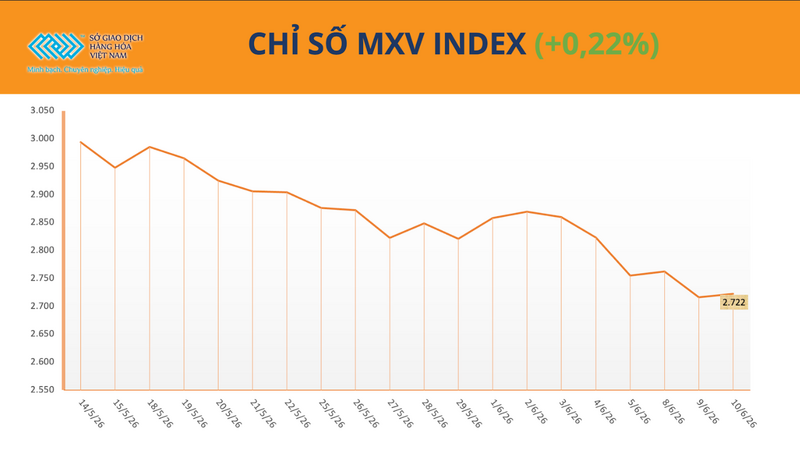
MXV-Index. Source: MXV
According to MXV's trading system, coffee contracts continue to attract strong capital inflows amidst conflicting market information regarding supply prospects. On the one hand, inventories on international exchanges remain low, while on the other hand, the market is still anticipating a large harvest in Brazil next season.
Data updated on June 10th shows that certified Arabica coffee inventories on the ICE exchange continued to decline by nearly 7,200 bags compared to the previous session, falling to approximately 402,700 bags, the lowest level in almost 6 months. Compared to the same period in previous years, current inventories are only about half of what they will be in 2024 and 2025. Even in 2023 – a time when the market was heavily impacted by adverse weather – Arabica inventories were still about 37% higher than they are now.
For Robusta, although inventory levels on ICE increased slightly to 3,713 lots, this figure remains close to its lowest point in the past two years.
According to MXV, the continued tightening of inventories is a significant supporting factor for the coffee market in the short term. At the close of trading on June 10th, the price of Arabica coffee futures for July delivery rose 1.64% to $5,476 per ton. Meanwhile, the price of Robusta coffee for the same delivery period increased 1.85% to $3,354 per ton.



Besides inventory levels, the market is also receiving support from the prolonged decline in exports from Brazil. According to the latest figures, the country's coffee exports in May reached only about 155,600 tons, down 8.6% compared to the same period last year. Cumulatively for the first 11 months of the 2025-2026 crop year, exports have decreased by approximately 20%.
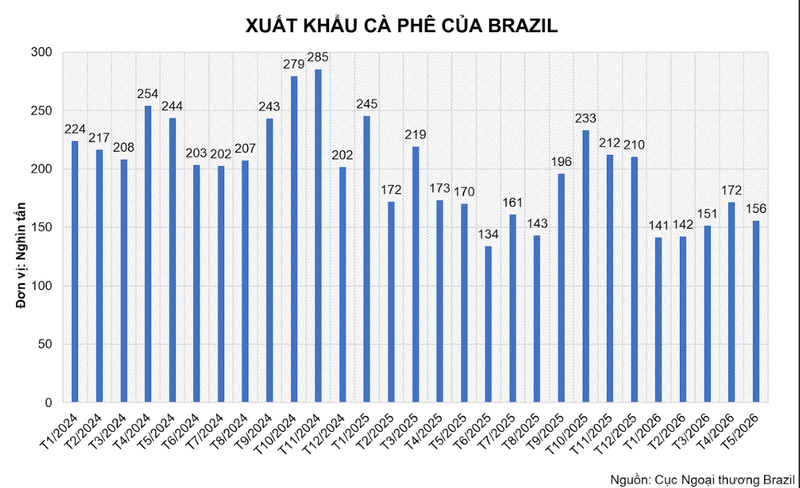
Brazil's coffee exports. Source: MXV
Regarding the weather, harvesting in Brazil is proceeding relatively smoothly thanks to dry conditions in early June. However, many growers are beginning to express concerns about the size of the coffee beans, particularly in the southern region of Minas Gerais and the Mogiana Paulista area. This is somewhat limiting selling pressure on the market.
According to an MXV trading member, the sharp increase in liquidity while coffee prices have only recovered modestly suggests that the market is still in the process of reassessing the supply and demand outlook for the new crop year. After weeks of consecutive downward price pressure, investors are now focusing on monitoring the harvesting pace in Brazil, inventory levels on ICE, and the potential for new supply in the second half of this year to determine the market's next trend.
Nevertheless, in the medium and long term, the supply outlook remains a factor that could put pressure on world coffee prices. Many analytical organizations currently forecast that Brazil's new crop yield could reach very high levels, thereby bringing exports in the period from July 2026 to June 2027 to around 50 million bags, an increase of more than 30% compared to the current crop year.
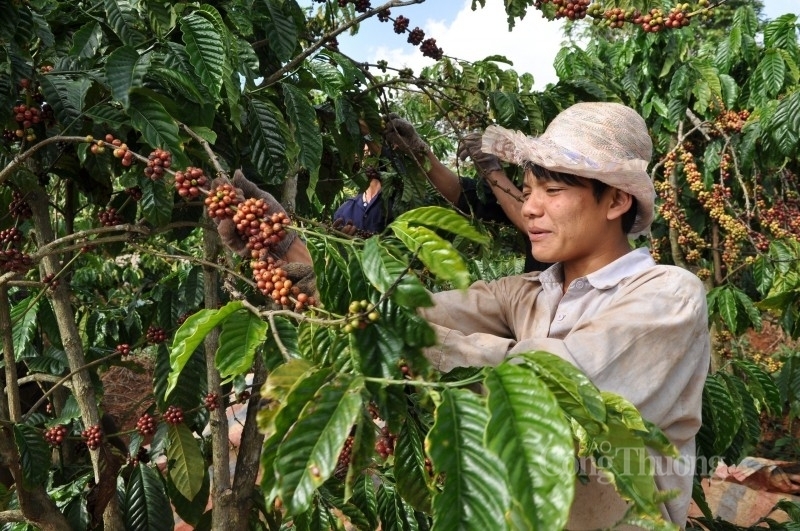
Tight supply is supporting the recovery of world coffee prices.



In the domestic market, coffee prices today, June 11, 2026, fluctuated around 84,300 - 84,800 VND in the Central Highlands provinces. Coffee trading in Vietnam this week was quiet due to increasingly tight supply and weak demand. Uneven rainfall distribution across coffee-growing regions raised concerns about yields in the upcoming crop year. In addition, coffee exports are forecast to increase moderately, while domestic consumption continues to grow.
Many experts believe the market is currently in a phase of searching for a new equilibrium after a series of sharp fluctuations from the end of May until now. In the short term, coffee prices may fluctuate in the range of 84,000 - 85,500 VND/kg. The subsequent trend will depend heavily on developments in world Robusta prices, import demand from major consuming markets, and the global supply situation.
Nevertheless, the long-term outlook for Vietnam's coffee industry remains positive. The U.S. Department of Agriculture (USDA) forecasts production for the 2026-2027 crop year to increase to 32.5 million bags, driven by high prices in the preceding period. Besides sustained export growth, expanding domestic consumption is also providing further impetus for the industry.
Source: https://congthuong.vn/gia-ca-phe-the-gioi-dong-loat-tang-460834.html


![[Photo] "Hanoi Lotus Festival" honors the lotus flower that has been associated with Vietnam for thousands of years.](https://vphoto.vietnam.vn/thumb/1200x675/vietnam/resource/IMAGE/2026/06/27/1782516943048_sen-ha-noi-2026-minh-duy-1-jpg.webp)






























































![[Infographic] 16 fireworks display locations to celebrate the 50th anniversary of Ho Chi Minh City being honored with the name of President Ho Chi Minh](https://vphoto.vietnam.vn/thumb/402x226/vietnam/resource/IMAGE/2026/06/27/1782539591308_man-ban-phao-hoa-ruc-ro-dem-khai-mac-638jpg-17242995540161175940469.jpeg)