

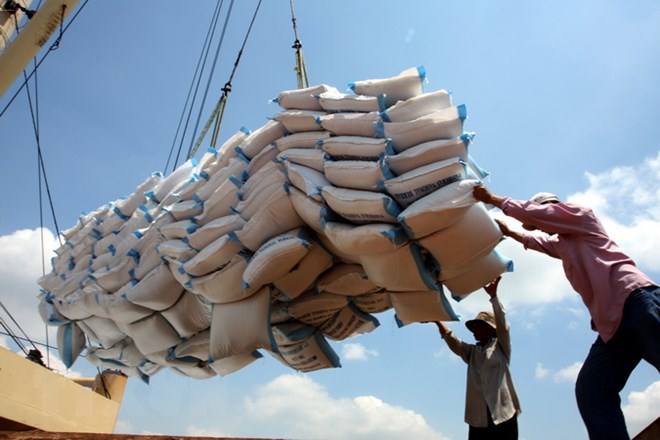
Loading and unloading Vietnamese rice for export. (Illustrative photo: VNA)
According to the Vietnam Food Association, in the Mekong Delta, the highest price for fresh fragrant rice at the field is 5,950 VND/kg, with an average of 5,664 VND/kg, a decrease of 64 VND/kg; while the price of ordinary rice increased by 7 VND/kg, with the highest price at 5,550 VND/kg and the average price at 5,339 VND/kg.
The highest price for grade 1 brown rice is 8,750 VND/kg, with an average of 8,458 VND/kg, an increase of 58 VND/kg; grade 2 brown rice has an average price of 7,771 VND/kg, with a highest price of 7,950 VND/kg, a decrease of 7 VND/kg.
Grade 1 polished white rice decreased by 150 VND/kg, with a maximum price of 9,550 VND/kg and an average price of 9,320 VND/kg; grade 2 polished white rice remained stable at an average of 8,870 VND/kg.
For by-products, the price of bran increased quite sharply by 507 VND/kg, averaging 7,414 VND/kg; broken rice increased by 23 VND/kg, averaging 7,651 VND/kg.
According to the Institute of Agricultural and Environmental Strategy and Policy, in Can Tho, last week Jasmine rice remained at 8,400 VND/kg, the same as the previous week; IR 5451 rice was 6,200 VND/kg; ST25 was 9,400 VND/kg; and OM 18 was 6,600 VND/kg.
In Dong Thap , IR 50404 rice is priced at 7,000 VND/kg, an increase of 100 VND/kg; OM 18 is 7,100 VND/kg, an increase of 200 VND/kg. Meanwhile, in Vinh Long, OM 5451 rice is priced at 6,700 VND/kg and OM 4900 at 7,200 VND/kg, both increasing by 100 VND/kg.
In An Giang , the prices of many types of fresh rice have decreased by 100-200 VND/kg compared to last week, as follows: OM 18 remains at 6,300-6,500 VND/kg; Dai Thom 8 at 6,300-6,500 VND/kg; OM 5451 at 5,600-5,800 VND/kg; while IR 50404 is still being purchased at 5,500-5,600 VND/kg.
In the An Giang retail market, rice prices remain stable: regular rice 11,500 - 12,000 VND/kg; Thai fragrant rice 20,000 - 22,000 VND/kg; Jasmine rice 16,000 - 18,000 VND/kg; white rice 16,000 VND/kg, Nang Hoa rice 21,000 VND/kg, Huong Lai rice 22,000 VND/kg, Taiwanese fragrant rice 20,000 VND/kg, regular Soc rice 17,000 VND/kg, Thai Soc rice 20,000 VND/kg, Japanese rice 22,000 VND/kg.
Regarding exports, Vietnamese 5% broken rice was offered at around $362-$366 per ton this week, showing little change from the $360-$365 per ton range of the previous week. A trader in Ho Chi Minh City said trading remained sluggish due to weak demand, while supply from competitors increased.
Weak demand and sluggish market activity have led to a slight decrease in export rice prices from India and Thailand this week.
In India, parboiled rice with 5% broken grains was offered at $353-$358 per ton this week, down from $355-$360 per ton last week. Indian white rice with 5% broken grains also fell to $350-$354 per ton.
Rice prices are falling primarily due to weak demand and the depreciation of the rupee. Mukesh Jain, Chairman of the Chhattisgarh Rice Exporters Association (India), said that foreign buyers are delaying signing contracts, expecting prices to continue to fall amid India's bumper crop.
According to trade officials and industry representatives, global rice prices are projected to continue facing downward pressure in 2026, as major producing countries such as India and Thailand compete to export surplus supplies, causing buyers to delay transactions.
In Thailand, the price of 5% broken rice is being offered at between $370 and $375 per ton, the lowest since December 4, 2025. Traders say that demand for rice is quite quiet, with no large contracts of significant volume recorded.
A rice trader in Bangkok said that exchange rate fluctuations and domestic prices are the reasons for the drop in rice prices, while there is also a surplus of supply in the region due to high rice harvests in many countries.
Meanwhile, in Bangladesh, domestic rice prices remain high, despite a favorable harvest and ample reserves thanks to imports. This situation continues to increase the financial burden on low-income households.
Regarding the US agricultural market, US corn futures prices rose more than 1% in the final trading session of the week on January 16th, partially reversing earlier sharp declines, as exporters and domestic buyers took advantage of lower spot prices to purchase corn.
Meanwhile, improving export demand signals and the closing of short positions also supported the rise in wheat prices, while soybean prices increased in line with the general trend, supported by sustained high domestic soybean crushing activity.
At the close of trading on January 16th on the Chicago Board of Trade (CBOT), the price of corn for March 2026 delivery rose 4.5 cents to $4.24 per bushel. The price of wheat for March 2026 delivery increased 7.5 cents to $5.18 per bushel, while the price of soybeans for March 2026 delivery rose 4.75 cents to $10.57-3/4 per bushel (1 bushel of wheat/soybeans = 27.2 kg; 1 bushel of corn = 25.4 kg).
Overall for the week, corn prices fell by more than 4%, marking the sharpest weekly decline since July 2025. Prices plummeted at the beginning of the week after the U.S. Department of Agriculture (USDA) announced higher-than-expected U.S. corn production and inventories. However, this price drop appears to have attracted bargain-hunting. In its daily report released on January 16th, the USDA confirmed contracts to sell U.S. corn to private companies totaling 418,000 tons, following the announcement of another large order of over 760,000 tons the previous day.
Terry Linn, an analyst at grain futures brokerage Linn & Associates (Chicago), commented: “After the market somewhat absorbed the supply factors from the U.S. Department of Agriculture’s crop report, global buyers started returning, and we’re seeing this trend from domestic consumers as well.”
Wheat prices were supported by new import tenders on the global market this week, including Saudi Arabia seeking to purchase 595,000 tonnes of wheat. In addition, commodity investment funds currently hold a significant net short position in CBOT wheat, making the market susceptible to price increases due to short covering.
Soybean prices followed the upward trend of corn and wheat, while soybean oil prices adjusted slightly downward, pausing their strong rally this week. The soybean market remains supported by strong domestic processing activity, with the National Oilseed Processors Association (NOPA) reporting that December 2025 crushing output reached the second-highest level on record.
Brazil is preparing to enter its soybean harvest season with record yields, expected to dominate global soybean exports in the coming months.
Meanwhile, Canadian canola futures prices rose to their highest level in six weeks after the Canadian government announced a trade agreement with China under which China would reduce import tariffs on Canadian canola seeds.
The global coffee market closed the trading session on Friday, January 16th, with a prevailing downward trend, ending a series of impressive gains earlier in the week.
On the New York exchange, Arabica coffee futures for March 2026 delivery lost their early gains, falling 2.80 US cents (0.77%) to close at 355.30 cents/lb (1 lb = 0.4535 kg). The main reason for the drop in Arabica coffee prices was the latest weather forecast models indicating an increased likelihood of rain in key coffee-growing regions of Brazil next week, easing concerns about drought that had previously driven prices up sharply.
On the London exchange, Robusta coffee prices fluctuated and closed slightly lower. The March 2026 Robusta futures contract fell by $3 (0.06%), closing at $4,000 per ton. Despite the price drop, Robusta coffee successfully defended the psychological level of $4,000 per ton, a crucial technical signal indicating that the medium-term upward trend remains unbroken, despite the impact of news of a significant increase in supply from Vietnam.
This weekend's price drop is seen as a reasonable technical correction after the coffee market had risen quite sharply in the middle of the week. Rain forecasts in Brazil served as a pretext for speculative funds to take short-term profits, bringing the market back to a more balanced state.
However, supply risks remain. Robusta inventories on the ICE exchange, while slightly higher, are still low, and whether actual rainfall in Brazil next week will be sufficient to quench the coffee plants' thirst is still uncertain.
Source: https://baotintuc.vn/thi-truong-tien-te/gia-lua-gao-bien-dong-trai-chieu-20260118163634270.htm







































































![[Photo] Celebration of the 75th anniversary of the first issue of Nhan Dan Newspaper](https://vphoto.vietnam.vn/thumb/402x226/vietnam/resource/IMAGE/2026/03/11/1773213390692_7-1859.jpeg)

































Comment (0)