

The 2025 SCOLI index was compiled for six socio -economic regions, comparing prices in five regions with the Red River Delta region, and for 34 provinces and centrally-administered cities, comparing prices in 33 localities with Hanoi.
The results of compiling the SCOLI index for 2025 show that the Red River Delta region has the highest SCOLI index; the Mekong Delta region has the lowest SCOLI index.
The five localities with the highest SCOLI index in the country are Hanoi , Quang Ninh, Hai Phong, Ho Chi Minh City, and Da Nang.
The five localities with the lowest SCOLI index in the country are Vinh Long, Gia Lai, Ca Mau , Quang Tri, and Tay Ninh.
In 2025, using the Red River Delta as a benchmark (SCOLI=100), the remaining regions all have lower costs of living. The Red River Delta continues to be the region with the highest cost of living in the country.
Second is the Southeast region with a SCOLI index of 98.88%. This is followed by the Northern Midlands and Mountains with 98.63%; the Central Coast and Central Highlands region at 96.59%; the North Central region at 96.11%, and the lowest is the Mekong Delta region at 95.11%.
Thus, the gap between the highest and lowest price regions is 4.89 percentage points, reflecting a relatively small difference in the cost of living between regions.
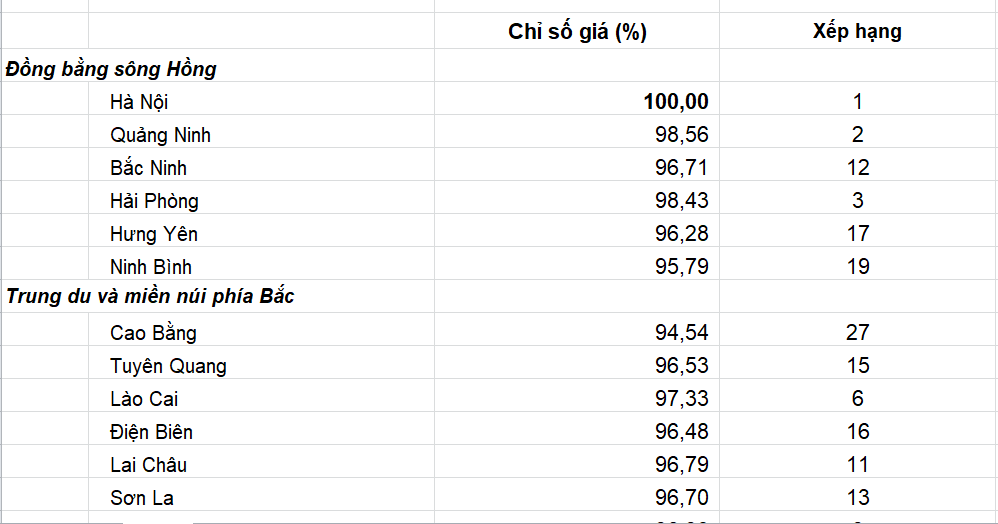
Among the 34 provinces and centrally-governed cities, Hanoi continues to hold the top position with the highest prices in the country in 2025.
Quang Ninh ranks second with a SCOLI index of 98.56%, the same as Hanoi. Quang Ninh has the advantage of developing a comprehensive economy with industries, services, and tourism, notably as a major tourist center with Ha Long Bay. Trade and services are thriving, attracting a large number of domestic and international tourists, contributing to increased consumer demand and higher prices for goods and services.
However, thanks to a stable supply of goods and services, along with reasonable living and transportation costs, the price level in Quang Ninh remains lower than in Hanoi.
Among the 11 main consumer goods and services groups, Quang Ninh has several groups with lower average prices than Hanoi: Clothing, hats and footwear at 89.62%; culture, entertainment and tourism at 93.93%; and transportation at 95.11%.
Conversely, there are three commodity groups with higher average price indices than Hanoi: the group of medicines and medical services at 106.96%; the group of housing, electricity, water, fuel and construction materials at 104.61%; and the group of beverages and tobacco at 103.83%.
Hai Phong ranks third with a SCOLI index of 98.43%, the same as Hanoi. Hai Phong is a major economic center in the northern region, possessing outstanding advantages in seaports and logistics, and serving as an important domestic and international trade hub. Its developed port infrastructure facilitates the transportation and circulation of goods, contributing to reduced logistics costs and stable supply in the area.
The strong development of industrial, commercial, and service activities, along with large-scale coastal industrial and economic zones, contributes to boosting consumer demand and increasing the price level of goods and services.
However, the average price level in Hai Phong is still lower than in Hanoi. Some product groups in Hai Phong have lower average prices than in Hanoi: clothing, hats and footwear at 97.61%; culture, entertainment and tourism at 88.32%; postal and telecommunications services at 88.56%.
Conversely, some commodity groups have higher average prices than Hanoi: Food and food services at 105.5%; medicine and medical services at 101.57%.
Ho Chi Minh City ranks 4th with a SCOLI index of 97.96% in 2025. It is a major economic center with a high rate of urbanization, a large population, and diverse consumer demands, contributing to high price levels. However, thanks to its modern distribution system, abundant supply of goods, and high level of competition, the average price level in Ho Chi Minh City remains lower than in Hanoi.
Some product groups have lower average prices than in Hanoi: Household equipment and appliances at 93.66%; clothing, hats and footwear at 94.33%; housing, electricity, water, fuel and building materials at 97.23%.

Da Nang ranks 5th nationwide with a SCOLI index of 97.89% in 2025. As a major economic, tourism, and service center in the Central region, Da Nang has advantages in geographical location and transportation infrastructure, creating favorable conditions for the flow of goods.
Despite the development of tourism, trade, and services, attracting a large number of domestic and international tourists, the average price level in Da Nang is generally lower than in Hanoi due to a stable supply of goods and services and a lower cost of living compared to Hanoi.
Some commodity groups have lower average prices than in Hanoi: Education at 91.79%; medicine and medical services at 95.87%; food and catering services at 98.47%.
The SCOLI index is a relative indicator (expressed as a percentage) reflecting the difference in prices of everyday consumer goods and services between provinces, centrally governed cities, and socio-economic regions over a specific period (usually one year).
The SCOLI index serves in the planning of socio-economic development policies and the evaluation of the results of poverty reduction, hardship assistance, and wage subsidies.
At the same time, this index also serves as the basis for calculating the Human Development Index (HDI) and the Gross Regional Domestic Product (GRDP) of provinces and centrally-administered cities based on purchasing power parity.
Businesses can use the SCOLI index to assess competitiveness in terms of price, market share, and product costs; individuals can use the SCOLI index to negotiate wages and consider the possibility of migrating between localities.
Source: https://hanoimoi.vn/gia-sinh-hoat-tai-ha-noi-dat-do-nhat-ca-nuoc-743100.html





























































































Comment (0)