

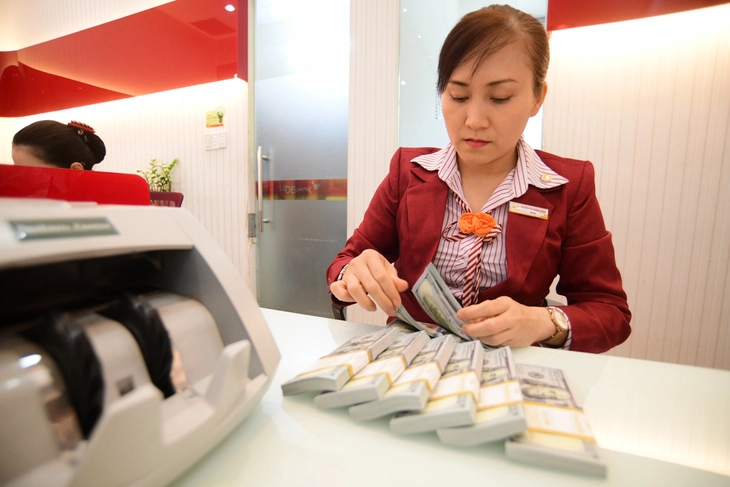
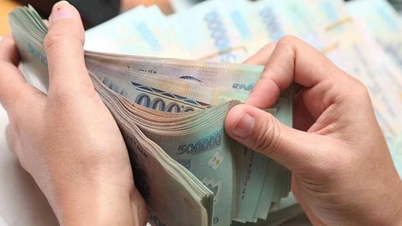
The USD exchange rate at banks unexpectedly dropped sharply - Photo: QUANG DINH
The USD exchange rate at banks has decreased by more than 200 VND/USD.
Vietcombank listed the USD buying price at 25,610 VND/USD and the selling price at 26,000 VND/USD, a decrease of 182 VND/USD in both buying and selling rates compared to yesterday.
BIDV also lowered its USD selling price to below 26,000 VND/USD. This morning, the USD selling price at BIDV was only 25,980 VND/USD, a decrease of 202 VND/USD compared to the end of yesterday. The buying price also fell to 25,620 VND/USD.
Eximbank lowered the selling price of USD to 25,990 VND/USD, equivalent to a decrease of 192 VND/USD.
On the buying side, the USD exchange rate listed at Eximbank fell even more sharply, by up to 260 VND/USD, to 25,570 - 25,600 VND/USD (cash - transfer).
Compared to the USD selling price at the beginning of April, which was around 25,820 VND/USD, the current USD price at commercial banks is only about 160-171 VND/USD higher.
Compared to the beginning of January, when the selling price of USD at banks was around 25,559 VND/USD, the current exchange rate has increased by approximately 1.73%.
The free market USD exchange rate also fell sharply.
Notably, the USD exchange rate at banks decreased amidst the State Bank of Vietnam's continued increase in the central exchange rate by 28 dong today, to 24,964 dong/USD, bringing the total increase since the beginning of the week to 78 dong/USD.
With the central exchange rate as stated above, banks are allowed to sell USD at a ceiling price of 26,212 VND/USD and a minimum price of 23,716 VND/USD.
Thus, today the selling price of USD at some banks has fallen significantly below the permitted ceiling.
In the free market, the selling price of USD today also decreased by 114 VND/USD, to 26,156 VND/USD, while the buying price fluctuated around 26,056 VND/USD.
According to analyses, the exchange rate has eased after Trump announced a 125% tariff on China and a 90-day postponement of tariffs on more than 75 countries that "did not retaliate," including Vietnam.
Previously, when US President Donald Trump announced reciprocal tariffs, the exchange rate came under considerable pressure.
Governor of the State Bank of Vietnam, Nguyen Thi Hong, assessed that the exchange rate fluctuations were complex and unpredictable, clearly evident after President Trump announced the tariffs, with the exchange rate rising by 0.6% on the first day. Especially when trading partners apply retaliatory tariffs, the financial and monetary markets will certainly experience complex developments every day and every hour.
"The State Bank of Vietnam will closely monitor market developments to manage tools and solutions with appropriate measures, especially considering the trade-off between exchange rates and the goal of reducing interest rates," the governor shared the operational direction.
Source: https://tuoitre.vn/gia-usd-ngan-hang-giam-sau-2025041012005103.htm




























































































Comment (0)