

According to AFP, a literal water shortage is currently affecting Uruguay's capital, Montevideo. To address this situation, local authorities are forced to search for an emergency water source.
For days now, the noise emanating from heavy drilling equipment in the 60-hectare Batlle Park, considered the "green lung" of Montevideo, has become familiar to the locals. Workers from the state-owned water company OSE are working to extract groundwater to supply hospitals and schools in the area. "There must always be a plan B. We are drilling for groundwater in Montevideo because of a water crisis," AFP quoted geologist Valeria Arballo, who is supervising the groundwater search, as emphasizing.
Montevideo, Uruguay's most populous city with 1.8 million people, has long relied on surface water. However, the past three years have been the most severe drought in 70 years for the city. Therefore, OSE decided to tap into groundwater. Two new wells, 42m and 90m deep respectively, have been put into operation. Water from these wells is treated before being supplied to residents.
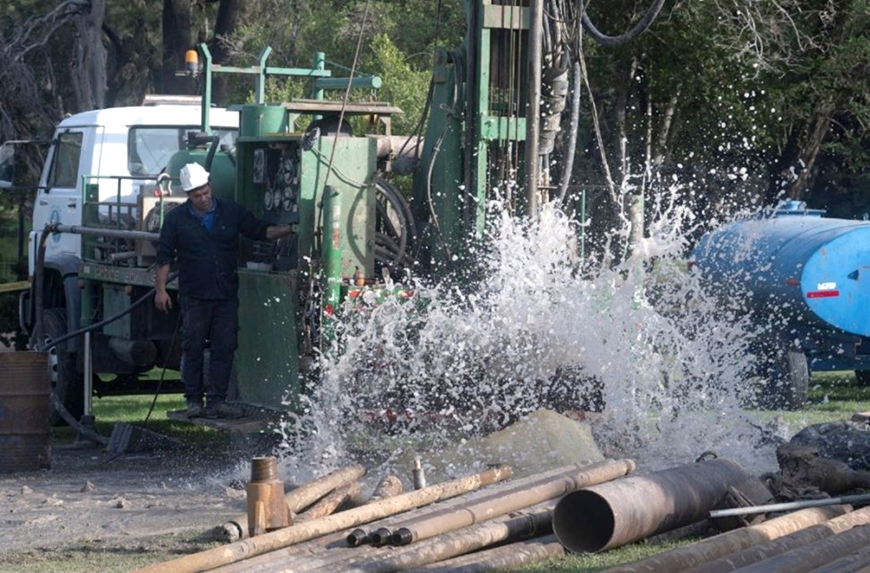 |
| Workers from the state-owned water company OSE drill wells to find groundwater in Montevideo, Uruguay. Photo: AFP |
Montevideo authorities plan to drill several more wells if the water shortage remains at its current alarming level. AFP reports that Montevideo's main freshwater source, Lake Paso Severino, located 85km north of the capital, will soon run dry if there is no rain. The lake's water level is at its lowest point in history. At times, it held only 4.4 million cubic meters of water compared to its full capacity of 67 million cubic meters. Meanwhile, the South American capital consumes an average of 550,000 cubic meters per day.
To prevent the prospect of freshwater depletion, the OSE (Uruguay State Health Authority) mixed brackish water from points near the Plate River with water from Lake Paso Severino, causing consumer dissatisfaction. In addition, the city's health authority extended the emergency permit for higher-than-standard sodium and chloride levels in the water until July 20th. They also allowed an increase in trihalomethanes (THMs) – chemical compounds formed when water is chlorinated and harmful if consumed over many years. "Increasing THMs for 45 days certainly will not affect people's health," AFP quoted Uruguayan Health Minister Karina Rando as saying, explaining the decision.
KHANH NGAN
Source
![[Photo] Prime Minister Pham Minh Chinh receives the Chinese Ambassador to Vietnam](https://vphoto.vietnam.vn/thumb/1200x675/vietnam/resource/IMAGE/2026/04/05/1775397481797_ndo_br_dsc-5512-jpg.webp)













































![[INFOGRAPHICS] Exploiting children's personal images for profit can result in fines of up to 50 million VND.](https://vphoto.vietnam.vn/thumb/402x226/vietnam/resource/IMAGE/2026/04/06/1775442200854_1775442148.webp)











Comment (0)