

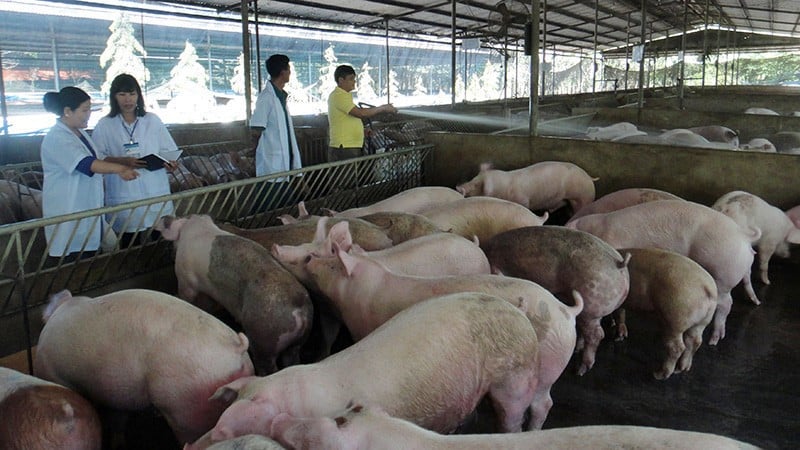
Against the backdrop of Vietnam's commitment to reduce methane (CH4 ) emissions by 30%. By 2030, "reducing emissions from livestock farming" is becoming a mandatory path, not just an encouraged option.
Greenhouse gas inventories show that emissions from livestock farming in Vietnam are increasing rapidly along with the size of the livestock herd. In 2010, CH4 emissions from livestock farming were approximately 16.5 million tons of CO2 equivalent (a unit of measurement for total greenhouse gas emissions), while by 2020 this had exceeded 20 million tons of CO2 equivalent. This indicates that the contribution of livestock farming to CH4 emissions in the economy is growing significantly.
The emission structure in livestock farming is also quite distinct, with approximately 74% coming from enteric fermentation in the rumen of ruminants, and the remainder mainly from manure and livestock waste management. Among ruminants, cattle account for the largest share of CH4 emissions from the rumen; while pigs account for a high proportion of emissions from manure management, alongside cattle, buffalo, and poultry.
The livestock development strategy for the period 2021-2030, with a vision to 2045, aims to achieve a pig population of 29-30 million, buffalo 2.4-2.6 million, cattle 7.15-7.3 million, and poultry 600-670 million by 2030. This provides a basis for increasing meat, milk, and egg production; however, it also means that greenhouse gas emissions, especially CH4 , will continue to increase if appropriate technical solutions are not implemented. The national climate change strategy to 2050 aims to reduce greenhouse gas emissions in agriculture by 43% by 2030, not exceeding 64 million tons of CO2 equivalent ; and by 2050, the reduction is targeted at over 63%, not exceeding 56 million tons of CO2 equivalent . Specifically for methane, Vietnam is committed to reducing it by 30% by 2030 and 40% by 2050.
To realize this goal, in 2024, in the livestock sector, the relevant authorities issued Circular No. 19/2024/TT-BNNPTNT dated December 3, 2024, on technical regulations for measuring, reporting, assessing emission reduction and inventorying greenhouse gases at the sectoral and livestock farm levels, effective from January 2025. This is an important legal basis for farms and livestock businesses to "measure" emissions, instead of just recording them qualitatively.
According to Dr. Le Thi Thanh Huyen from the Institute of Animal Husbandry, solutions to reduce CH4 emissions in livestock farming currently focus on two "hot spots": the digestion process in the rumen and the management and treatment of waste. Therefore, the first step is to improve the feed ration to reduce emissions from the rumen. The fermentation process in the rumen of cows and buffaloes produces volatile fatty acids (acetate, propionate, butyrate) while also generating H2 , CO2 , and CH4 gases.
Specific solutions include: Using silage (soybean and grass fermented with urea or biological additives) to improve digestibility, increase dry matter intake, improve weight gain, and reduce CH4 emission intensity per kilogram of weight gain; applying PC Dairy software in formulating feed rations for dairy and beef cattle, prioritizing the combination of legumes and industrial by-products to ensure nutrition while reducing emissions; using methane-inhibiting feed additives such as 3NOP , activated charcoal, zeolite, and tannin-rich feeds to suppress the activity of methanogenic bacteria in the rumen.
Furthermore, waste management needs to be circular. It is estimated that Vietnam's livestock industry generates over 62 million tons of solid waste and over 300 million tons of liquid waste annually; of which pig and cattle manure accounts for a large proportion. If processed using appropriate technology, this could be a significant source of organic fertilizer and energy, instead of becoming a pollutant for soil and water and emitting methane.
The proposed solutions include building and upgrading biogas digester systems to recover CH4 from manure, using it as fuel for cooking, electricity generation, or providing heat for livestock. Applying solid-liquid waste separation technology at pig and cattle farms; the solid portion is composted, while the liquid portion can be further processed or used for irrigation according to technical procedures. Composting can be supplemented with straw, agricultural by-products, and even combined with biochar to accelerate decomposition, increase nutrient content, and significantly reduce CH4 emissions during the composting process.
A study showed that composting cow manure with straw reduced E. coli (dysentery bacilli) and Coliform bacteria (the culprits behind dangerous gastrointestinal diseases) by more than 96% compared to before composting, while composting cow manure alone only reduced the number of pathogenic bacteria by about 70%.
Another solution is to use biological bedding in cattle barns. The bedding (sawdust, rice husks, or other microbial-enriched fillers) helps decompose manure and urine directly on the barn floor, reducing odor, decreasing the need for barn cleaning, and improving animal welfare. Experiments have shown that cattle raised on biological bedding have a higher average weight gain, reduced hoof disease, and after the rearing cycle, the bedding becomes a source of organic fertilizer...
Pilot projects at beef cattle farms and studies on straw silage, compost, and biological bedding have shown that, if implemented correctly, solutions to reduce CH4 emissions in livestock farming are entirely feasible and suitable for Vietnam's production conditions, especially when linked to direct economic benefits for farmers. The current challenge is how to standardize these solutions technically through specific procedures and guidelines. This includes integrating them into livestock development support programs and projects, agricultural extension, and green credit, and ensuring they are calculated, recorded, and evaluated within a system of measurement, reporting, and assessment to demonstrate emission reduction results and provide a basis for accessing future climate finance resources.
Source: https://nhandan.vn/giam-phat-thai-trong-chan-nuoi-post932544.html



![[Photo] Prime Minister Pham Minh Chinh receives the Director of RMIT University Melbourne (Australia)](https://vphoto.vietnam.vn/thumb/1200x675/vietnam/resource/IMAGE/2026/04/02/1775142120087_thiet-ke-chua-co-ten-2026-04-02t214220784-png.webp)












![[Video] Announcement of the conclusions of the first inspection and supervision phase for the Standing Committee of the Phu Tho Provincial Party Committee](https://vphoto.vietnam.vn/thumb/402x226/vietnam/resource/IMAGE/2026/04/02/1775143922917_dung00-32-30-20still005-png.webp)
![[Video] Phu Tho opens Tay Thien Festival 2026](https://vphoto.vietnam.vn/thumb/402x226/vietnam/resource/IMAGE/2026/04/02/1775143925646_dung00-35-03-15still006-png.webp)
![[Photo] Prime Minister Pham Minh Chinh receives the Director of RMIT University Melbourne (Australia)](https://vphoto.vietnam.vn/thumb/402x226/vietnam/resource/IMAGE/2026/04/02/1775142120087_thiet-ke-chua-co-ten-2026-04-02t214220784-png.webp)



















































Comment (0)