

In recent Lunar New Year seasons, theater schedules have been packed with traditional Vietnamese opera (Ho Quang), lasting from the 1st to over 10th day; while Vietnamese opera (Tuong Viet) has no place on any day, or only features sporadically for one or two nights.
Throughout the year, the production of traditional Vietnamese opera (tuồng hồ quảng) was much higher, with several troupes such as Huỳnh Long, Minh Tơ, Chí Linh - Vân Hà, and Lê Nguyễn Trường Giang staging plays every few months, or alternating performances every month. Meanwhile, Vietnamese opera (tuồng việt) was only staged by the Trần Hữu Trang Theatre and the Đại Việt stage of impresario Hoàng Song Việt, and even then, they only had enough money to produce two plays per year, or sometimes just one. This stark disparity has caused many to wonder. If cải lương (Vietnamese traditional opera) remains limited, younger generations will have a different perception of it, and traditional cải lương will fade away.
People's Artist Tran Ngoc Giau, Chairman of the Ho Chi Minh City Theater Association, said: "The State has always guided and encouraged traditional cải lương (reformed opera), or encouraged Hồ Quảng troupes to return to classical opera, meaning less Chinese elements, less use of Hồ Quảng forms, music , and dance. People's Artist Thanh Tòng contributed to reforming Hồ Quảng into classical opera, and now we are doing the opposite, which is strange. Why keep praising examples of loyalty and righteousness from distant countries, while our country also has no shortage of famous people and generals worthy of praise? And when writing or staging plays about our own national figures, it is naturally difficult to 'include' Hồ Quảng because it is inappropriate, so we must definitely return to traditional cải lương."
WE NEED A "MIDWIFE" FOR GOOD SCRIPT
Two recent Cai Luong plays have proven what Mr. Giau said. "The Epic of Gia Dinh" (produced by Tran Huu Trang Theatre) and "Thunderclap on Nhu Nguyet River" (produced by Chi Linh - Van Ha group), one by a public institution and the other by a private organization, are both commendable efforts to revive traditional Cai Luong.
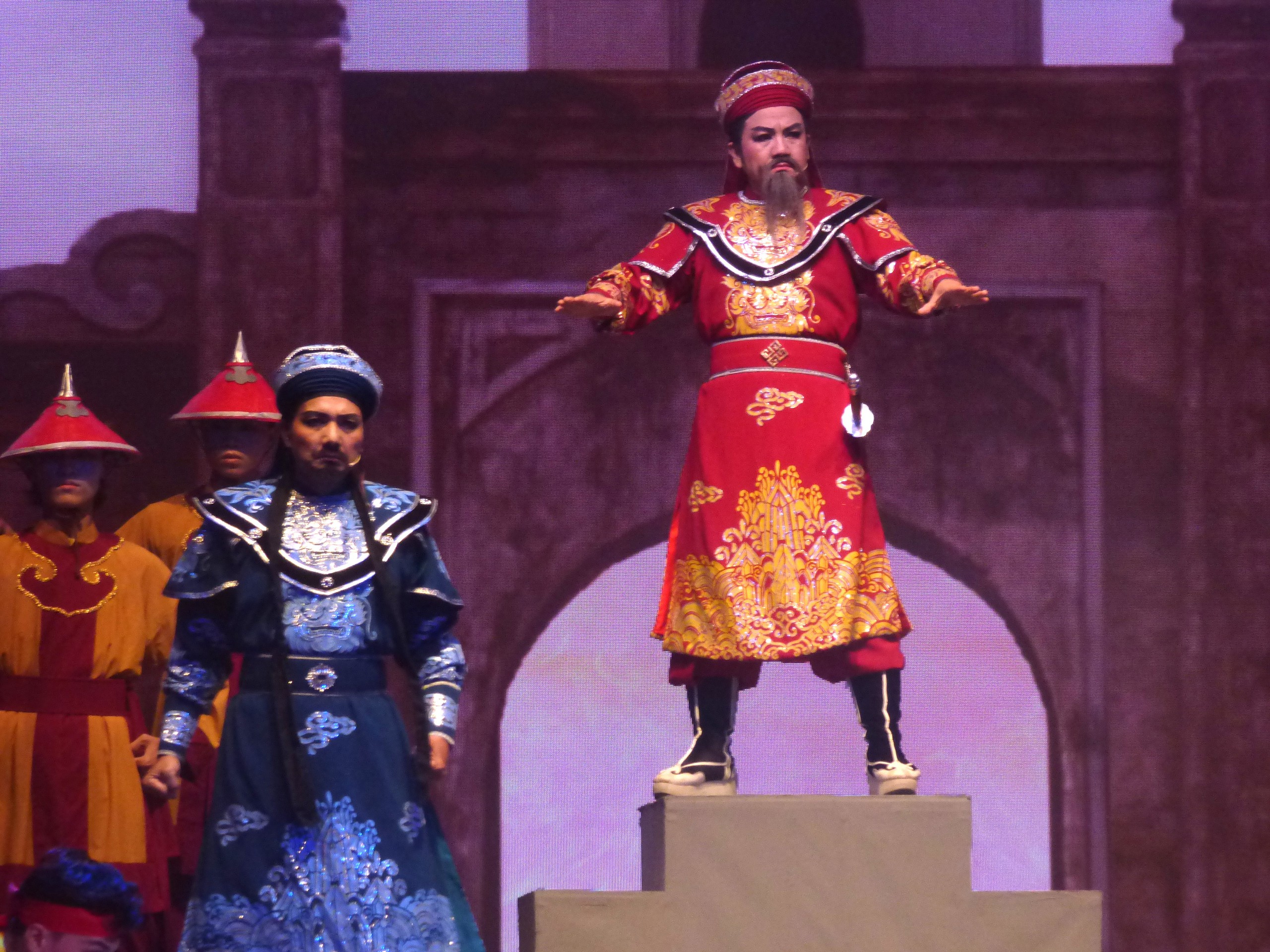
The play "The Epic of Gia Dinh Citadel" by Tran Huu Trang Theatre
The epic play "Gia Dinh" received state funding, making the process relatively "easier." The challenge lay in finding someone with discerning eyes to recognize and support the script during its development, so that the "child" could be born. Author Pham Van Dang recounted: "I love history. When reading the history of Saigon - Gia Dinh, I found the Battle of Long Tau River particularly interesting, and General Vo Duy Ninh deserved to be honored. I presented my idea to the leaders of the Tran Huu Trang Theater, and then to Ms. Nguyen Thi Thanh Thuy, Deputy Director of the Department of Culture and Sports of Ho Chi Minh City. Ms. Thuy enthusiastically encouraged me to write, helped me find additional materials, and offered suggestions to improve the script. The script was included in the theater's plan and quickly put into production."
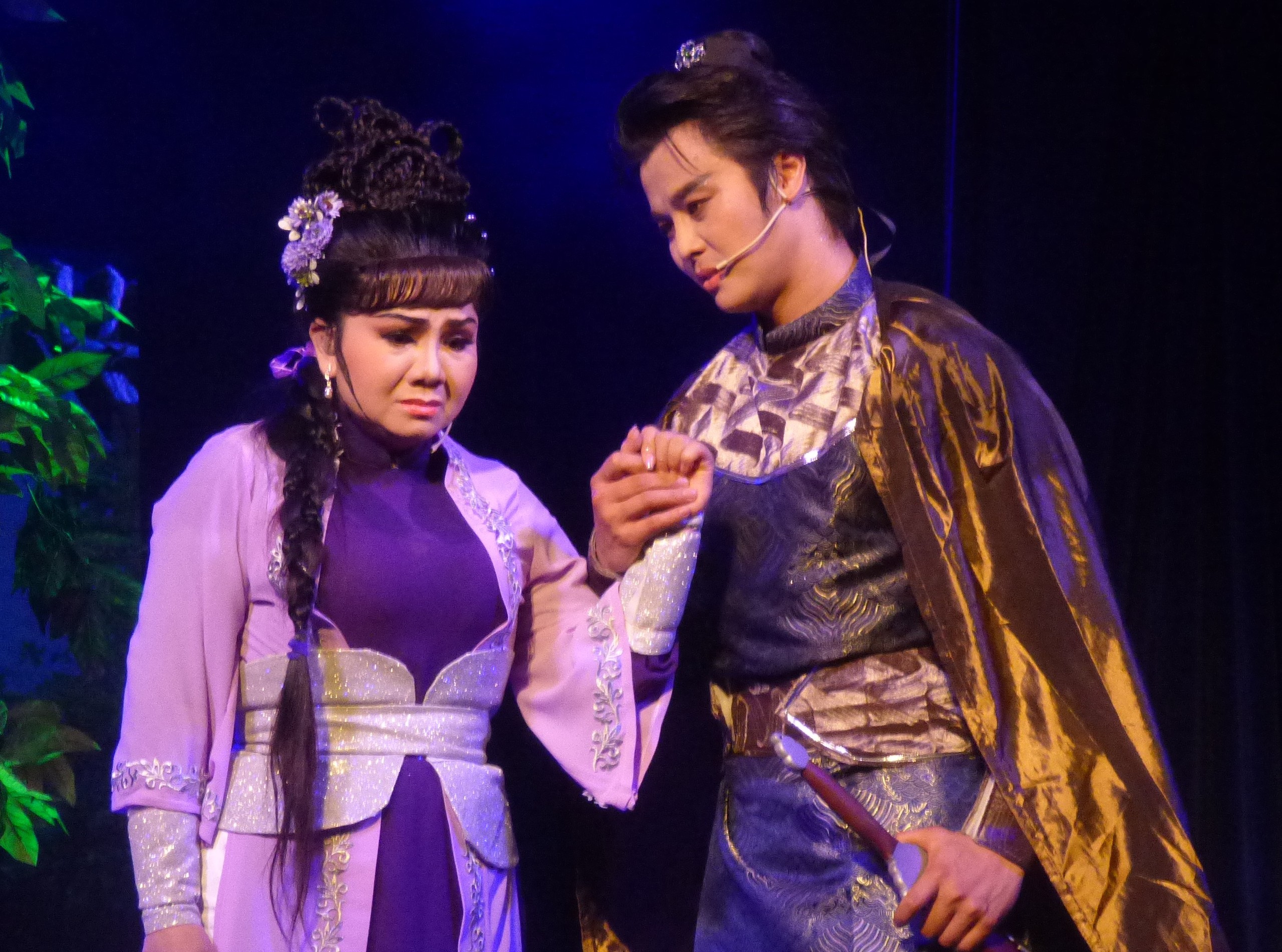
The play "Thunder Echoes on the Nhu Nguyet River" by the Chi Linh - Van Ha group.
The play "Thunderclap on the Nhu Nguyet River" is an effort by Meritorious Artist Chi Linh, who, while strong in classical and Ho Quang-style Cai Luong, is now shifting to traditional Cai Luong. He said: "There were many difficulties. First, the script; it wasn't easy to find a new, good script." He explained that the author, Yen Ngan, is an accountant at a company, but she is very passionate about Cai Luong, participating in clubs and researching techniques, writing short excerpts for the actors to perform. Then she sent him a longer script, and Chi Linh found the pace to be good and dramatic, so he immediately began developing it. Of course, as a veteran director, he offered suggestions, corrections, and support to perfect the script, but he welcomed young writers who have helped Cai Luong have new works.
The royalties for author Pham Van Dang's play, "The Epic of Gia Dinh Citadel, " are considered quite reasonable, as they come from state funding allocated to a public institution. Such royalties provide authors with the necessary motivation to invest their intellectual resources, as writing historical plays requires a long time to gather and research materials—sometimes a year, or even two to three years, to produce a script that meets quality standards.
As for authors working for privately funded organizations, they only receive royalties on a per -per ...
It's difficult to find the materials.
Traditional Vietnamese opera is indeed facing competition in terms of appeal compared to other art forms such as spoken drama, film, and music.
Historical cải lương plays face the added challenge of insufficient documentation. Our country has endured numerous wars, resulting in the destruction of both written documents and artifacts, leading to a constant shortage of information and vagueness. To create compelling scripts, authors must add fictional elements, but such fiction is often scrutinized. In contrast, hồ quảng plays have a vast library of Chinese stories readily available for adaptation and fiction. Even now, some troupes adapt Chinese films into cải lương scripts without objection. Therefore, when staged, hồ quảng plays are incredibly captivating with their rich characters and plotlines.
Author Pham Van Dang confided: "Creating traditional Cai Luong (Vietnamese traditional opera) requires ensuring both historical accuracy and artistic appeal, which is incredibly difficult. Fortunately, in the story of the Long Tau River, I read about a female soldier unit, just a few lines, without further explanation, but that was the 'grey area' that inspired me to create characters for many female artists of the Tran Huu Trang Theater. Writing about a war with only men is boring; there must be the presence of beautiful women, of love, to make it sweeter."
PRODUCTION COSTS ARE TIGHT
In reality, there is no shortage of human resources and talent in cải lương (Vietnamese traditional opera), but why are they hesitant to venture into traditional cải lương? The reason is funding. The Trần Hữu Trang Theater is a public institution, so its funding comes from the state, which is not too bad. However, the state only provides public institutions with funding for one or two plays per year, which is not considered much compared to the population of the city.
Socialized theaters like Chi Linh - Van Ha and Dai Viet theaters invest billions of dong themselves in production, sometimes only recovering half of that. Chi Linh said: "Staging Ho Quang plays is less expensive because costumes are easy to rent and reuse for many plays; sometimes the lead actors even provide their own costumes to their liking. The number of rehearsal days is also less because the routines and choreography are already prepared. Traditional plays, however, require many rehearsal days because they have to be rehearsed meticulously and precisely. Costumes also need to be researched accurately, designed carefully, and entirely made from scratch." The cost of renting the theater, staff salaries, artist salaries, and all other expenses alone amounts to 150-200 million dong per night. Selling tickets risks incurring losses, so he hasn't dared to restage "Thunderclap on Nhu Nguyet River" for another performance.
Given the situation, the only solution is for the government to intervene. The Department of Culture and Sports has promised to provide funding for the play "The Epic of Gia Dinh" to tour various districts and counties. However, for privately-run theaters, I think there should also be some support and encouragement through specific policies. Otherwise, if the theater scene becomes too difficult, people will resort to performing traditional opera to make a living, and it's hard to blame them. They can save up money to stage a traditional play occasionally to ease their guilt, but their constant livelihood will depend on traditional opera again.
Source: https://thanhnien.vn/gian-nan-lam-cai-luong-thuan-viet-185240624222537951.htm
![[Photo] General Secretary and President To Lam and his wife begin their state visit to China.](https://vphoto.vietnam.vn/thumb/1200x675/vietnam/resource/IMAGE/2026/04/14/1776133794926_z7723148772587-ffefa3c4b1e54e100de1554593a862c6-jpg.webp)
![[Photo] General Secretary and President To Lam visits and delivers a policy speech at Tsinghua University.](https://vphoto.vietnam.vn/thumb/1200x675/vietnam/resource/IMAGE/2026/04/14/1776164592318_vna-potal-tong-bi-thu-chu-tich-nuoc-tham-va-phat-bieu-chinh-sach-tai-dai-hoc-thanh-hoa-trung-quoc-8700658-5437-jpg.webp)
![[Image] Expediting land clearance at Alley 310 Nghi Tam to facilitate the construction of Tu Lien Bridge](https://vphoto.vietnam.vn/thumb/1200x675/vietnam/resource/IMAGE/2026/04/14/1776160406551_ndo_br_z7724148990408-9e5d4777e3c4504998b4286178b2e66e-jpg.webp)









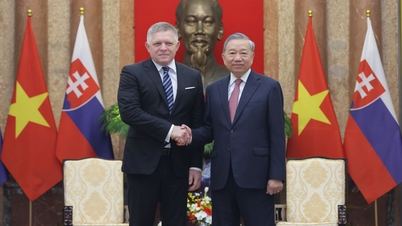
![[Photo] General Secretary and President To Lam receives Slovak Prime Minister Robert Fico](https://vphoto.vietnam.vn/thumb/1200x675/vietnam/resource/IMAGE/2026/04/13/1776080592076_a1-bnd-8227-6002-jpg.webp)


































Comment (0)