

"Now, even if I receive hundreds of payments a day, I don't have to keep any records; at the end of the day, I just open the banking app and know my profit and loss," Ms. Hoa shared. This is not just Ms. Hoa's story, but also reflects a larger trend – people are buying faster, paying more smoothly, and spending more freely as transaction friction has almost disappeared.
The sweep changed consumer behavior.
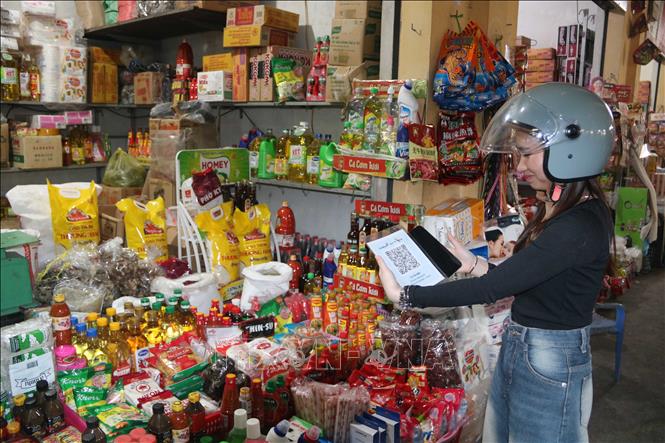
QR code scanning, once exclusive to modern stores, has now infiltrated small alleyways, pho restaurants, convenience stores, and late-night food carts. QR codes are popular because they are fast and don't require touching a wallet. A 25,000 VND cup of coffee, a 5,000 VND parking ticket, a 15,000 VND bunch of vegetables… are all processed in seconds. This increased shopping speed has significantly accelerated the inventory turnover for many businesses. Habits like waiting to find change or returning small change have completely disappeared.
Mr. Nguyen Duc Le, Deputy Head of the Market Management Department ( Ministry of Industry and Trade ), believes that cashless payments help eliminate physical barriers and reduce friction in buying and selling, especially in small transactions. Simple payment methods encourage consumers to spend more, reduce the fear of paying with cash, and boost consumption in retail, food, tourism, and personal services sectors.
The QR code payment method, implemented by the Vietnam National Payment Corporation (NAPAS) along with the expanding network of VIETQRPay payment acceptance points for domestic transactions and VIETQRGlobal for cross-border transactions, is making transactions more seamless.
According to Mr. Nguyen Duc Le, e-commerce is highly anonymous, especially through social media platforms, making it difficult to control the flow of money if data is lacking. Therefore, payment using QR codes is a solution that helps regulatory agencies monitor effectively.
For businesses, digital payments are accurate down to the last penny, preventing losses; reducing costs for printing, transporting, and storing cash; and managing cash flow transparently. Mr. Le said that digital payments also help businesses expand their markets, reach customers beyond traditional locations, and optimize products and services thanks to transaction data. Consumption increases due to continuous and less interrupted transactions.
Furthermore, in the context of a rapidly developing digital economy , cashless payments, especially via QR code, are key tools for reducing transaction friction, benefiting consumers, businesses, and regulatory bodies.
According to Mr. Mai Son, Deputy Director of the Tax Department (Ministry of Finance), using cashless payments reduces manual record-keeping for small businesses, makes it easier to track cash flow at the end of the day, thereby creating peace of mind in business and increasing transparency. Mr. Mai Son also emphasized that the application of digital payments needs to be in accordance with the law and the business conditions of each group.
The digital payment system also opens up real-time transaction data, helping authorities track money flows, reduce tax evasion, and detect unusual transactions early. "This is a crucial factor in protecting both the input of goods and consumers," Mr. Son said. This data also helps suggest automatic declarations, saving time and costs and minimizing errors.
Accelerating the digital economy
It's easy to see that digital payments have a significant impact on the economy, helping to accelerate the flow of goods, improve social productivity, reduce transaction costs, support economic management, expand markets for small businesses, and create a transparent consumer culture.
According to Mr. Nguyen Duc Le, when three factors—goods accompanied by invoices, invoices linked to tax obligations, and cash flow tracked through banks—operate in a synchronized manner, management becomes more transparent and consumers are better protected.
Another advantage is that the cost of deploying QR codes is almost zero, requiring no POS machines or complex contracts; simply printing the QR code is sufficient. Millions of small businesses can access digital payments without significant investment. With the widespread adoption of mobile banking, nearly 90 million accounts are capable of scanning VietQR, making the payment market more equitable than ever before.
Statistics from NAPAS for the first 10 months of 2025 show that VietQR transactions increased by 52% in volume and 85% in value, becoming the "common payment language" for tens of millions of Vietnamese people. QR also helps small and medium-sized enterprises expand domestic and international transactions.
This popularity reflects the effectiveness of the consensus between banks, payment intermediaries, and regulatory authorities. According to Mr. Nguyen Quang Minh, General Director of NAPAS, promoting domestic and cross-border payments through VIETQRPay and VIETQRGlobal is fundamental to supporting businesses, protecting users, and assisting regulatory agencies.
“VIETQRGlobal is a launching pad for Vietnam's trade and tourism to strongly integrate with the regional economic flow. When borders are no longer a barrier, users have convenient experiences, and Vietnamese businesses increase their competitive advantage,” Mr. Minh added.
NAPAS and banks/payment intermediaries are continuing to expand the VIETQRPay and VIETQRGlobal networks, collaborating with partners in the region to serve cross-border tourism and e-commerce, ensuring safety and sustainability.
With the widespread adoption of cashless payments, each scan not only completes a transaction but also contributes to the growth and development of the digital economy. This is a crucial foundation for Vietnam's digital economic development in the 2025-2030 period.
Source: https://baotintuc.vn/tai-chinh-ngan-hang/giao-dich-lien-mach-kinh-te-so-tang-toc-20251204081147867.htm































































































Comment (0)