

In many countries, integrating AI into schools is becoming a daily reality. For example, in the UK, children are exposed to computer science , algorithms, and data from primary school onwards, helping to build a foundation for logical thinking and analytical skills.
In the United States, several states, such as California and Massachusetts, have issued guidelines for teaching AI, focusing on three pillars: conceptual understanding, tool application, and ethical consequence analysis. Since 2017, Japan has encouraged the entire system to utilize new ICT technologies, including AI. South Korea has implemented AI-related subjects in middle and high schools.
Following this trend, Vietnam is taking its first steps, albeit with great determination. Resolution No. 71-NQ/TW of the Politburo affirms that, in the context of digital technology and artificial intelligence profoundly changing the face of global education, each nation must redefine its vision and strategy for the future of its education system.
The Government's action plan to implement Resolution No. 71-NQ/TW aims for Vietnam to achieve initial results in enhancing its technological and artificial intelligence capabilities by 2030. A series of specific tasks are outlined in the Resolution to realize this goal; including integrating AI into educational programs and promoting creative and experiential activities.
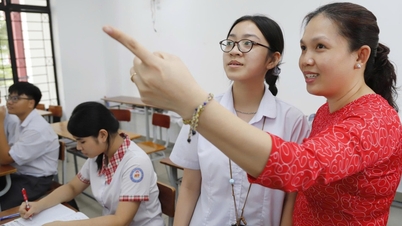
Many localities have taken proactive steps. For example, the Ho Chi Minh City Department of Education and Training has initiated several pilot programs integrating AI into management and teaching. In many schools across the country, AI is gradually becoming an indispensable tool, helping teachers innovate educational activities, from lesson planning and management to personalized learning...
The potential of AI in education is enormous. However, integrating AI into educational programs also presents many challenges. These include disparities in digital literacy across regions, impacting equitable access to AI infrastructure and resources for students; the awareness and skills of both teachers and learners; inconsistent infrastructure and the incompleteness of AI tools themselves; and the legal framework and specific regulations within schools, including rules to avoid negative consequences such as the risk of AI dependence.
But the biggest question isn't whether or not to introduce AI into education – as that's already an irreversible trend – but rather how we will teach and learn with AI?
In this regard, UNESCO emphasizes the principles of inclusiveness, ethics, and the protection of children's rights. The OECD, in its studies on 21st-century competencies, considers understanding AI a crucial component of scientific and technological competence in the context of globalization. UNICEF is particularly concerned with equity and inclusiveness, aiming to ensure that all students, regardless of socioeconomic status or region, have the opportunity to access and develop AI knowledge.
To effectively and sustainably harness the potential of AI, Vietnam needs a comprehensive strategy: continuous training and professional development for teachers; building an AI competency framework; investing in technological infrastructure; developing a scientific, modern, and appropriate AI education program; and enacting clear regulations on the use of AI in schools. The key is to help students weigh the benefits and risks, knowing when to use AI for support and when to assert their own abilities and intelligence…
The line between "using AI" and "depending on AI" is very thin. If properly utilized and guided by the humanistic goals of education, AI can help each student learn according to their individual abilities, free teachers from repetitive tasks to dedicate their efforts to creativity, and create a more equitable distribution of knowledge. However, if we rush into it, we may lose sight of the very core of education: the formation of character, independent thinking, and the ability to live responsibly in a rapidly changing world.
Source: https://giaoducthoidai.vn/giao-duc-va-tri-tue-nhan-tao-post750909.html
![[Photo] General Secretary and President To Lam meets with National Assembly delegates from ethnic minorities.](https://vphoto.vietnam.vn/thumb/1200x675/vietnam/resource/IMAGE/2026/04/20/1776696701056_a1-bnd-8331-3342-jpg.webp)
![[Image] National Assembly discusses the implementation of the socio-economic development plan.](https://vphoto.vietnam.vn/thumb/1200x675/vietnam/resource/IMAGE/2026/04/20/1776696707422_ndo_br_img-20260420-185419-jpg.webp)












































































Comment (0)