

On the morning of April 1st, 2026, the round mouths of Phuc Anh, Binh, Dung, Dat, Khiem, and Phong – from class 3A of Bach Long Vi Primary School – confidently recited the poem "The Voice of Our Country" in unison. Amidst the sound of waves crashing against the embankment, the children's clear, crisp, and strong voices rang out.

A peaceful morning by the harbor next to Bach Long Vi Primary School. (Photo provided by the author)
The lesson of "staying close to the sea"
This is my third year leaving the mainland to teach at Bach Long Vi. I've gradually become accustomed to these unique classes. From the podium, looking through the window where the salty air lingers, I realize that amidst the vast expanse of waves, the peace here is earned daily through sweat and perseverance. Hearing my mother tongue spoken on the most remote island in the Gulf of Tonkin, I understand that wherever the Vietnamese language is spoken, the image and sovereignty of the Fatherland are present.
After finishing the reading practice, the class moved on to understanding the text. I took the chalk and wrote the phrase on the board: "Accent mark - Father's word - Vast ocean."
"Do you know what the open sea is?" I asked, prompting them.
Eight-year-old children, raised amidst the stormy waters of Bach Long Vi, are accustomed to perceiving the world through concrete images. Therefore, Vietnamese language lessons cannot simply be found on the pages of a book; I must connect each letter with images of ships brimming with fish and shrimp far out at sea.
Without waiting for any frowns, I stepped down from the platform, gesturing towards the window: "The vast ocean out there is the open sea. There, Khiem's grandfather and Binh's father are fishing day and night. Their voices carry the power of the sea, contributing to maintaining peace on the border and the sovereignty of the Fatherland."
Phong timidly raised his hand, his voice still lisping: "Teacher, on TV they build border markers with bricks. So how do we plant border markers at sea? What if the waves break them if we plant them in the sea?"
Faced with that unexpected question, I didn't rush to give dry definitions. Based on the poem I was teaching, I carefully wrote the two words "clinging to the sea" on the board and then explained: "You know, our ancestors have called it 'clinging to the sea' for generations, meaning that no matter how stormy or difficult the weather, we never let go or leave the sea."
The classroom suddenly buzzed with excitement. Dat looked up and quickly exclaimed, "But last month, during the monsoon season, the Tam Ha ship was still carrying goods back to the mainland, teacher!"
The innocent nature of these children, accustomed to the rough seas, brings the concept of "living by the sea" to life. Binh continued, "Even on rough seas, with the waves crashing, my father still managed to pull in a whole tray of squid." Khiem retorted, "My grandfather sailed the boat far out to sea, keeping the lights on every night. One night, he caught three mackerel weighing almost 50 kilograms each…"
Six schoolboys vied with each other to tell their stories, their children's voices drowning out the sound of the waves. Each wanted to prove that their grandfather or father was the most capable. The pride of the island children was both boisterous and straightforward. The awareness of their ancestors' role in preserving their homeland's seas had naturally and genuinely permeated the blood and flesh of these young people.

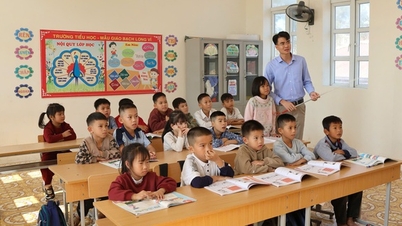
Teacher Pham Luong Thien and 6 students from class 3A of Bach Long Vi Primary School during a Vietnamese language lesson.
I tapped my ruler lightly on the desk to get the class to be quiet, then walked over to Phuc Anh's desk and smiled: "For generations, our ancestors have clung to the sea like this, not only for a more prosperous life but also to protect our borders. When you grow up, you will understand better that each fisherman, each fishing boat of your fathers and grandfathers, is a 'border marker'!"
A new "keyword" appeared in the students' minds: "border marker." I opened the cupboard and took out the national flag from the "Proud of the Fatherland Flag" program – a meaningful gift from the Nguoi Lao Dong newspaper to the soldiers and civilians on Bach Long Vi Island – and then told the whole class to look out the window towards the harbor, where the ships were waiting to set sail: "Children, the border markers in our homeland's sea are not built of reinforced concrete, but are the ships cutting through the waves out there. Each red flag flying atop the cabin is one such marker."
An emotional lesson
After finishing the introductory lesson, I moved on to the second lesson with the "Extended Reading" activity. As requested, the students had to share a story or poem about their hometown, and then fill in their thoughts on a reading sheet.
Seeing the six students frown at the line about "characters, scenery, events," I chuckled. For children who grew up amidst the sun and wind of Bach Long Vi, vivid images are far more important than words. I instructed them: "For the scenery section, I'll make an exception. Instead of writing, you can use pencils and crayons to draw the most beautiful picture of your island."
Unlike the days when I taught in the fragrant, milk-scented city of Hai Phong , my classroom now stands amidst the salty sea breeze. The wind causes teaching equipment and supplies to rust quickly, and the door hinges creak. Yet, the children's voices still fill the room.
Six heads huddled together excitedly. Binh meticulously colored the lighthouse, Dung drew the harbor embankment, and Khiem sketched a scene of children playing on the beach.
I walked slowly around the classroom. When I reached Dat's desk, my steps faltered. He had drawn a scene of children riding bicycles to the harbor, with ships anchored in the distance. He was concentrating his efforts, pressing down hard on the red crayon to color the flag on top of the fishing boat very boldly. Dat boasted, "I have to color it this bright red so that the strong waves and wind won't fade it, teacher."
I quietly held the naive drawings, all prominently featuring the red flag with a yellow star. The salty taste of the sea was etched onto the sun-tanned faces of these eight-year-old students.

The national flag, ships, and scenes of children playing on the beach are depicted through the innocent drawings of the children.
Standing on the podium on this remote island, looking into the clear eyes of the children, I understand that "sowing" each letter has never been just a pedagogical task. I cannot cram abstract concepts or slogans into them. I choose to teach them to love their mother tongue through each tone mark, to love the morning glory, the casuarina trees that protect against the sand, to love the harbor and the docks – where their parents make their living. That is enough.
The school bell rang, bringing an end to an emotional lesson. Six students rushed out into the sunny courtyard. I stood in the hallway, smiling as I watched Phuc Anh. She still clutched her painting of a ship at sea with the bright red national flag.
I believe that the ships sailing day and night, the clear voices of children singing "Our Country's Voice," and even those trembling red wax seals—these are the most silent yet enduring ways to ensure that national sovereignty remains inviolable forever.

Source: https://nld.com.vn/gieo-chu-o-bach-long-vi-196260404200406624.htm
![[Photo] Prime Minister Pham Minh Chinh receives the Chinese Ambassador to Vietnam](https://vphoto.vietnam.vn/thumb/1200x675/vietnam/resource/IMAGE/2026/04/05/1775397481797_ndo_br_dsc-5512-jpg.webp)
















































Comment (0)