In the context of administrative reorganization, preserving these values is not only a responsibility to the past but also a way to safeguard cultural identity for the future.
Cultural heritage endures.
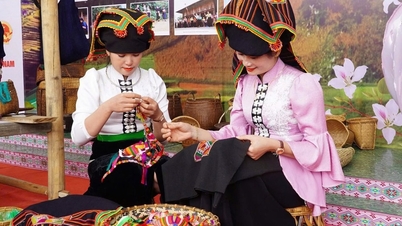
At the foot of the Tay Yen Tu mountain range, Mau village is the long-standing home of the Dao ethnic group, with many unique cultural values that are still preserved today.
Elaborately hand-embroidered traditional costumes, coming-of-age ceremonies, folk songs, knowledge of medicinal plants, and customs deeply rooted in community life are still present in daily life. The village has 350 households, and most women know how to embroider traditional clothing.
 |
The tradition of fetching water from the Jade Well at the Dinh Chanh festival in Tan Yen commune. Photo: Vuong Lam. |
Mr. Nguyen Van Toan, Secretary of the Mau Village Party Branch, said: “The Dao people here have always considered preserving traditional culture as the responsibility of each family and community. No matter how life changes, the language, costumes, coming-of-age ceremonies, and folk songs of our ancestors must be preserved by their descendants. Because these are what create our identity and become an important resource for developing community tourism and improving the lives of the people.”
What is valuable is that during the development process, the traditional beauty of this land has been preserved and promoted as a unique advantage. This is also vivid evidence that cultural preservation is not about maintaining the past but about ensuring that traditional values continue to live in contemporary life.
Along the Cau River, the pottery kilns in Phu Lang village have been burning brightly for centuries. For a long time, this ancient pottery village has not only preserved a traditional craft but also maintained a unique cultural space. Now over 70 years old, artisan Nguyen Thi Toan still spends her days working with clay and kilns. Having worked in the craft for many years, she has witnessed the changes in the village. For this elderly craftswoman, the fire in the pottery kiln has created exquisite handcrafted products. It is also a memory and a love for the craft passed down from generation to generation.
Located north of the Cau River, Van village (Yen Vien residential area, Van Ha ward) still retains the distinctive features of an ancient village. Despite the many changes over time, the people here have preserved the traditional craft of brewing rượu (rice wine), the water-ball wrestling festival, Quan Ho folk songs, and a strong sense of community. Along with building a brand for its famous local products, Van village has also preserved many cultural values associated with rural life in the delta region.
It is evident that each rural area preserves a part of the cultural memory of Kinh Bac. These values do not belong solely to one village but have become a shared asset of the community, contributing to the diverse and distinctive cultural landscape of Bac Ninh today.
Don't let the soul of the village remain only in memory.
Following the provincial merger, Bac Ninh has a population of over 3.99 million people living in 2,858 villages and residential areas across 99 communes and wards. Each place carries its own historical story, community memory, and unique cultural values.
The current reorganization of villages and residential areas is a sound policy, in line with the development requirements of the new era. However, along with changes in boundaries, names, and organizational models, many people are also concerned about how to prevent the values associated with each village from fading over time.
| In the context of reorganizing villages and residential areas, besides preserving tangible and intangible cultural heritage, it is necessary to promote the digitization of historical documents of villages and communes, genealogies, royal decrees, and legends; build a local cultural database; and record the memories of the elderly. Most importantly, it is crucial to cultivate a love for the homeland in the younger generation so that traditional values can be passed on naturally and sustainably. |
According to Associate Professor, Dr. Bui Hoai Son, a member of the National Assembly 's Committee on Culture and Society, villages in Vietnam are not simply residential units but cultural structures formed and nurtured over centuries. Behind each village name lies the history of its founding, the temples and shrines, festivals, village regulations, traditional crafts, kinship ties, and community memories. Therefore, when rearranging administrative units, special attention must be paid to preserving cultural values associated with the local community.
In reality, the real concern is not the change in administrative names, but the risk of the erosion of the values that define the identity of each region. If ancient genealogies are lost, stories of origins are no longer told, and beautiful customs are no longer passed down, then over time, the connection between the past and the present will gradually fade.
 |
A festival commemorating the founder of Quan Ho folk singing in Diem village, Kinh Bac ward. Photo: Viet Hung. |
Therefore, preserving village culture is not just about retaining tangible structures such as communal houses, temples, pagodas, or historical relics; more importantly, it's about preserving intangible values deeply ingrained in community life. These include the Quan Ho folk singing during festivals; traditional crafts passed down through generations; neighborly solidarity; the principle of remembering one's roots; and pride in one's homeland.
In Tu Mai residential area (Canh Thuy ward), the tradition of gathering on New Year's Eve or celebrating the longevity of the elderly at the beginning of the year has been maintained for many years with the full participation of families. These seemingly simple activities contribute to community bonding and educate the younger generation about filial piety and responsibility towards their homeland.
For Mr. Dao Quang Huy, 94 years old, residing in Song Khe 1 residential area (Tien Phong ward), even though his hometown has undergone changes in administrative boundaries and names, the tradition of studiousness and patriotism of the village known as the "Village of Doctors" is still cherished by the people. He shared: "Even if hamlets and residential areas are divided or merged, the memories of our homeland cannot be lost. What I hope most is that my descendants will still know where they came from and remember the customs and way of life that their ancestors have preserved."
Bac Ninh is entering a new phase of development with a larger space, stronger resources, and a convergence of diverse cultures. In this context, preserving the cultural values of rural villages is especially significant. It is not only an act of gratitude to the past but also a way to preserve the cultural essence, creating a spiritual foundation for long-term development. Village names may change, but the cultural values distilled over hundreds of years of history still need to be cherished and preserved.
Amidst the hustle and bustle of modern life, preserving village culture helps future generations remember their roots, be proud of their homeland, and continue writing the story of the historically rich Kinh Bac region.
Source: https://baobacninhtv.vn/bg2/dulichbg/gin-giu-hon-que-kinh-bac-postid447744.bbg
![[Photo] Opening Ceremony of the 13th National Congress of the Ho Chi Minh Communist Youth Union](https://vphoto.vietnam.vn/thumb/1200x675/vietnam/resource/IMAGE/2026/06/24/1782286753905_ndo_br_1-8510-jpg.webp)

![[Photo] The 13th National Congress of the Youth Union conducts personnel work.](https://vphoto.vietnam.vn/thumb/1200x675/vietnam/resource/IMAGE/2026/06/24/1782299943080_ndo_br_1-6868-jpg.webp)

![[Photo] General Secretary and President To Lam attends the Central Public Security Party Committee Conference](https://vphoto.vietnam.vn/thumb/1200x675/vietnam/resource/IMAGE/2026/06/24/1782302063612_a1-bnd-9302-9166-jpg.webp)