

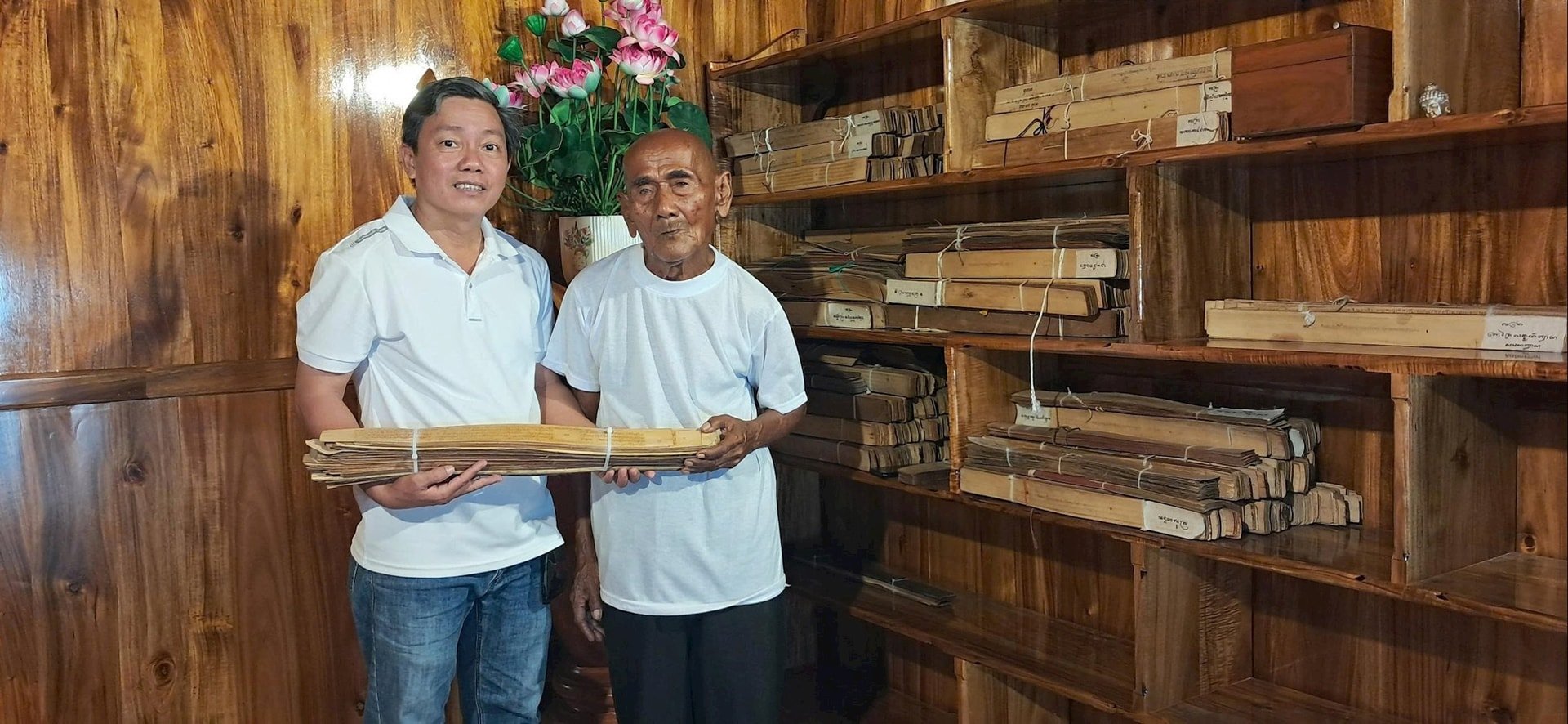
The ancient temple contains the most Buddhist scriptures written on palm leaves.
Wandering through the grounds of Xvay Ton Pagoda, built in the late 17th century, on an early autumn morning, I suddenly thought of the Buddhist scriptures written on palm leaves that people have passed down through generations, but which I have never had the chance to see with my own eyes.
So, I struck up a conversation and told the temple caretaker, Chau Thonh, that this was my third visit and I hadn't yet had the chance to admire this unique and "rare" collection of folk knowledge.
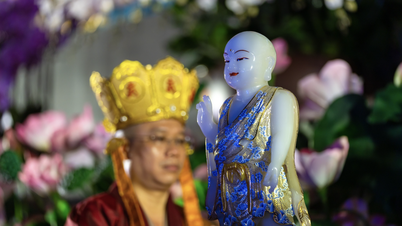
Mr. Chau Thonh nodded and led us into the shrine, which was filled with golden Buddha statues of various shapes and shimmering colored lights.
But that wasn't what caught my eye; it was the modest wooden cabinet in the corner, where bundles of yellow or earthy brown palm leaves were tied together and neatly arranged.
Mr. Chau Thonh gently took out a set of scriptures for me to touch and examine firsthand the ancient Pali and Khmer script carved onto the leaves, weathered by centuries.
How many millions of years have passed since humankind first learned to express their thoughts and words through writing on earth and rocks in caves? The exact number remains unknown.
But those winding characters on the centuries-old leaves fascinated me in a strange way.
There, it sounds as if barefoot missionaries from India have been spreading their teachings down to Southeast Asia for thousands of years; along with the soft rustling of leaves being turned and the solemn, mysterious murmur of chanting.
Then, along that journey, in the 19th century, following Theravada Buddhism, palm leaf sutras reached the Khmer community in Southern Vietnam and remain there to this day…
In the quiet setting, Mr. Chau Thonh explained that Xvay Ton is the oldest pagoda in the Tri Ton region, built in 1696 with simple thatched roofs and wooden walls; it was only 200 years later that it was renovated and upgraded into a pagoda built with bricks, tiles, and wooden columns in the Southern Khmer architectural style; it was recognized as a national architectural and artistic heritage site in 1986.
In a region ravaged by fierce battles during two wars of resistance against Western colonialism and imperialism, the pagoda stood firm and was not destroyed, thus becoming a sacred and safe place to store palm leaf scriptures. Later, in 2006, the Vietnam Book of Records Center recognized it as the pagoda with the most palm leaf scriptures in Vietnam.
According to research by authors Nguyen Van Lung and Nguyen Thi Tam Anh ( Ho Chi Minh City Open University) published in 2021, Xvay Ton Pagoda preserves 98 sets with approximately 320 palm leaf scriptures, out of a total of 170 sets with approximately 900 scriptures in pagodas throughout An Giang province.
The Buddhist scriptures and folklore, passed down through generations in the Khmer community, converge here as if by divine providence…
The Buddhist monk who wrote the scriptures is a People's Artist.
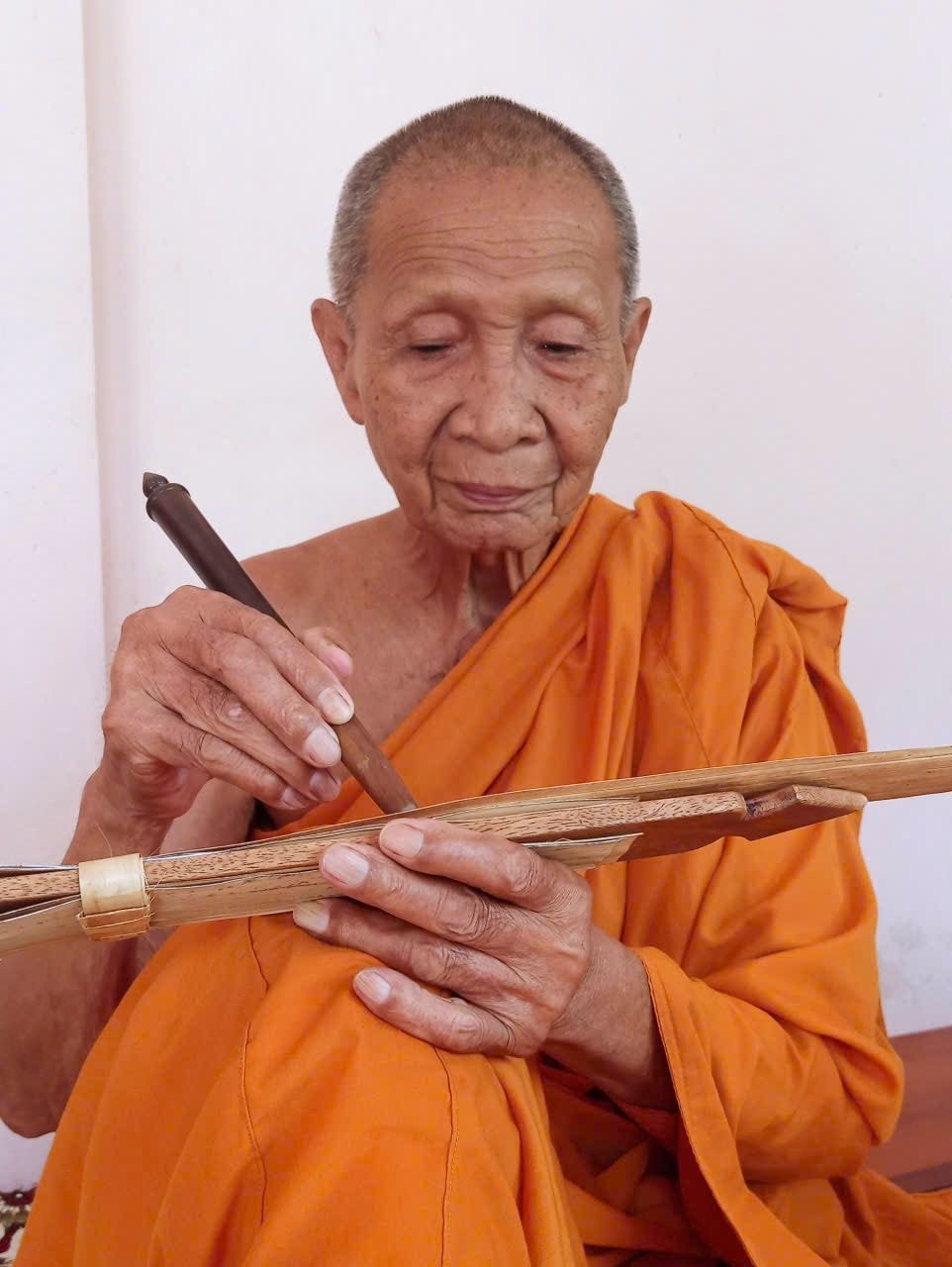
According to Mr. Chau Thonh, the most skilled and oldest monk who writes on palm leaves is Venerable Chau Ty, the abbot of Soai So Pagoda at the foot of To Mountain. Soai So Pagoda is located next to a rice field.
On a quiet autumn afternoon, a sun-tanned boy cycled across the yard and asked who the visitor was looking for.
I asked if this was the temple where the abbot wrote the most scriptures on palm leaves. The boy nodded and told us to wait.
The Venerable Abbot Chau Ty, dressed in a yellow robe, waited for us under the temple's eaves, on a polished wooden platform.
The Vice-Chairman of the Council of Buddhist Elders of Vietnam, over 80 years old, has a weathered yet compassionate and gentle face.
After a brief exchange, the Venerable Monk told us to wait a moment, then called for someone.
A little later, a young man arrived, clasped his hands in a respectful bow, and sat beside the monk to act as the narrator, as the monk was elderly and not very fluent in the Kinh language.
The story goes back about 60 years, when Soài So Pagoda was still nestled in Tô Mountain. At that time, Abbot Chau Ty, then in his early twenties, was taught the skill of writing on palm leaves by his predecessors.
The talipot palm trees, also known as buong palms, were then abundant on Mount To and along the Bay Nui region of An Giang province.
Venerable Chau Ty recalled: "At that time, I was young and passionate about writing scriptures. I was taught and was very eager to learn and practice writing; gradually, writing became a skill."
Now, due to failing eyesight and shaky hands, I can only teach the scriptures and can no longer directly write them on leaves.
Through this story, we learn that, thanks to his work spanning over half a century, Venerable Chau Ty is recognized as the only People's Artisan currently carving Buddhist scriptures on palm leaves within the Khmer monastic community.
To prevent this precious art form from being lost, in addition to teaching the monks at Soài So Pagoda, the Venerable Monk opened the first class in 2014 to teach young Khmer people in An Giang how to write scriptures on leaves.
The heartfelt feelings of young "successors"...
Adding to our good fortune, one of the most accomplished successors of Venerable Chau Ty in the art of writing on palm leaves is Kim Somry Thi, a young man who is currently guiding this conversation.
After giving the Venerable Monk time to rest at lunchtime, Somry Thi took us to his home in To Trung hamlet, Tri Ton commune.
Under the trees, on a stone table lay unfinished volumes of Buddhist scriptures written on palm leaves.
At thirty-six years old, having spent over ten years practicing Buddhism at Soài So Pagoda, Somry Thi is immersed in Buddhist scriptures and the ancient cultural heritage of the Khmer people.
After returning to civilian life and focusing on his work, he still nurtured his passion for writing calligraphy on palm leaves.
"To engrave characters on leaves, one needs not only perseverance, patience, and skillful techniques, but also knowledge of ancient Pali and Khmer scripts, as well as Buddhist teachings."
"When carving the characters, you can't make a single mistake; if you do, you have to discard the entire scripture and start over," Somry Thi said, while preparing a handful of palm leaves.
For him, writing scriptures on palm leaves is as meticulous as carving letters!
Continuing with her unfinished work, Somry Thi sat cross-legged on the chair, one hand holding a round wooden pen, about the size of her thumb, with a sharp needle attached to the tip, pushing the letters across the thick stack of palm leaves resting on her knees.
After harvesting, the palm leaves are dried and processed through several stages, then cut into strips about 60cm long and 5cm wide, and clamped onto wooden bars to keep them straight and even.
After carving the lettering running from left to right, top to bottom, Somry Thi took a cotton ball, dipped it in the prepared black ink mixture in a bowl, and brushed it onto the leaf's surface; then, she wiped it with a clean cloth.
Each line of text appeared perfectly aligned.
Then he carefully applied kerosene evenly to both sides of the leaves, "to protect them from termites, insects, and damage over time," as he explained.
Each palm leaf, after being carved with characters, is punched with holes, strung together in sets, stored, and used on special occasions.
Watching Somry Thi meticulously and patiently carve each character on a palm leaf, I suddenly wondered: Why go through all this trouble, and what's the point of carving when the application of technology in preserving and disseminating written language in particular, and language in general, has advanced so far in the 21st century?
The Khmer boy didn't answer the question directly, but explained that the inscriptions on the palm leaves reflected the teachings of Buddha, folk knowledge and culture such as folk tales, poems, and songs... teaching people good things that are deeply ingrained in the blood and flesh of the Khmer people.
These palm leaf scriptures are carefully preserved and opened for Dharma teachings or recitation during major festivals such as Chol Chnam Thmay, Sen Don Ta Festival, Kathinat Robe Offering Festival, Ok Om Bok Festival, and Flower Offering Festival... every year.
Listening to Somry Thi speak, I envisioned the hardships involved in preserving and promoting the precious traditional culture of the Khmer people in this area, a heritage passed down through generations.
While previous generations of monks, like Venerable Chau Ty, lived through war and turmoil, facing difficulties in preserving palm-leaf scriptures, today's young people, like Somry Thi, confront the rapid development of information technology and modern techniques while preserving and passing on traditional handicrafts and the nation's long-standing cultural heritage.
On the way back, in the afternoon autumn sun of the border region, that nagging thought lingered in my mind: that these confrontations weren't limited to young Khmer people and the practice of carving scriptures on palm leaves...
Source: https://baodanang.vn/giu-chu-tren-la-buong-3306701.html























































































Comment (0)