

Fortune telling based on the Tale of Kieu, according to the spirit of contemplation.
In his book "Vietnamese Customs," scholar Phan Kế Bính (1875-1921) wrote about the practice of fortune-telling using the Tale of Kiều as follows: "Fortune-telling using the Tale of Kiều is when you have something you want to know, whether it will be good or bad, you pray to Thúy Kiều and Kim Trọng, asking for a few lines or verses, and then use the corresponding lines on that page to make your prediction. This is a form of playful fortune-telling, but many people believe it to be accurate."
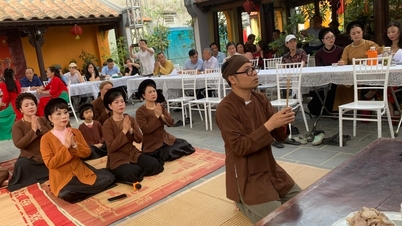
In the book "Springtime Fortune Telling with the Tale of Kieu" by Zen Master Thich Nhat Hanh, it is stated that: In Mai Village, everyone who consults the Tale of Kieu praises its effectiveness. The process and rituals of fortune telling with the Tale of Kieu are very respectful, combining contemplation with meditation: To seek advice, one must go before the altar of Buddha and the ancestors, bow three times respectfully, then sit down, place their hand on the bell, breathe three times mindfully, and then draw a divination stick from the bell. This stick is given to the person responsible for interpreting the divination. This person is knowledgeable about the literary work "The Tale of Kieu," possesses psychological insight and observation skills, and most importantly, has knowledge of Buddhist teachings and experience in spiritual practice.
The "Spring Fortune Telling with the Tale of Kieu" card set consists of 210 cards, presented in numerical order and featuring corresponding verses from the Tale of Kieu, along with 84 pages explaining the meaning of each verse.

The "Spring Fortune Telling with the Tale of Kieu" card set by Zen Master Thich Nhat Hanh.
Regarding divination methods, in Mai village, the monks, nuns, and lay practitioners usually follow this method:
In a couplet of six-eight verses, one line might be the cause and the other the effect. The effect could be something that has already happened in the present or a desired outcome in the future. The cause is advice on how to behave and practice to achieve transformation or realization. For example, "As clear as the sound of a crane flying by" represents one's own tranquil mind, considered the present effect. The cause of that effect is "Seemingly near the purple forest, seemingly far from the red dust," meaning having learned to be close to the Three Jewels and away from dangerous environments.
Similarly, as in hexagrams 48 and 78, line 8 is the cause and line 6 is the effect, and in hexagrams 93 and 100, line 6 is the cause and line 8 is the effect. Sometimes, in a line of 8, the first four words are the cause and the last four are the effect, or vice versa. The meaning in the hexagram doesn't necessarily have to follow the meaning of "The Tale of Kieu." For example, "My heart still longs for the golden clouds" doesn't necessarily mean the person still remembers their homeland, but could mean that their ideal of spiritual practice remains strong, their Bodhi mind is still intact, because the golden clouds here can be seen as the sublime ideal of Buddhism, of the golden light of the Dharma. "The two autumns have closed their outer wings" means one should not dwell on worldly affairs, but should focus their mind on spiritual practice. "A thousand fathoms rely on the shadow of the pine tree," according to the spirit of Quy Son Canh Sach, means relying on great virtuous teachers. In short, divination readings serve to comfort, encourage, and enlighten those seeking them on their spiritual path.
Why is "The Tale of Kieu" the only text that can be used for fortune telling?
According to Dr. La Mai Thi Gia, Head of the Folklore Department - Faculty of Literature, University of Social Sciences and Humanities, Ho Chi Minh City, the folk practice of fortune-telling using the Tale of Kieu is explained as follows: “Perhaps initially, readers found that many lines in Nguyen Du's 'The Tale of Kieu' could accurately describe their own feelings in specific contexts, as if the poet had an astonishing understanding of their innermost thoughts, so they turned to 'The Tale of Kieu' to find answers to predictions about the future.”
"The Tale of Kieu" is a book of life, encompassing family and social relationships, and featuring all kinds of people, good and bad, from high to low, and from all walks of life... The work expresses the joys and sorrows of humankind. Because a work so comprehensively reflects the human condition, people consider fortune-telling through the Tale of Kieu a fascinating way to experience it for themselves.
Divination using the Tale of Kieu is a form of entertainment, also considered an appreciation of words and meanings, "to see how fate will turn." A person who practices divination using the Tale of Kieu understands the story, knows how to interpret its meaning and allusions, and is not superstitious like fortune tellers, shamans, or spirit mediums. They usually perform this practice alone or only for family members. It is a refined, elegant, and respectful form of wordplay, a tradition favored by educated people.

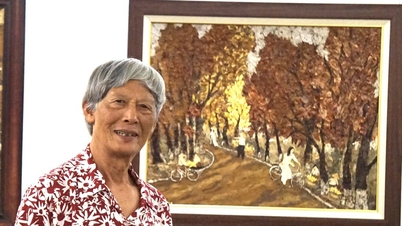
Dr. La Mai Thi Gia. (Photo: Provided by the interviewee)
Divination using the Tale of Kieu is a form of entertainment, also considered an appreciation of words and meanings, "to see how fate will turn." A person who practices divination using the Tale of Kieu understands the story, knows how to interpret its meaning and allusions, and is not superstitious like fortune tellers, shamans, or spirit mediums. They usually perform this practice alone or only for family members. It is a refined, elegant, and respectful form of wordplay, a tradition favored by educated people.
According to Dr. La Mai Thi Gia, the fortune-telling ritual using the Tale of Kieu unfolds as follows: “The fortune teller holds the book with both hands, lights an incense stick, closes their eyes, and prays: 'O Buddha Shakyamuni, O Tu Hai spirit, O Giac Duyen nun, O Thuy Kieu fairy, O Nguyen Du, please grant me a fortune. My name is, how old am I, where am I from, and I wish to be answered about…' All prayers are silently recited in the heart. The person interpreting the Tale of Kieu will not hear the fortune teller's requests or questions.”
To put it more concisely, just recite the four prayers: "I bow to King Tu Hai, I bow to the nun Giac Duyen, I bow to the fairy Thuy Kieu, I bow to the venerable Nguyen Du." However, in some regions, the prayer is even recited as a nursery rhyme, such as: "Thuy Van, Thuy Kieu/Vuong Quan, Kim Trong/Mr. and Mrs. Vien Ngoai/Tu Hai, Giac Duyen/Living wisely, dying sacredly/Come here to have your fortune told/Don't pick flowers/Don't play with children/Don't sit in inns/Come here to cast your fortune…". Then the person seeking fortune telling states their name and their request. After the prayer, they open the book of Kieu, and use their left or right thumb to press on any position in the book; the pair of six-eight verses where their finger presses is the line from Kieu corresponding to the fortune teller's prediction.
The fortune teller will use those two lines from the Tale of Kieu to provide the answer, and at this point, the lines only have textual meaning, completely separate from the content, the situation of Kieu, or the fate and character of the other characters in the story. Therefore, some interpretations are almost the opposite of the events described in the Tale of Kieu using those two lines. For example, when a fortune teller asks for the two lines: "Why worry about that? An ant in a cup can't crawl away." The content of these two lines is actually bad news (for the character Thuy Kieu in the story), but the interpretation of those lines is positive: The fortune teller's worries about the coming year are not worth worrying about, everything can be resolved, and what belongs to them cannot be lost, like "an ant in a cup can't crawl away."
One way to find a foundation for trust.
Speaking about fortune-telling using the Tale of Kieu and memories of Tet (Lunar New Year), Dr. La Mai Thi Gia confided: “Even now, although I have been away from my homeland for more than 20 years and rarely return home for Tet to ask my father for a fortune-telling reading from the Tale of Kieu, I still maintain the habit of turning to Nguyen Du's 'The Tale of Kieu' whenever I have concerns that need guidance, not only during Tet but at any time of the year. I learned how to interpret the Tale of Kieu from my father and my teacher, moving away from the literal meaning of the text, away from Kieu's 15 years of wandering and misfortune, choosing for myself an understanding full of faith in good things to come. Just yesterday, amidst the sleepless nights and anxieties about my parents' illnesses, I turned to the Tale of Kieu again and encountered the verse of reunion: 'A single banyan tree, a courtyard full of cinnamon and acacia trees'.”
Dr. La Mai Thi Gia shared that her father had read the Tale of Kieu for her, and she has many memories from her school days to the present.
“The year I took the university entrance exam, on New Year's Eve, I asked for two lines of poetry that I found lucky: 'Intelligence is a natural gift from heaven / Mastering the arts of poetry and painting, mastering singing and reciting poetry' (Nguyen Du's description of Thuy Kieu's beauty and talent at the beginning of the story). My father explained that I was naturally quick-witted and learned quickly, and now I just needed to 'master the arts of poetry and painting,' meaning I should strive to expand my knowledge and read more books, and I would pass any exam. I don't know if my father was just reassuring me, but my heart was filled with confidence, and I studied with even more enthusiasm, certain that my name was already on the list of those who would get into university. Also during that Tet holiday, an elderly woman, nearly 70 years old, from the neighborhood came to ask my father to tell my fortune using the Tale of Kieu. She got the line: 'Hesitating, half staying, half leaving / The sound of golden music is heard nearby' (Nguyen Du's description of Thuy Kieu going to visit her graves, preparing to return when she meets Kim Trong). My father asked: 'Are you planning to go somewhere far away, but your heart is still undecided?' She confessed that she was planning to move to the South to live with her daughter because her family was struggling.” "She's a woman who just gave birth, but she's still tied down by her husband who absolutely refuses to leave her hometown."
“The year I was about to defend my doctorate, almost five months had passed and the independent reviewer hadn't sent back the feedback to the university, I was extremely worried. On the sixth day of Tet (Lunar New Year), we gathered to wish my professor a happy new year, and he brought out "The Tale of Kieu" for us to tell our fortunes. My colleague got the line: “The wind roars, the clouds swirl / A carriage in the mortal world flies like a bird” (Nguyen Du describing Ma Giam Sinh's wedding carriage carrying Thuy Kieu as a foreshadowing of the stormy days ahead). None of us knew what he was asking about, but my professor interpreted it as, “Perhaps this year you will go abroad.” My friend was shocked because, indeed, when he asked about applying for a short-term research trip abroad, he did go that year. As for me, I got the line: “Even if there are strong winds and heavy rain / With me here, there will be no excuse” (So Khanh's promise to take Thuy Kieu out of the brothel). My professor had no idea I was asking about my dissertation; he just said, “Don't worry, Thi Gia, just do your work.” "There will always be someone to support you, and everything you hope for will go smoothly." And that year, everything I hoped for truly came true," Dr. Thi Gia recounted.
Source: https://baophapluat.vn/xuan-sang-gieo-mot-que-kieu.html

![[Photo] General Secretary and President To Lam meets with National Assembly delegates from ethnic minorities.](https://vphoto.vietnam.vn/thumb/1200x675/vietnam/resource/IMAGE/2026/04/20/1776696701056_a1-bnd-8331-3342-jpg.webp)
![[Image] National Assembly discusses the implementation of the socio-economic development plan.](https://vphoto.vietnam.vn/thumb/1200x675/vietnam/resource/IMAGE/2026/04/20/1776696707422_ndo_br_img-20260420-185419-jpg.webp)


























































Comment (0)