A new look for the mountainous commune.
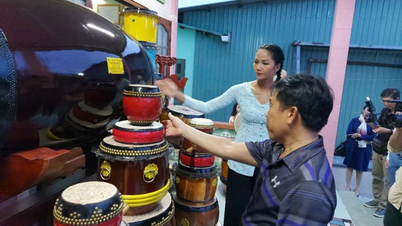
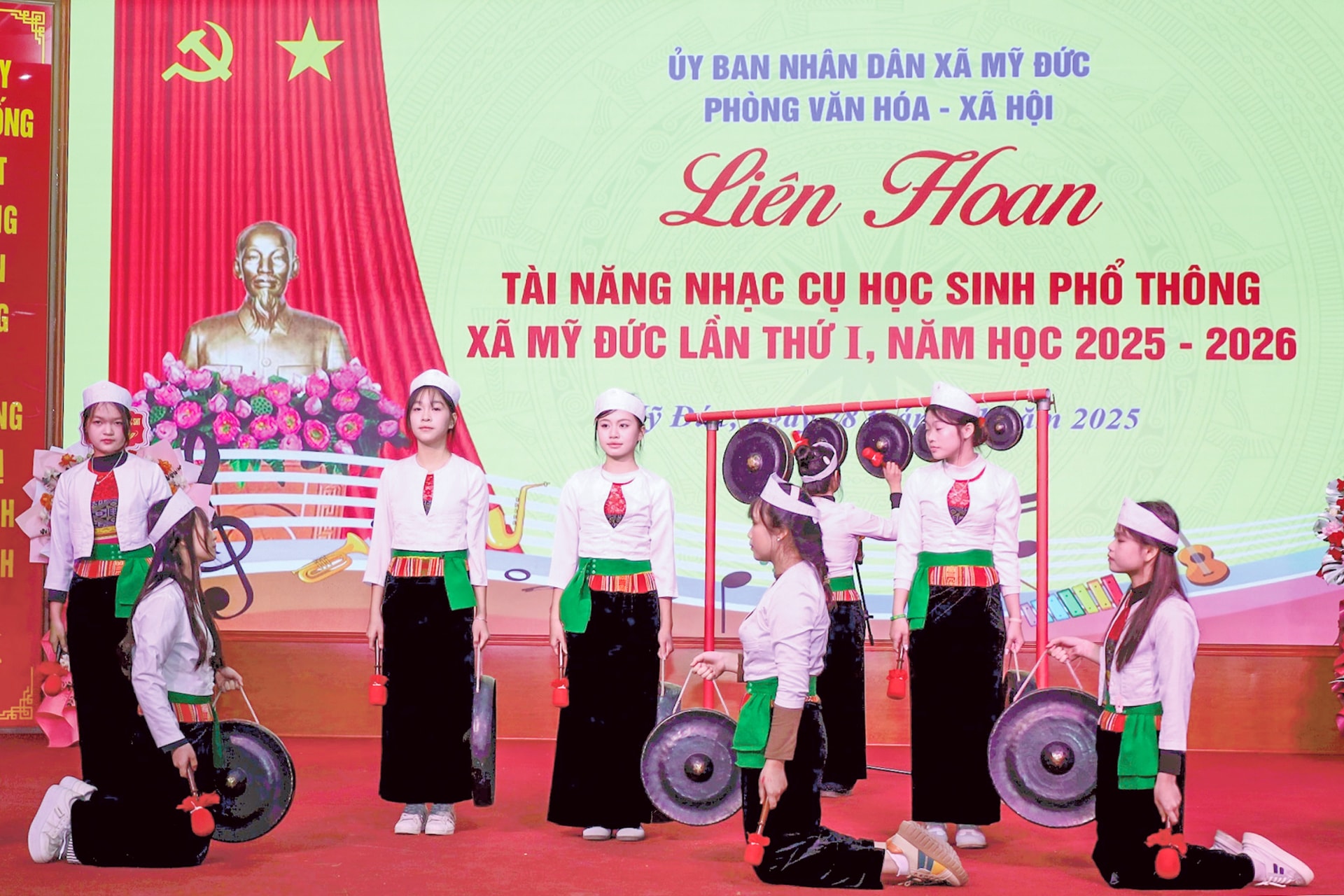
Attending the My Duc High School Student Musical Instrument Talent Festival on November 28th, a reporter from HanoiMoi Newspaper was particularly impressed by the gong performance by students from An Phu Secondary School. It was the only performance among 13 entries that used traditional musical instruments. Even more remarkable, the gong players were all children of the Muong ethnic group in An Phu. Under the stage lights, the gong sounds resonated with a slight hesitation but also with pride, as if the students were tapping on the very cultural vein of their people.
On the sidelines of the festival, Dang Thi Ngoc Han, a 9th-grade student, shared that having been born and raised in An Phu amidst the sounds of gongs, lullabies, and folk songs, she has always loved traditional musical instruments. Participating in a class organized by the commune this past summer, Han understood more about the meaning of each gong beat, each song – things that seemed familiar but contained a cultural depth she had never noticed before. “I only hope there will be more classes so I can perform with the teachers and the elders,” Han said, her eyes sparkling with excitement.
These days, visiting the villages of An Phu, one can easily see the changes clearly. Inter-village and inter-hamlet roads have all been concreted or asphalted; schools and community centers are spacious and well-maintained; and people's lives are improving day by day. The head of Goc Bang village, Quach Cong Doan, shared that An Phu used to be the most difficult area in the old My Duc district because of its rugged terrain, where people traveled on foot for six months and by hand (rowing boats) for six months. "Now the roads are good, the schools are beautiful, the community center is spacious, and the people are much better off. But I'm also worried that if we don't preserve the Muong language and gongs, it will be difficult to find them again in the future," he said.
In reality, this transformation stems not only from the efforts of the people but also from significant resources from national target programs. From 2021 to the present, the state budget has poured unprecedented resources into An Phu: 100% of schools are now structurally sound, 100% have access to electricity and clean water, health stations meet standards, village health services are fully available in all 13 villages, and the average income of ethnic minority communities is estimated to reach 78 million VND/person/year by 2025. The socio -economic landscape of the area has changed rapidly and noticeably.



However, alongside the rapid changes in the socio-economic landscape, many of the most fragile cultural values are also at risk of fading, raising concerns about the erosion of cultural identity. Traditional stilt houses are becoming less common, the Muong language is no longer frequently heard in many young families, and activities associated with farming – the rhythm of gongs, dances, and traditional dishes – are increasingly absent.
Preserving the Muong language and maintaining cultural traditions.
According to Dinh Cong Vo, Deputy Head of the Culture and Social Affairs Department of My Duc Commune, An Phu is a concentrated residential area of the Muong people and one of the unique cultural spaces of My Duc Commune. After the merger of Dai Nghia, An Phu, Hop Thanh, Dai Hung, and Phu Luu Te communes and towns, My Duc Commune now has a large development space in terms of both area and population, with An Phu identified as a key area for community-based cultural and tourism development. “For sustainable development, we must first preserve our cultural identity. If officials don't know the Muong language or understand the Muong gongs, it will be difficult to persuade the people to preserve it,” Mr. Vo said. He himself recently completed a course in the spoken and written Muong language organized by the Muong Cultural Heritage Museum – an effort to make those working in culture the core of preserving their cultural roots.
An Phu's cultural infrastructure is currently at a level rarely seen in mountainous localities: 100% of villages have cultural centers, 14 gong ensembles, 6 musical instrument ensembles, and 6 performing arts groups maintain regular activities. Classes in gong playing, folk songs, and the Muong language have been continuously organized in recent months, attracting 1,230 students from 7 Muong villages – a number that demonstrates the strong resurgence of Muong culture.
According to Nguyen Quang Duong, Chairman of the People's Committee of My Duc commune, adhering to the city's program and plan for preserving and promoting the cultural values of ethnic minority communities, My Duc commune will continue to expand classes teaching traditional languages, scripts, and musical instruments; strengthen performance spaces at the ethnic cultural center; and develop distinctive community tourism products associated with the Muong An Phu identity. "We recognize this is not only a cultural task but also a driving force for the socio-economic development of the commune. Preserving our identity means preserving our unique advantages for the future," Mr. Duong emphasized.
The recent enrollment of 1,230 students in classes on gong playing, folk songs, and the spoken and written Muong language demonstrates the Party and State's attention and is the clearest evidence of the vitality of Muong culture in An Phu. From schoolchildren to middle-aged women, from young people returning from working far away to officials like Mr. Dinh Cong Vo, everyone is learning together to preserve the language, the rhythm of the gongs, and the cultural traditions of their ethnic group. As the classes grow larger, and the sounds of Muong music and gongs resonate in the cultural centers of each village, there is reason to believe that Muong culture in An Phu is not only being preserved but is being passed on to the future in the most sustainable and natural way.



Infrastructure can be built in a few years, but culture can only be built through the perseverance and love of those who believe that preserving one's own language and traditions is preserving one's roots.
Source: https://hanoimoi.vn/giu-gin-ban-sac-muong-o-an-phu-726004.html