

 |
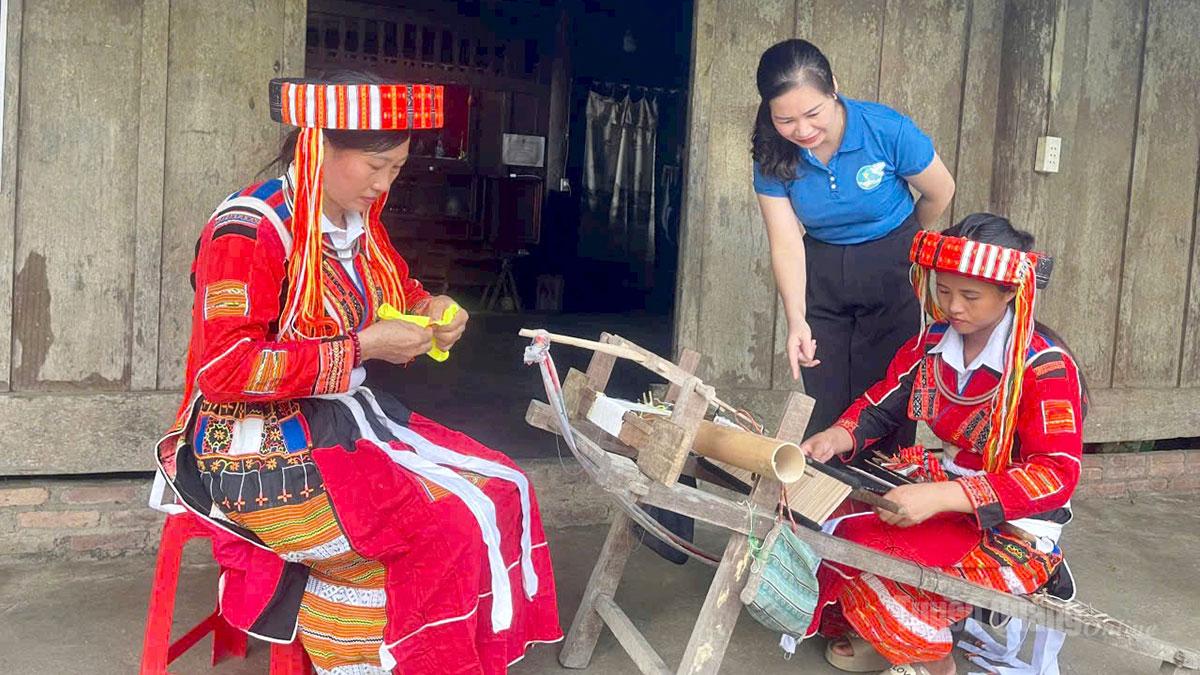
| Women members of Minh Quang commune preserve the traditional craft of embroidery and brocade weaving. |
Preserving traditional crafts from the villages.
In Minh Quang commune, the Pa Then ethnic group numbers over 700 people, and the craft of embroidering traditional clothing is still preserved as a enduring cultural heritage passed down through generations. From a young age, Pa Then girls are introduced to the embroidery frame, learning to express their emotions and thoughts through each stitch; thus, the traditional clothing becomes a cultural asset for a girl before she goes to her husband's home.
For Ms. Trieu Thi Tam from Thuong Minh village, the craft of embroidering traditional Pà Thẻn ethnic costumes wasn't something she learned in her childhood, but rather during her early days as a daughter-in-law in the area. Ms. Tam shared: “When I first came to my husband's home, my mother and grandmother taught me each step of embroidering and weaving Pà Thẻn costumes. Initially, I found the craft very elaborate, requiring meticulous attention to detail to perfect each pattern. But the more I understood the meaning of each motif, the more I loved it and wanted to create a traditional costume for myself.”
Sharing the same sentiment, Ms. Lan Thi Som, a member of the Na Nghe village women's association, said: "I realize that preserving and promoting traditional cultural identity through embroidery and brocade weaving is a very important task. Therefore, I have actively encouraged the women in the association to study and learn together, gradually mastering traditional techniques."
According to Ms. Nong Thi Thuan, President of the Women's Union of Minh Quang commune, the commune currently has 3 village women's union branches that maintain classes teaching embroidery and weaving of Pa Then ethnic brocade, attracting nearly 100 members. Besides traditional clothing, the women also learn to embroider and weave a variety of brocade products such as blankets, pillowcases, scarves, bags, and wallets… to serve the tourism business, contributing to increased income.
Linked to sustainable development
From traditional homes where weaving and embroidery are naturally preserved in daily life, the preservation of traditional costumes in many localities has gradually been elevated to a new level. Not only are the crafts maintained within individual households and clans, but many women have boldly joined forces, integrating traditional crafts into cooperative models. As a result, traditional weaving and embroidery products are gradually finding their place in the tourism and market, being displayed at fairs, tourist stops, and homestays; attracting many domestic and international tourists to visit and experience the weaving, dyeing, and pattern-making processes.
A prime example is the Can Ty Linen Weaving Cooperative in Can Ty commune, established with the desire to preserve the raw materials, traditional craft, and techniques of the local people. Using flax fibers from the mountains and forests, the members, all Mong ethnic women, have maintained all the traditional processes: planting, harvesting, stripping, pounding, dyeing, and drawing patterns – all done manually. They are gradually bringing the traditional craft out of the village, linking it with community tourism development.
Ms. Sung Thi May, Deputy Director of Can Ty Linen Weaving Cooperative, said: “Since the cooperative was established, we have had the opportunity to visit and learn many new techniques, especially how to combine colors and improve designs to suit the needs of tourists. With direct guidance from teachers, our products have become more diverse, sell better, and are chosen by many foreign tourists as souvenirs. Most importantly, we have both preserved the traditional craft and earned additional income to stay committed to linen weaving in the long term.”
Currently, the Can Ty Linen Weaving Cooperative provides employment for 6 permanent workers with an income of 5 million VND/month. They design over 35 diverse product lines ranging from traditional dresses and blouses, scarves, blankets, pillows, and embroidered wallets to handbags, backpacks, and carpets… Among these, 7 products have achieved OCOP 3-star and 4-star certifications, gradually establishing themselves as a typical local handicraft brand.
To ensure that preservation goes beyond simply maintaining it within the community, the transmission of traditional crafts has been systematically implemented through state programs and projects. Under Project 6 of the National Target Program for socio -economic development in ethnic minority and mountainous areas for the period 2021-2025, the Department of Culture, Sports and Tourism, in coordination with relevant agencies and communes, organized 15 training courses on embroidery and weaving patterns on traditional costumes for ethnic minority groups such as the Pà Thẻn, La Chí, Lô Lô, and Bố Y.
In reality, preserving and promoting traditional clothing still faces many challenges. The convenience of modern clothing and the pressure of making a living are causing many young people to gradually move away from looms and embroidery. Without appropriate methods to both preserve and create livelihoods, many traditional cultural values are at risk of being confined to performances and exhibitions.
Therefore, preserving traditional costumes requires the coordinated efforts of all levels, sectors, and organizations. When culture is integrated into daily life and nurtured by sustainable livelihoods, the needlework not only "preserves the soul" of the nation but also opens up long-term opportunities for women in mountainous regions and future generations.
Text and photos: Nhu Quynh
Source: https://baotuyenquang.com.vn/van-hoa/202602/giu-gin-trang-phuc-truyen-thong-6c73e19/
![[Photo] National Assembly Chairman Tran Thanh Man attends the opening session of IPU-152](https://vphoto.vietnam.vn/thumb/1200x675/vietnam/resource/IMAGE/2026/04/16/1776277863731_ctqh5-jpg.webp)
![[Photo] Mrs. Ngo Phuong Ly meets and exchanges views with Mrs. Peng Li Yuan](https://vphoto.vietnam.vn/thumb/1200x675/vietnam/resource/IMAGE/2026/04/16/1776277858080_phu-nhan-1-jpg.webp)
![[Photo] My Son at night: A thousand-year-old heritage site amidst the Milky Way](https://vphoto.vietnam.vn/thumb/1200x675/vietnam/resource/IMAGE/2026/04/15/1776261039184_ndo_br_chon6-jpg.webp)
![[Photo] The General Secretary, President and his wife meet with Vietnamese-Chinese friendship leaders.](https://vphoto.vietnam.vn/thumb/1200x675/vietnam/resource/IMAGE/2026/04/15/1776264829725_vna-potal-tong-bi-thu-chu-tich-nuoc-to-lam-gap-mat-nhan-sy-huu-nghi-viet-nam-trung-quoc-8703641-3130-jpg.webp)














































Comment (0)