

It is both an opportunity to pay tribute to our ancestors and preserve the soul of our craft, and a way for people to persistently nurture their identity, connect heritage with contemporary life, and transform traditional cultural values into a driving force for sustainable social development.

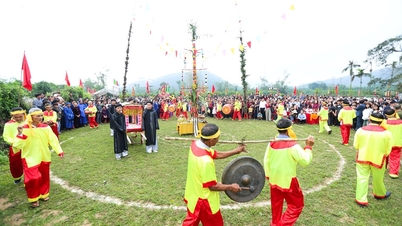
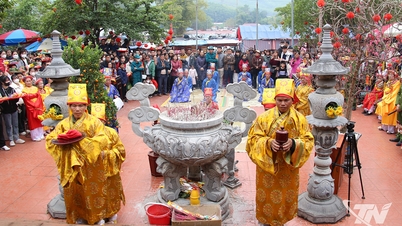
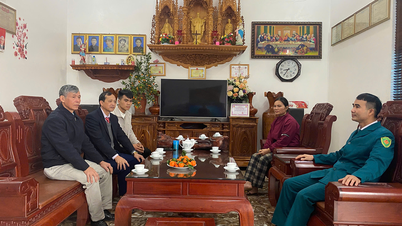
Village elders in Tra Que perform traditional sacrificial rituals.
Enjoy the festive season!
Folk festivals and ancestral commemorations of traditional crafts and agriculture in Hoi An after the Lunar New Year of the Year of the Horse, such as: the Tra Que Flower Offering Ceremony (7th day of the first lunar month); the Ancestral Worship Ceremony and Kim Bong Craft Village Festival (11th and 12th days of the first lunar month); the Cam Nam Sticky Corn Festival (expected 19th and 20th days of the first lunar month)... continue to honor the value of labor, express gratitude to ancestors, and promote local products - elements that contribute to the cultural depth of Hoi An.
In the over 500-year-old Tra Que vegetable village (Hoi An Tay ward, Da Nang city), farmers have been busy preparing for the new planting season since early morning, bustling with preparations for the traditional flower offering festival. This is an occasion to express reverence and gratitude to heaven and earth, the deities, and the ancestors who founded the village, and to pray for favorable weather, prosperity, and a bountiful harvest in the new year.
At the same time, the festival is also an opportunity to introduce to tourists the vegetable farming profession, which has been recognized by the Ministry of Culture, Sports and Tourism as a National Intangible Cultural Heritage, under the category of "Folk knowledge and traditional crafts".
As a land rich in cultural values, the people of Tra Que today still preserve and maintain long-standing rituals, customs, and traditions. Spiritual ceremonies are prepared and performed by the village elders according to ancient customs. From erecting the ceremonial pole, welcoming the deity to the altar, performing the ceremonial offerings, presenting gifts, and offering sacrifices to the God of Agriculture, to writing the ceremonial text, selecting the chief worshipper, the left and right chief worshippers, the ceremonial procession, the person reading the text, the person chanting the prayers… all are meticulously and solemnly prepared.
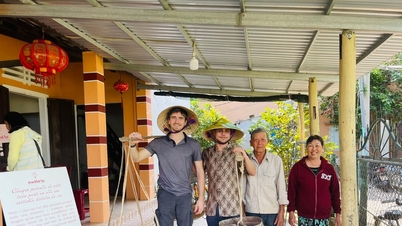
Foreign tourists are enthusiastic about experiencing the Cau Bong festival, especially the festive part with competitions in tilling the land, planting vegetables, preparing food , and playing folk games, creating a lively and close-knit community atmosphere.
On this occasion, the locality also organized activities to introduce Tra Que as the "Best Tourist Village of 2024," honored by the United Nations Tourism Organization (UN Tourism). This aims to promote the value and reach of the title for the community, creating motivation for people to continue preserving and promoting their cultural identity, improving their livelihoods, and enhancing their living standards.
Following the flower offering festival, on the 10th and 12th of January, the Kim Bong carpentry village (Hoi An ward, Da Nang city) will host the Ancestor Worship Ceremony and the Kim Bong Craft Village Festival - a place famous for its carpentry craft, which has been recognized as a National Intangible Cultural Heritage.

From February 26-28 (corresponding to the 10th-12th days of the first lunar month), Kim Bong carpentry village will hold a ceremony to honor the village's ancestors and a traditional craft festival.
Preserving festivals and developing sustainable tourism products.
Throughout the formation and development of the ancient trading port city of Hoi An, traditional crafts and villages such as Tra Que vegetable village and Kim Bong carpentry village have always played an important role. This has led to the formation of a rich system of folk knowledge in production processes, religious festivals, and product consumption, contributing to ensuring the socio-economic well-being of the people.
Through cultural exchange, adaptation, and social development, many traditional crafts and villages in Hoi An continue to receive attention for preservation and development in a creative direction, adapting to new conditions and making positive contributions to the local socio-economic development.
In particular, the revival of festivals associated with traditional crafts is given special attention, regularly organized, and attracts large community participation, such as: the Flower Prayer Ceremony in Tra Que vegetable village; the Ancestor Commemoration Ceremony for the Kim Bong carpentry craft; the Ancestor Commemoration Ceremony for the Thanh Ha pottery craft; the ornamental plant festival in Cam Ha commune; the sticky corn festival in Cam Nam; the Ancestor Commemoration Ceremony for the swiftlet farming craft in Cu Lao Cham and Cam Thanh; the fishing prayer ceremony in Cua Dai… Along with that, traditional art forms and folk performances are also revived and organized during festivals, creating new vitality for the craft villages.
It can be said that festivals in craft villages are a vibrant "picture" of the agricultural life and spirit of the people of Hoi An. In the context of increasingly fierce competition among tourist destinations, the people of these craft villages have learned to leverage their internal strengths, combining creativity and flexibility with new trends to create many attractive tourism products, attracting more and more tourists to visit and experience them.
In the new context following the merger, along with preserving, maintaining, and promoting traditional folk festivals, localities continue to focus on investing in infrastructure associated with tourism development in craft villages.
Ecotourism and community-based tourism models in branded craft villages have created new destinations and tour routes, contributing to the diversification of local tourism products; at the same time, reducing the pressure of overcrowding in tourist centers, extending the length of stay and increasing tourist spending. The preservation and promotion of folk festivals not only enriches the cultural and spiritual values of the homeland but is also invested in on a large scale and systematically, thereby promoting and upgrading suburban community-based tourism products, creating momentum to spread the cultural and historical values of craft villages to domestic and international tourists.
According to the Hoi An World Cultural Heritage Conservation Center (Da Nang City), as a member of the UNESCO Creative Cities Network in the field of handicrafts and folk arts, localities will continue to invest in the restoration and preservation of relics, the collection and preservation of heritage documents, and the revival of rituals, festivals, and folk art forms to sustainably preserve this unique part of cultural heritage. Traditional craft villages are considered a cultural resource, a "raw material" for new creations. If effectively exploited, products from craft villages will become tourism products with high cultural content.
Source: https://baovanhoa.vn/van-hoa/lang-nghe-thuc-giac-mua-xuan-207249.html
![[Image] 20 islands in the Spratly Islands special administrative region hold early elections.](https://vphoto.vietnam.vn/thumb/1200x675/vietnam/resource/IMAGE/2026/03/08/1772949669607_img-20260308-112026-90-jpg.webp)
![[Image] Vietnam's diverse colors on its journey of innovation](https://vphoto.vietnam.vn/thumb/1200x675/vietnam/resource/IMAGE/2026/03/09/1773041390813_anh-man-hinh-2026-03-09-luc-14-28-17.png)



















![[Photo] Diary of the photojournalism contest “Vietnam on the journey of innovation”](https://vphoto.vietnam.vn/thumb/1200x675/vietnam/resource/IMAGE/2026/03/09/1773041117692_anh-man-hinh-2026-03-09-luc-14-24-45.png)





































Comment (0)