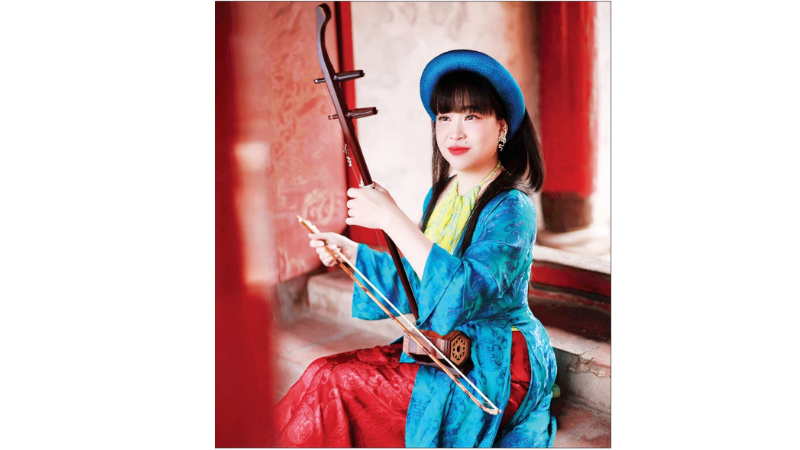
Artist Mai Tuyet Hoa. (Photo: CAO MINH TIEN)
Born in 1976, artist Mai Tuyet Hoa is known as the outstanding successor of the "living human treasure" - the late Xam singing artist Ha Thi Cau. She is currently the Director of the Center for Research, Preservation and Promotion of Traditional Music , and also one of the key artists of the Xam Ha Thanh group. Listening to Tuyet Hoa sing, one might assume she must have been immersed in the atmosphere of Xam melodies from a young age. But that's not the case; her connection to Xam was purely coincidental, a matter of fate.
At the age of eight, guided by her father to study the two-stringed fiddle (đàn nhị), she dedicated herself to this instrument through the elementary, intermediate, and university levels at the Hanoi Conservatory of Music (now the Vietnam National Academy of Music). Although this instrument is closely associated with xẩm (a traditional Vietnamese folk music genre), it wasn't until 1996, while collaborating with the Institute of Music to separate lyrics, transcribe music, and record ancient musical materials from numerous field trips by experts, that she coincidentally heard the voice of artist Hà Thị Cầu, like a silkworm spinning its own thread, and began to fall in love with xẩm. The more she "fell in love" with the very real and heartfelt lyrics and melodies of xẩm, the more heartbroken she became when she realized that xẩm was in danger of disappearing due to the huge "gap" in both practitioners and research materials. This is what motivated her to find every way to prolong the life of xẩm.
In 1998, Mai Tuyet Hoa began to delve deeper into Xam singing. She decided to pursue an additional degree in music theory and criticism and chose Xam singing as her research topic. From 2000 onwards, whenever she could find the time, she would return to Ninh Binh to meet the artist Ha Thi Cau in person, staying for a whole week each time to listen to every rhythm, pronunciation, and way of delivering verses.
To this day, Tuyet Hoa still vividly remembers her last meeting with "Aunt Cau," when she affectionately held her hand and instructed her: "My child, try your best to preserve the ancestral craft!" That saying has always been deeply cherished in her heart, becoming the motivation that keeps her steadfast on the path she has chosen.
Driven by a desire to deepen her knowledge of xẩm (a traditional Vietnamese folk singing style), she also sought out old audio and video recordings of previous xẩm artists to learn on her own. Simultaneously, she met directly with music researchers such as Dang Hoanh Loan, musician Hanh Nhan, People's Artist Xuan Hoach, Meritorious Artist Van Ty, and musician Thao Giang... to listen and learn. From there, her unique xẩm singing style, named Mai Tuyet Hoa, gradually took shape, built upon a foundation of systematic training in the two-stringed fiddle (dan nhi).
While striving to refine her singing technique, she also diligently documented, restored, and systematized her knowledge of Xẩm (a traditional Vietnamese folk singing style). In 2005, she, along with Professor Pham Minh Khang, musicians Thao Giang and Quang Long, and People's Artist Thanh Ngoan, established the Center for the Development of Vietnamese Musical Arts, under the Vietnam Musicians Association. She and her colleagues tirelessly traveled to various rural areas to research different Xẩm styles and revive melodies that seemed to have been lost. She called this work like mining ore, gradually gathering the sounds to recreate a more complete picture of Xẩm.
Once they had accumulated a considerable amount of capital, Mai Tuyet Hoa and her colleagues nurtured the idea of bringing Xam (a traditional Vietnamese folk music genre) more prevalent in daily life. They persistently persuaded the authorities to allow them to regularly organize Xam performances in several public spaces in Hanoi's Old Quarter. In 2009, she teamed up with musician Nguyen Quang Long to establish the Xam Ha Thanh group.
Besides maintaining regular performances on weekend evenings in front of the King Le Temple, the group also collaborates with researchers to restore some ancient Xam melodies, including: Xam Anh Khoa, Xam Phon Hue, Quyet Chi Tu Than…, especially the characteristic Xam Tau Dien melody of Hanoi.
Artist Mai Tuyet Hoa is known as the outstanding successor of the "living human treasure" - the late Xam singing artist Ha Thi Cau.
She is known as the first person to perform the "Tram Xẩm" folk song, creating a melody that helps prolong the memories of old Hanoi. She believes that to bring Xẩm closer to today's audience, especially young people, one cannot cling to things belonging to the past. That is why the Hanoi Xẩm group frequently composes songs that reflect contemporary life, such as: "Tea Xẩm," "Four Seasons of Hanoi Flowers," "Four Flavors of Hanoi," etc.; along with works that combine Xẩm with modern artistic elements such as rap, beatbox, and hip hop.
Notably, Mai Tuyet Hoa not only helped bring Xam singing to the prestigious setting of the Hanoi Opera House, but she also initiated the first Xam singing festival held in Ninh Binh in 2019. She also contributed to the training and teaching of the next generation of artists.
Looking back on her 30-year journey with Xẩm (a traditional Vietnamese folk music genre), filled with hardships and difficulties, Mai Tuyết Hoa feels both moved and proud to have contributed to bringing Xẩm back from the brink of extinction, resonating in many spaces, and being further supported by the establishment of Xẩm clubs. However, according to her, for Xẩm to truly revive sustainably, it needs the involvement of cultural management agencies with specific policies. She and her colleagues are also continuously striving to produce textbooks that can be introduced into music schools nationwide so that Xẩm can be systematically passed on and become a lasting part of contemporary music.
TRANG ANH
Source: https://nhandan.vn/noi-nhip-xam-qua-nam-thang-post947111.html
































































































Comment (0)