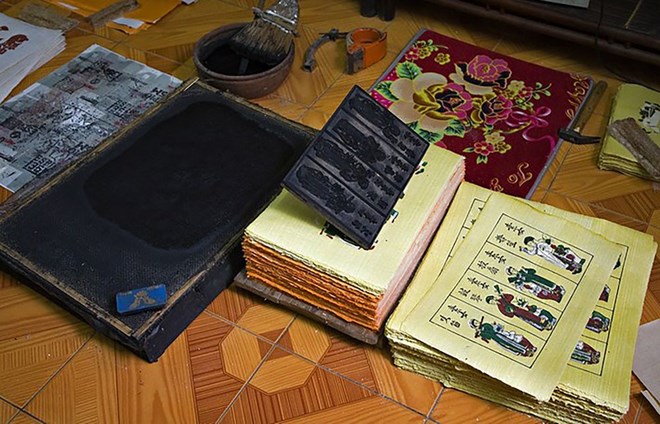
Dong Ho folk paintings, embodying the soul of the nation. Photo: Kim Son.
Dong Ho folk paintings, a unique style of woodblock printing originating from Dong Ho village, Thuan Thanh ward, Bac Ninh province, have existed and developed over hundreds of years. More than just a handicraft , this style of painting serves as a vivid reflection of traditional Vietnamese agricultural society, preserving the soul of the nation through each grain of wood and fold of paper.
Craftsmanship by skilled artisans.
Technically speaking, Dong Ho paintings belong to the category of woodblock prints, a production process that requires close coordination between aesthetic thinking and exquisite craftsmanship. Unlike conventional painting, Dong Ho paintings are created using a system of printing blocks, in which the woodblocks play a core role. The wood used for carving must be either persimmon or mulberry wood. The tools used are sets of chisels made of hardened steel, each set consisting of about 30 to 40 pieces of different sizes, allowing for the creation of intricate details.
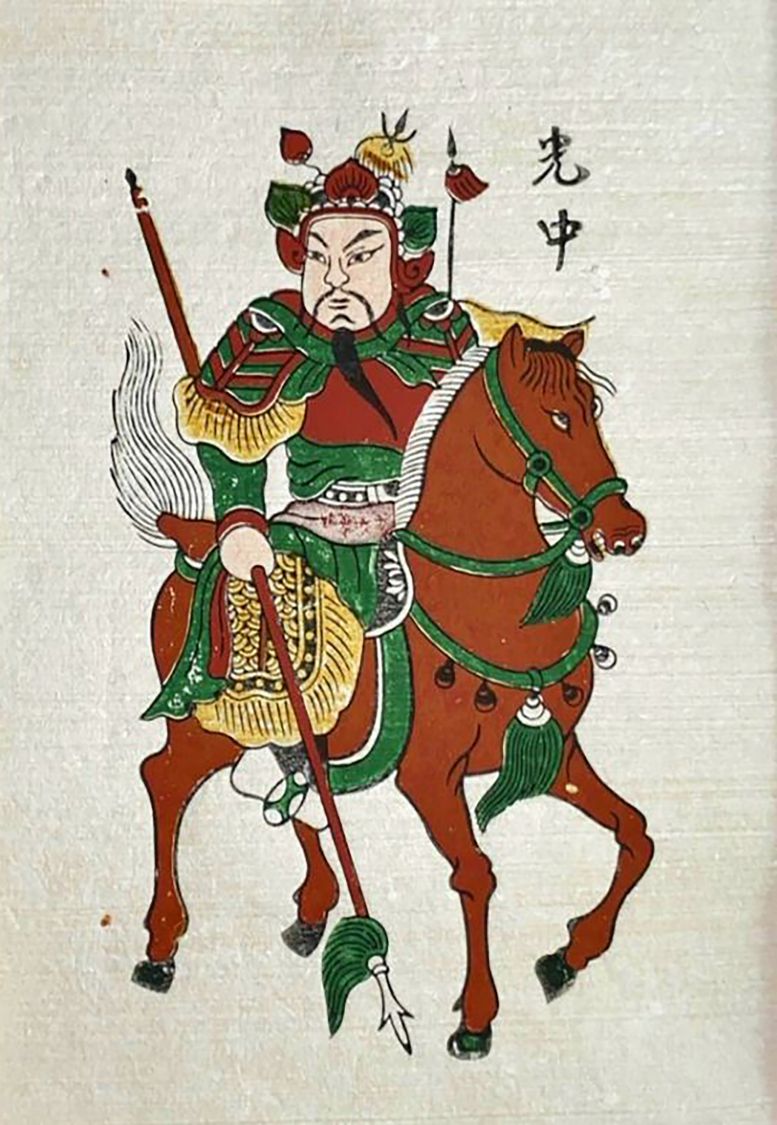
King Quang Trung riding a warhorse is depicted in a Dong Ho folk painting. Photo: Kim Son
The unique and unmistakable identity of Dong Ho paintings lies in their materials and colors. The paper used for printing is traditional Do paper, handcrafted from the bark of the Do tree, with a surface coated with a layer of crushed scallop shell powder, creating a distinctive iridescent white hue. The color system used in the paintings is entirely natural, reflecting the close connection between people and nature in the Northern Delta region. Yellow is extracted from Sophora japonica flowers, crimson red from cinnabar or sappan wood, white from scallop shell powder, black from bamboo leaf charcoal, and blue from indigo leaves. These are the basic, original colors, usually unmixed.
The process of printing traditional Vietnamese paintings adheres to strict principles regarding printing layers and techniques. Before printing, the dó paper is prepared in large stacks. The artist uses a brush made of pine needles to apply color to the cover, then applies the "board stacking" method – that is, pressing the printing block down onto the colored cover to ensure even ink absorption, before firmly pressing the block onto the paper. The printing technique demands absolute precision so that the color areas match each other without misalignment. The unwavering principle in this process is that each color corresponds to a separate woodblock; the number of color prints is equal to the number of colors in the sample painting. After each color is printed and dried, the black outline is always printed last to complete the artwork. This process creates the physical and visual depth of the painting, making the colors seem to permeate the paper fibers, enduring over time.
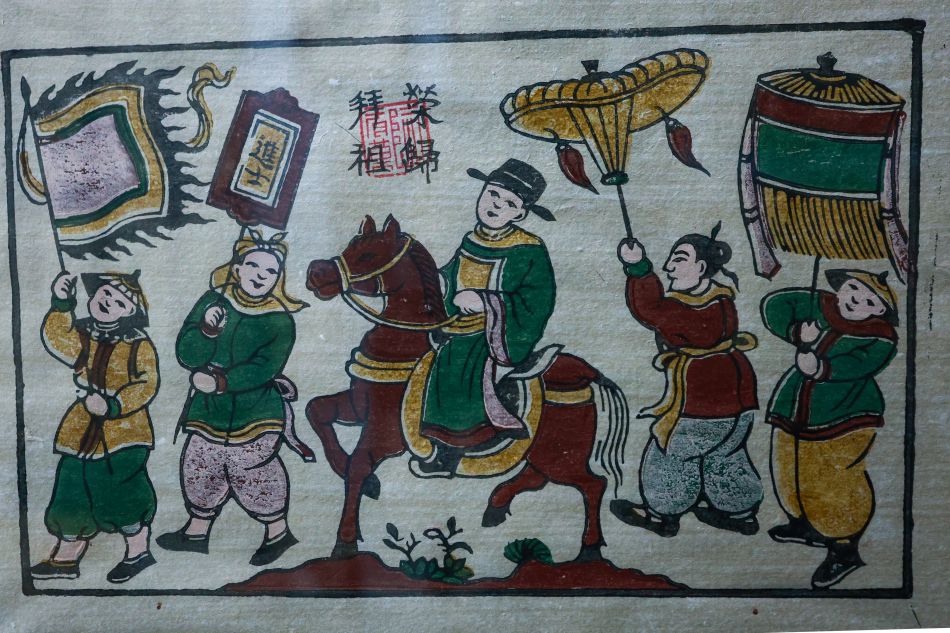
Painting depicting the triumphant return home to pay respects to ancestors. Photo: Hai Nguyen
Profound artistic value
From an artistic perspective, Dong Ho paintings possess a unique visual language with high symbolic and decorative value. The compositions are usually tight, using simple lines and flat, even color blocks. However, behind this simple and unpretentious beauty lies a whole system of profound philosophical insights into human life and social reflection. The content of Dong Ho paintings encompasses seven main types: devotional paintings, celebratory paintings, historical paintings, narrative paintings, proverbial paintings, landscape paintings, and paintings reflecting daily life.
Through these themes, Dong Ho paintings become a visual chronicle of the material and spiritual life of ancient Vietnamese farmers. They represent the age-old aspirations for a harmonious, prosperous, and happy family life; the yearning for a just and better society; and lessons in morality and the celebration of beauty. From a folk aesthetic perspective, Dong Ho paintings not only provide aesthetic pleasure but also fulfill an educational function, preserving traditional cultural heritage. The creation process is not a solitary individual endeavor but the result of collective intelligence, inherited and perfected through many generations of artisans. This explains why there are many different versions of the same theme, or why a single painting can have many different color combinations, reflecting the continuous movement and creativity of the craft village community.
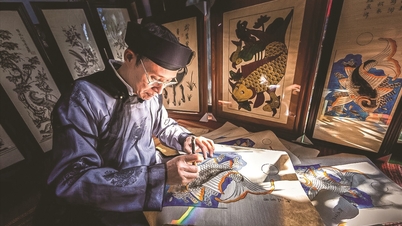
Despite its immense historical and cultural value, the craft of Dong Ho painting has experienced periods of both prosperity and decline. Its golden age spanned from the 19th century to the 1940s, when Dong Ho Tet paintings were indispensable items in every household. However, historical upheavals after 1945 nearly wiped out the craft. From 17 families involved in painting in the past, the village now only maintains a weak existence with two families of artisans, Nguyen Dang Che and Nguyen Huu Sam. The latest statistics show that there are only 3 artisans left, about 20 practitioners, and only 2 elderly artisans capable of teaching the craft.
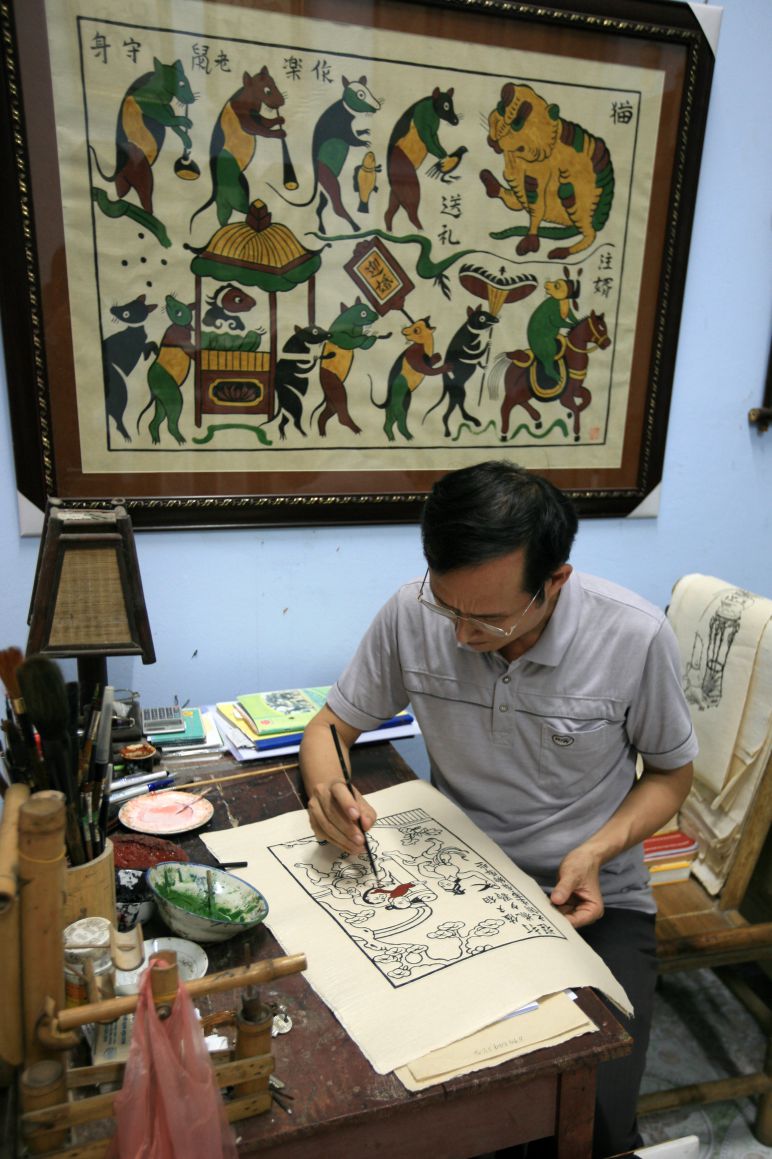
Artisans in Dong Ho painting village. Photo: Le Bich
From National Title to UNESCO Recognition
Recognizing the importance and critical status of the heritage, the Bac Ninh provincial government and the Ministry of Culture, Sports and Tourism have implemented many timely intervention measures. In 2012, the Dong Ho folk painting craft was included in the National List of Intangible Cultural Heritage. Notably, on December 9, 2025, at the 20th session held in India, UNESCO officially inscribed Dong Ho folk paintings on the List of Intangible Cultural Heritage in Need of Urgent Safeguarding. This is the 17th Vietnamese heritage to be honored internationally. This inscription is not only a strong affirmation of the unique artistic and historical value of Dong Ho paintings but also opens up great opportunities and places a heavy responsibility on protecting this heritage from the risk of disappearance.
Bac Ninh province has issued resolutions on the development of small-scale handicraft villages, established a separate planning zone, and assigned the Department of Culture, Sports and Tourism to implement the "Preservation of Intangible Cultural Heritage of Dong Ho Painting Village" project. The Dong Ho Folk Painting Preservation Center , inaugurated in 2023, is an important step forward, creating a space for tourists to visit, experience, and learn about the painting process. However, preservation cannot stop at mere recognition; it must also address the issue of sustainable livelihoods for the communities involved.
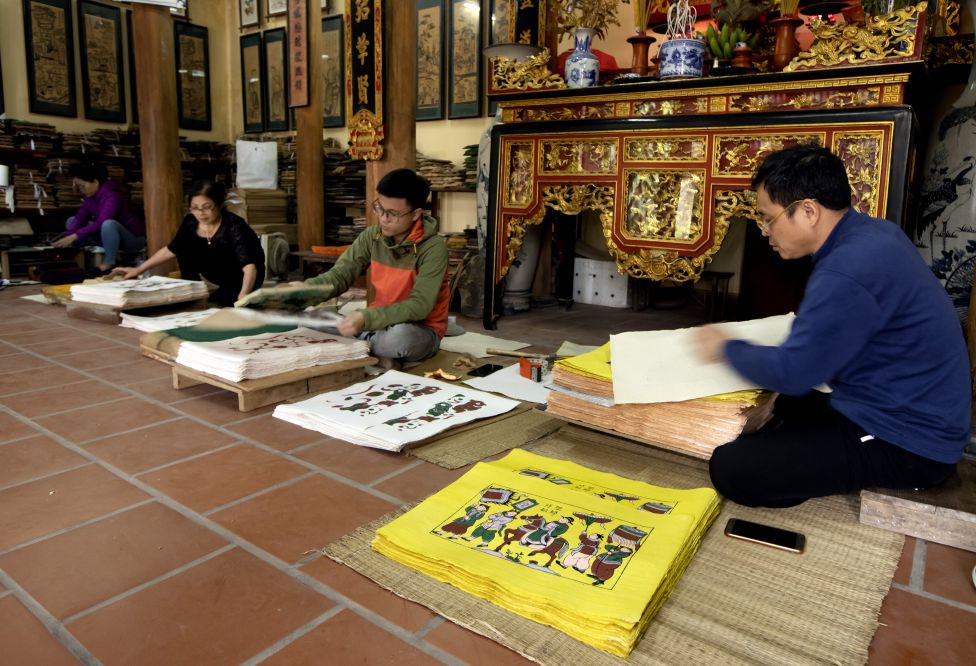
Artisans in Dong Ho painting village. Photo: Le Bich
The current state of tourism in the painting village reveals many limitations. Despite welcoming tens of thousands of visitors annually, the tourism model remains focused on "quick visits and experiences," lacking depth. Tourists primarily stay for short periods to take photos, spending little, thus failing to truly benefit those involved in the craft. The heritage is becoming detached from the living space and daily life of the community, risking becoming a mere performance space rather than a vibrant cultural entity.
To address the challenges of conservation and development, the construction of a Duong River tourism route is being considered as a strategic direction. This tourism route is not simply a transportation solution, but an approach to heritage along the historical and cultural flow. The Duong River connects Dong Ho painting village with a dense network of historical sites such as Dau Pagoda, But Thap Pagoda, and the tomb of King Kinh Duong Vuong. The journey on the river will allow visitors to slowly absorb the cultural space of Kinh Bac before approaching the craft villages.
This approach also helps shift the tourism model from "check-in" tourism to in-depth experiential tourism. Tourists will have enough time to thoroughly learn about the traditional paper-making techniques, natural colors, and woodblock carving under the direct guidance of artisans. In this model, artisans are not just skill-showcasers but also transmitters of knowledge and community memories. This model promises to create a stable and selective flow of tourists, opening up a consumption space for products that reflect the value of handcrafted labor, while reducing the pressure of direct commercialization on the traditional craft village.
Source: https://laodong.vn/lao-dong-cuoi-tuan/mau-dan-toc-tren-tranh-dong-ho-1653266.ldo





































































Comment (0)